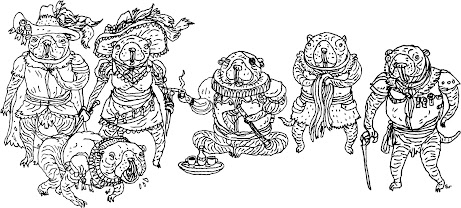
Downtime in Zyan, my new zine, has just launched on Kickstarter! The zine presents a system for downtime, the activities characters engage in between adventures. Brought to life by the whimsical and alluring art of Evlyn Moreau, the mole rats of Zyan will show you how to transform the neglected space between adventures into a site where player-driven schemes and dreams grow with delightful results.
Tuesday, February 8, 2022
Downtime in Zyan: Pants or No Pants?
Downtime in Zyan, my new zine, has just launched on Kickstarter! The zine presents a system for downtime, the activities characters engage in between adventures. Brought to life by the whimsical and alluring art of Evlyn Moreau, the mole rats of Zyan will show you how to transform the neglected space between adventures into a site where player-driven schemes and dreams grow with delightful results.
Tuesday, November 28, 2023
Downtime: Home away from Home
I had some more thoughts on downtime I wanted to share. But first, speaking of downtime, it was just announced that my supplement, Downtime in Zyan, is one of the winners of The Awards 2023! You can check out the full list of winners here. It’s an honor I share with my team. Downtime in Zyan is what it is thanks both to the meticulous layout of Lester B. Portley, and especially to Evlyn Moreau’s superb mole rat illustrations, without which the supplement would be a hollow shell. But back to the topic at hand.
My downtime system is designed to deliver various goods. It serves as an antidote to the relentlessly cooperative and world-focused character of OSR play by allowing PCs to develop some uniqueness and depth. It facilitates the pursuit of individual ends in addition to the collective ones. By not gating downtime behind name level play it allow players to pursue their dreams and leave their mark on the campaign world from early levels. It is also designed to be part of a virtuous circle with adventuring, so that downtime itself creates hooks and problems to be solved through adventuring, and adventuring creates the possibility of further downtime.
Last time I was talking about the problem of the transition in an OSR style campaign between the quick jaunts of early sessions, in and out of perilous adventure locales in 1 or 2 sessions, and the more ambitious many (4-8) session adventures that tend to organically arise starting at mid levels. The thought was that if you have reached the point in the campaign where players adventure for 4+ sessions, and you give players one downtime session every time they return to home base, downtime dwindles in significance. To keep players invested in downtime, I suggested calibrating downtime to the number of sessions adventuring, giving multiple downtimes when returning home after longer adventures.
This time I wanted to talk about a different trick you can use to allow downtime to work with longer jaunts into dangerous territory. The setup I’m thinking of here is one where there is a homebase that is safe where downtime usually happens and most or all adventuring happens in some perilous terra incognita, a hostile area to be explored that lies in some sense “outside” the homebase. A classic example would be a megadungeon, where there is a “town”, and all (or most) adventuring happens in the exploration of the hostile subterranean dungeon. Other examples might include a West Marches style wilderness crawl with a town on the edge of some howling wilderness, or what is on the other side of a certain printmaker’s door in the waking world. In these cases, to penetrate deeper you must often travel further and further from home base, which in turn leads to longer adventures.
One way to limit this problem is to create discoverable shortcuts, e.g. secret doors, hidden elevators in a dungeon, or secret entrances that lead directly into deeper levels. But another way to handle it and keep downtime going is to establish possible basecamps where downtime can happen that also serve as staging areas for deeper exploration. These are, in essence, a home away from home. I’ve been thinking a lot about what you need to do to make this option sing.
Introducing a second space for downtime is a delicate balance. If you design the basecamp so that it provides everything the homebase does, and it is more conveniently located, then your basecamp will predicatably become the campaign’s new homebase. While I think it’s great if this arises organically, I don’t think you want to design the basecamp to force that decision. The biggest problem is that many downtime activities are tied to a location and so not transferable, particularly two of the most important: cultivating relationships and building institutions. It’s unfortunately when some PCs have been sinking time and resources into building something special back at the original homebase and the GM more or less mandates that downtime play shifts to a new arena.
My way of handling this problem is to treat basecamps as scaled down version that presents a smaller world of possibilities than homebases. What you want is enough for people to become invested and pursue downtime while on larger expeditions, while also welcoming the eventual return home to the original homebase.
In fact, there is a spectrum here. At one end, you might have locations in the dungeon or wilderness that offer primarily a single unique downtime action. A couple of options to incorporate in a dungeon might include:
A perpetual feast of viking ghosts in a Valhalla style mead hall that one can join for spectral revelry
A dungeon library, manned by demonic librarians, where can research the kinds of mysteries found in lower levels of the dungeon.
An efreet smithy who uses elemental fires to craft splendid weapons for visitors who can pay his price.
This designs a foothold, a stopover where some may want to do the main downtime action, and others might do an alternative one, like engaging in martial training with a drunken viking ghost, or cultivating a relationship with a demonic librarian, without there being much staying power to the location. At the other end, there are basecamps proper that have real opportunity to build something lasting. How can you build a proper basecamp?
The answer is that you should employ the same techniques you use to build an original homebase, which I talk about at the end of Downtime in Zyan, but give it a more limited and small scale flavor. In brief, since my system of downtime generates problems and adventure hooks with many mixed success rolls it also needs to be a space rife with factions, rival institutions, patrons, in short people with desires and an a potential interest in the PCs adventuring in.the unknown. If we just look at the core of my location specific downtime activities we can see some features we’ll need:
Build an institution: There should be some pre-existing institutions, including perhaps rivalries, along with space for building new institutions.
Cultivate a relationships and Gather Intelligence: There should be interesting NPCs, who have some tensions, and who may want various things that adventurers could provide through adventure, who have access to a rumor mill, and who may be interested in serving as adventuring companions.
Revelry: There should be some possibilities for debauches to blow off steam.
Others downtime actions are either more player driven, or seem more optional, but potential sources of fun might be to include some NPCs that have skills to teach, or some warriors who can engage in martial training, or some special site for spiritual exercises, or a trove of information to engage in research.
To really make a basecamp sing, I think you also need a new version of a campaign events table might used for a homebase, but geared towards the specific nature of the basecamp.
An Example: The Hanging Merchants
![]() |
| Illustration of the Hanging Merchants by Michael Raston |
Each of the four merchants specializes in a different sort of goods. Two of the are over-merchants, from wealthy houses. Each of these over-merchants is locked in bitter rivalry with the other, and each is beholden to a powerful rival jungle patron who will seek the service of any party that uses the area as a basecamp. There are also two under-merchants, with much humbler shops, whom the over merchants look down upon. Finally, there are the Sons and Daughters of the Vigilant Watcher, a mercenary house that the merchants pay to provide protection against jungle incursion and river piracy.
I model the four merchants as four separate rival institutions the players can choose to bolster. (Certainly the Sons and Daughters taken together as a mercenary house are also an institution.) There is also the possibility of trying to open a fifth shop, or more grandly, of trying to restore the platforms of the hanging merchants to their earlier splendor by fixing the place up and attracting visitors. (Each of these two projects was pursued by in separate campaigns by players: one group tried to build up one of the under-merchants, and the other took on the task of restoring the whole place to its former grandeur.) Furthermore there are plenty of NPCs to befriend here, as well as sources of information. Since the Over-merchant are eager to host lavish parties there is the opportunity for revelry as well, and since each under-merchant has a specialty in respectively jungle botany and animal husbandry, there are skills that can be learned as well.
The campaign events for this basecamp includes special goods coming in to the merchants, restocks of sold wears, visitors to the platforms of the merchants from Zyan above, stranger visitors from the jungle below, a couple of jungle related events, and so on.
In short, if you’re doing the kind of campaign where you have a fixed homebase, with all adventuring happening in hostile terrain, consider introducing one or more footholds where downtime can be pursued in the deeper areas of exploration. This can provide variety and keep downtime relevant as the campaign often pushes further from homebase.
Wednesday, July 10, 2024
The Future of Through Ultan's Door
Two Problems
Although I haven’t exactly been quiet for the last few years—I’ve created a supplement about downtime and a launched a first season of a podcast on megadungeons—I have been stuck on releasing new issues of Through Ultan’s Door. I’ve been flummoxed by two things.
The first was that my Zyan material is a tightly integrated weird setting designed at each step to pull players deeper and deeper into exploration. This makes presenting material in an episodic fashion a nightmarish question of information design. The ideal solution to this problem would be to release single giant version of the setting in book format. Then you could get it all at once, and have everything you need to run an entire 5+ year campaign in Zyan.
But the issue is that I don’t have the time to do that. It would take even longer than it took for BREAK!! to come out. Working in smaller chunks is how I make progress. The small scale of the zine format is a huge stimulus to my productivity. It gives me a timetable, forces me to think about how to present information, and gets me writing. Just as importantly, the zines also fund my purchase of art, editing, and layout. But I’ve faced a lot of decision paralysis, and flip-flopping, about what to tackle first and how to carve up the material.
The second issue is that fulfillment for the Kickstarter for Through Ultan’s Door 3 burned me badly. It ate up a larger portion of my life than I can afford to give again. Since I’m not a full time game designer, my other commitments put uncomfortable limits on how much time I can afford to devote to my hobbies or (when money is involved) “side gigs” like rpg publications, even where these are labors of love that bring me joy. This didn’t stop me from running a Kickstarter for, and printing and fulfilling Downtime in Zyan. But that was an intentionally scaled back project: a single zine, possible to ship with minimal packing in a single rigid mailer. The thought of publishing and fulfilling multiple zines, along with reprints of past issues, has been paralyzing.
So I’ve been trying to figure out how to surmount these problems so that I can, at last, develop and share my Zyan material with you.
Two Solutions
Solution 1: Move to Patreon
I’ve considered two possibilities, neither ideal. I’m genuinely torn between them. If I moved to a Patreon format, this could motivate me to release things in bite-sized pieces in the same way that zines do. In fact, since less work would be required for each release, it might work a lot better than zines for this. I think I could release a nice chunk of Zyan material once a month. Since no physical printing is involved, it would allow me to set aside logistics until we arrive at the final printing of the actual project.
The model here would be Luka Rejec’s Ultraviolet Grasslands, or Miranda Elkin’s Nightwick Abbey. They both have used Patreon to good effect, supporting longterm, ambitious dream projects. The support here would be both financial and social in terms of building an enthusiastic base of supporters who helped to take the actual physical launches over the top. The modern social media landscape is very alienating and fragmented, and I do worry a lot about reaching people and drumming up support for my projects. While not solving all problems, Patreon would give me a leg up.
I could use Patreon money to commission editing, art, and layout for the posts I release as I go along. So people would get real value, and I would make real progress towards what I hope would be a jaw dropping final physical release. I could involve a graphic designer for layout, and some artists, on a more regular basis and just get working. As you’ll see below, I probably already have almost a year’s worth of material that I could get into shape to share in (say) bi-monthly posts starting as soon as next month.
Solution 2: Continue with Printed Zines in Batches
One problem with Patreon is that people have connected with Through Ultan’s Door as a physical object. I’ve worked really hard to fuse the physical quality of the zines and the luxurious imaginative content into a single unique package. What buzz they have created has, I think it would be fair to say, been in no small part because of their quality as embodied artifacts. My suspicion is that there are a not insignificant number of people who would buy physical zines, but who would be disappointed by the digital format of a Patreon. I would potentially lose momentum by moving into a purely digital format on an entirely new platform. Although it involves a lot more work, and the zines cost so much more to print than other people’s zines, I still suspect I could better financially support the project, and build buzz, by just getting on with printing more zines.
If I stay the course with physical zines, to overcome the first problem, I will need to release them in batches. Where a zine needs more context to actually use, the idea would be to release multiple zines to provide that context, to the extent possible. My standard in general will be to give people enough to actually begin playing the new material. It won’t ever be perfect, since anything published will always point towards further unpublished material. But it will be enough so that each new release can be profitably used.
As for the problem with logistics, I will need to run Kickstarters, so as to know how many physical copies I should print and to raise the money for printing. I will also need to partner with a warehouse that can do Kickstarter fulfillment for me. This would free me from the most agonizing and unmanageable portion of the process: packaging and shipping the zines.
At one point Matt from Exalted Funeral offered their warehouse for this purpose, as has Andy Action, so I’m hopeful that one of those two might provide a solution. I’ll still be printing the zines locally, so I’ll also have to figure out how to package them securely and ship them by freight to the warehouse in question. They also have a lot of separate parts, including encounter cards and so on, so I’m a bit nervous about having a warehouse do it, as it would be an ungodly number of pulls for each order, unless I did some pre-packing. I’ve never worked on these kinds of logistical difficulties before! But it will be well worth it if I can outsource fulfillment. In truth, there’s no other way I can move forward with the project if it remains in physical form.
Given that physical zines are a formula that I know works for me if I could just solve the logistics problem, I lean in this direction, although the Patreon option is veeerrrrryy tempting.
The State of the Zine
There is so much in development, it’s almost comical.
Republishing Downtime in Zyan
Since Downtime in Zyan is out of print, I have plans to republish it, hopefully by the end of July. I should be able to put it back up for sale in my store by late August. So that’s good news!
New Issues of Through Ultan’s Door
Temptations to switch to a Patreon model aside, I have been working productively on the zines this summer. I’ve gotten to a point where I’m inching up on four or five zines worth of content. Here’s a quick rundown of what’s in the hopper.
Through Ultan’s Door 4
This issue of Through Ultan’s Door takes you to the threshold of the White Jungle, presenting the hanging merchants, a launching pad for exploration of the White Jungle that lies just beyond the harbor that ends issue 3. It’s a jostling set up, full of Vancian shenanigans, with writeups of four backbiting merchants from the city of Zyan, and a few other notable NPCs, their wares, rumors for adventure in the White Jungle, possible otherworldly patrons who might sponsor jungle exploration, and more. It also shows how I would use the downtime system presented in Downtime in Zyan to build what I call a “basecamp”, a way station or home away from home, where one can engage in downtime activities on a smaller scale. It also shows one way to integrate that system with a table of campaign events and rising threats that keep the pressure cooking, while bringing a medley of strange visitors to the merchants, along with many opportunities for downtime and adventure. In some ways, although the issue is constrained to a single location, it’s also the most ambitious of Zyan materials I’ve penned to date.
The rough draft of this issue is 90% done. So it’s pretty close!
Through Ultan’s Door 5
This issue presents rules for exploring the dreamlike environment of the White Jungle that hangs from the bottom of the flying island on which Zyan sits. The White Jungle consists of four stacked hex maps that allow movement in 8 directions (the normal 6 hex faces plus up and down between maps) in a giant wilderness exploration hexcrawl where falling is a constant danger. This issue also presents the first level of the white jungle, the Brambles, a nighted level filled with hanging mossy isles, bramble thickets with wilted albino roses, and many strange locales. This issue includes a massive d100 encounter table for this level of the jungle, a hex map, and a hex key with entries for each of 51 numbered hexes for this level.
The rough draft of this issue is 50% done. Right now I’m working on expanding encounter tables and further developing the hex key, one bloody hex or encounter entry at a time. It’s grueling, but I’m making progress! (This is what I’m currently working on.)
Through Ultan’s Door 6
This issue presents three adventure locations from The Brambles in greater detail: The Cenotaph of Shirishanu, The Tower of the Golden Spore, and The Cages of the Empty Witch. Think of them as three 1- or 2-shot location-based adventures that can be found on the hexmap from issue 5. They integrate deeply with factions from the level, intimate significant lore for the setting, and give characters a crack at getting some wild magical objects with campaign altering significance. Having run each of them now several times, in several different dreamlands campaign, I think they’re a lot of fun.
The rough draft of this issue is 80% done. The work that remains here is much less grindy than on Issue 5, since it mainly involves polishing, expanding, and perfecting already existing material.
Through Ultan’s Door 7
This issue presents the second level of White Jungle: The Depths. The Depths are the beating heart of this vertical jungle. They present a fever dream of rich beautiful and dangerous flora and roaring fauna. It also hosts some of the farthest out hex locations imaginable, including Lake Yannu that hangs like a teardrop in the jungle; a holy dungeon in the body of a giant snake; and the wreck of a ship that once traveled the Oeneiric Seas and is now leaking the Id of its former crew into a corrupted portion of the jungle. This issue also introduces some otherworldly factions that have only been hinted at in earlier issues, like the Phantamorians, beings from the dreamlands of the dreamlands, and the spirits of the air, demons of the Endless Azure Sea.
The rough draft of this issue is 50% done. This is the level that has seen the most play in my campaigns, so it needs less grindy filling in than issue 5, as more hexes and encounters already exist. But I also haven’t polished it at all yet, so there’s a lot of work to be done here.
Pale Echoes
Finally, when I published Through Ultan’s Door 3, I promised to pull together a new line of zines called Pale Echoes that would explore different campaign premises, set in different versions of the waking world.
Pale Echoes 1
Pale Echoes 1 presents an alternate campaign frame, called “Elspeth’s Letter”, where the players travel to the dreamlands through the memories of a dead adventurer, the titular Elspeth. The party inherits her estate along with a host of problems. I have been play-testing this campaign frame with a full campaign for the last 3 years, and it is working just splendidly. This issue showcases a tight integration of local setting in dreary waking world, downtime actions, campaign events, and a campaign calendar, where most of the tension comes not so much from the waking world as from Elspeth’s past itself. It’s a premise designed to work less with an open table and more with a dedicated stable party of 4-6 characters.
This is 75% done. I’m still trying to crack the best version of campaign events, which are a devil to design with enough detail to be interesting, while also being flexible enough to support half a decade of play. I’m getting there, but there’s still some distance to cover.
Pale Echoes 2
Pale Echoes 2 presents in much greater detail the campaign frame that I originally employed, called “Ultan’s Door”, where the adventurer’s travel to the dreamlands through a door that has recently opened. In this issue I present the waking world setting of which Through Ultan’s Door 1 provides only the slightest glimpse. In this issue, expect writeups of the fickle Chatelaine of Storms, her seven colorful wizard apprentices, the state sanctioned religion of sleep and dreams, and the quaint customs of this ancient city. This setting is dominated by the fact that this is not the first such door to open, and that the last time it opened it brought the Chatelaine and prevailing religious order to power. This premise can be run either with a dedicated stable party, or with an open table. Most of the pressure comes from the fact that the campaign begins with a very unstable situation that threatens the involvement of many possible rival adventuring parties, and eventually the Chatelaine herself. The integration of downtime actions and campaign events is tied to the pressures that arise from this unstable starting situation.
This is 20% done, so quite unfinished. While I look forward to working on this, it’s definitely been on the backburner.
Thoughts?
So that’s my exhaustive update on everything in development. I would love to hear your thoughts on this situation. While I don’t make decisions by consulting polls, I do value your opinions. What are you most excited about seeing published form? How do you feel about Patreon vs. physical zines? If you are a publisher how have you navigated fulfillment headaches?
Thursday, November 9, 2023
Further Thoughts on Downtime and the Campaign Arc
![]() |
| Art by Evlyn Moreau |
I have been using my downtime system, published in Downtime in Zyan and originally presented across this blog here, for my face to face dreamlands campaign. This is a game with a stable group of 4 players rather than a bigger open table game. Over this campaign and my previous one, which also have shrunk to a 4 or 5 person group of stable players at the higher levels, I've discovered a tendency that undermines the use of downtime over time. I think it's a tendency that arises in games where the initial default at low levels is short jaunts to perilous adventuring locations--getting into and out of a dungeon in one or two sessions. In that context downtime as I've designed it works very well.
On my system, each character gets one downtime action between adventures from a large menu of freeform options. It involves a 2d6 roll with base and situational modifiers. Generally, there's a tracker with a certain number of steps to complete the project. A 7-9 is a mixed result that often requires one to adventure to make progress or eliminate an obstacle. A 10+ is a straightforward success. The general idea is that in a game relentlessly focused on cooperative play, this allows player characters to pursue their individual dreams and leave their mark on the campaign world.
In online games I handled downtime actions in discord between sessions. This was fun, because you could prep and go deep with downtime, dropping tons of lore or colorful NPCs. But sometimes it was hard to corral people to do downtime between sessions, and I very often found myself failing to "do my DM homework", which sucked the air out of downtime. In face to face games I've found it works better to resolve downtime at the start of a session in about 30 minutes at the table without much prep on my part.
Here's how I start that 30 minute period. I have a system of tables for campaign events, along with some clocks that get triggered by past player actions. So I start by telling them the campaign news to give them something to react to if they want to, which every once in a while includes a threat that needs to be dealt with in downtime or the opportunity to perform time-sensitive downtime actions. Then I remind each player of all the downtime actions they had going in the past. Without keeping notes about this and reminding them what they've been doing, I find that they leave a ton of loose threads and have trouble remembering what they had going. This really diminishes the significance of downtime. But with a little reminder of what they've been up to in the past this problem vanishes.
I then move around the table to have them declare downtime actions. I then begin resolving the actions. I find that I weave between different players as they resolve the actions, switching the spotlight at dramatic moments. They often advise one another or make creative contributions along the way, so people stay pretty engaged. This makes for a very dynamic 30 minutes that players look forward to as a reward between adventures. But the main point is that it doesn't involve very much homework for me at all. Sometimes I think for about 15 or 30 minutes before the game about it, but sometimes I don't think about it at all. Everyone understands that it's more freeform and improvisational than the sessions we're running, and I think they like that rhythm of the more structured adventures and the more improvisational downtime.
The problem I've identified is that as the party rises in level, and gets invested in the campaign world, they start going on longer and longer adventures. What was once one or two sessions in the dungeon becomes six or seven sessions of hex crawling, or city crawling, or hopping between three different adventure locations to accomplish some multi-part mission. I could try to stop this but I wouldn't want to because it feels organic and allows us to play a deeper game driven by more ambitious player objectives. This means that downtime diminishes in significance to a nearly vanishing point since it happens so rarely. People feel disconnected from their projects, which feel impossible to finish anyway. Downtime decreases in importance precisely at the point where it should matter the most, when the player characters become increasingly invested in the campaign world, and ought to care the most about accomplishing self-invented projects.
My new solution to this problem is to grant the party multiple downtime actions after a longer adventure. The thin rationale is that if an adventure takes 4 or more sessions to complete, then the characters need a longer break and may take an extra downtime action. (This is related to an earlier idea I had about using downtime to model a campaign hiatus, discussed here.) I've found this solves the problem. The difference between 1 and 2 downtime actions is noticeable in play. It allows each character to pursue two different dreams at once, or to suddenly make a lot of progress on one project. Each downtime feels like a big deal. Given that downtime is happening less often, I think it really helps to keep them invested in the downtime phase. When they've just come back from a six or seven session adventure, it also creates a lovely feeling that we're closing one chapter and opening another. In an anarchic game that is a player driven sandbox without narrative arcs or discrete planned chapters, this is a nice organic substitute.
Monday, March 17, 2025
The Oneironaut Launches! Downtime in Zyan is back in print!
There are two pieces of big news I want to shared with you. The first is that I have launched the first installment of my new physical zine for my Patreon titled The Oneironaut. It is a zine that shares my second thoughts, items from the cutting room floor, previews of things that are ready, but won’t printed for a long time in Through Ultan’s Door. Before I say more, just look at this beautiful cover, with header and design from Lester B. Portley and the stunning illustration by longtime zine collaborator Huargo.
It follows the journeys of the titular Oneironaut, a Phantamorian from the dreamlands of the dreamlands. Separated from his crew and forced by the pull of the strange currents of Oneric Sea through the splendors and horrors of Zyan. The first issue revisits hrough Ultan’s Door 1. In addition to introducing the story of the Oneironaut, it provides more lore on the strange denizens of the Inquisitor’s Theater, more materials for more dynamic faction play there, and also gives you a glimpse of some of the sources of inspiration in my design.
Some of the material will ultimately be republished in reivisions of the zines or in an integrated final hardcover version of Zyan. But it will never be reprinted in this form.. I printed only 200 copies. Half are already gone. When the remainder are claimed, they are gone forever and will never be reprinted. Until then, While copies remain, I will gladly mail one to any Patron who supports at the High Priest of MĀNA YOOD-SUSHĀĪ level.
Friday, February 4, 2022
Downtime in Zyan
On Tuesday 2/8 I launch my next Kickstarter, this time for Downtime in Zyan, It presents a unified and flexible system for handling the actions characters take between adventures. Brought to life by the whimsical art of Evlyn Moreau, the mole rats of the dreamlands will show you how to transform the neglected white space between adventures into a garden in which player-driven schemes and dreams grow with delightful results.
The zine also contains an article on the theory of downtime, and more importantly, an article explaining how GMs can leverage downtime to help build their campaign setting and sandbox world, and prep adventure locations and NPCs. By integrating this system into your campaign, I really think you can supercharge active player involvement in your campaign and bring the sandbox to life in new ways.
Wednesday, August 7, 2024
Ultan's Door Patreon Launches!
I have big news for the future of Through Ultan’s Door. As I spoke about last time, I’ve been trying to solve several problems so that I could break the log jam and move forward with publishing future issues. So, the big announcement is that I am launching an Ultan’s Door Patreon. Check it out here!
Patrons will help fund layout, editing, and art for future issues. In return, for the first time ever, I will open my library and share never before published draft material. In the coming months Patrons can expect to at long last travel to the inverted White Jungle that hangs from the bottom of the flying island on which Zyan rests. The first Patron exclusive post—which is already up!—takes us to the pavilions of the hanging merchants, a basecamp for exploration of this vertical sandbox, full of dubious, jostling Vancian npcs, looming threats, dangling hooks, and exquisite wares for sale.
In the next installment, I will provide a robust table of campaign events designed to keep the pavilions constantly in motion, guidelines for integrating this basecamp with the system of Downtime Activities presented in Downtime in Zyan, and a section on visitors to the pavilions. Together they will show you how I integrate a homebase, campaign events, and downtime with sandbox exploration. Later, Patrons will descend into the jungle , first encountering the nighted Brambles, then penetrating deeper still to the Depths, beating heart of the White Jungle. Who knows what else lies on the horizon? One day we may even ascend to Zyan Above to explore that cursed city of the dreamlands in its falling down splendor.
At present, there are three tiers of support for the Patreon, marking one’s progression in service to MĀNA YOOD-SUSHĀĪ, the slumbering God whose dreams sustain reality. They give access to PDFs of draft material from future issues (with art or art free), and previews of commissioned artwork for future issues. Of interest to many fans of the zine, the highest tier also receives a quarterly Patreon exclusive mini-zine, The Oneironaut, that I will hand assemble, and mail domestically or internationally in a 6x9 plain manilla envelope. This zine presents supplementary material for use with past issues of Through Ultan's Door or with the newly released draft material from future issues. It will never go on sale, and is only available to Patrons. It may sound strange, but I really look forward to lovingly assembling a (smaller number) of zines by hand, which I haven’t done since 2018!
Becoming a Patron at any of these levels is a perfect way for those who want to run a campaign in Zyan to get an advance look at much more material. It may slake the thirst of parched travelers who wander the desert lying between the release of each issue of the zine. Finally, it's a great way to provide much appreciated and needed support financing the production of future issues of this lavishly illustrated, painstakingly written, and physically constructed zine. I want to continue the line and resume publishing new issues at a quicker pace. But this is only possible with your generous support.
For those who cannot afford to offer support, or those with greater patience, this will be of benefit to you as well. The Patreon will not change anything, except to speed the release of future issues of the zine. In the meantime, you can continue to purchase physical copies of my zine at my webstore here and digital copies at DTRPG or Itch. I will continue my newsletter, and this blog as I always have. And if I don’t see you over at the Patreon, I’ll see you in slumberland instead!
Monday, November 4, 2019
Downtime Activities: Cultivating Relationships
This is a continuation of my series presenting a system of downtime activities. The idea is to introduce a downtime minigame that encourages the players to pursue various avenues that make the world a more dynamic place, choosing at most one downtime action. You can find the rest of the series here. I'm going to let you in on a secret. The way I'm developing this system is by asking myself, "What do my most engaged players already do that is generative of dynamic and fun games?" My goal is just to create a system that reminds players who maybe don't intuitively do this kind of stuff that it's always an option.
So here's something that player characters often want to do in downtime in my experience: cultivate relationships with people. Here are some real examples from my game.
- A player character wants to befriend the guards at the Pagodas of the Hanging Merchants to use as a source of information.
- A player wants to spend time with a boy the players rescued from a cult, trying to acculturate him to the waking world, and undo his brainwashing.
- A player wants to seduce the Chatelaine of Storms, the evil witch queen of Rastingdrung.
The basic mechanic I propose continues the use of clocks from earlier posts. When the player announces the intention to cultivate a relationship of one kind or another, the DM should set a clock. Sometimes this clock will be a generic relationship clock. In other cases, where the stakes are higher and the goals more specific, the clock will tailored to the individual and relationship in question.
For generic clocks there are four ticks representing four levels of intimacy of relationship: Acquaintances, Associates, Friends, and Intimates. To advance the clock on a relationship, the player says how their character is strengthening the bond between them. This is connected with one of Vincent and Meguey Baker's koans: "If you want to do the move, do it." In this context what this means is that you cannot deepen a relationship by saying "my character deepens the relationship". You must say how the character does this, how the relationship is deepened. The DM will judge if this makes sense. If so, the player will roll 2d6 modified by charisma, and advance the relationship clock on a 7+.
However, in some cases it makes sense to give a tick for free, as people who share an adventure, for example, will be acquaintances, or someone on whom the character has lavished extraordinary and much needed generosity will be associates. By contrast, for many people and relationships, it makes sense to put a hard limit on the clock, absent an extremely convincing way of deepening the bond. Sometimes it is hard but not impossible to overcome barriers, and so a penalty may be applied. On the other hand, there may be excellent reason for the NPC to be receptive, in which case, there may be a bonus.
Each level allows the character to draw on the relationship for information or favors to different degrees. However, in some cases it says that favors "may come with a cost". In these cases, to draw on this higher level of favor may strain the relationship, and so comes with stakes. The player rolls a reaction roll (2d6) modified by Charisma. On a 6 or lower, the NPC will decline the favor. On a 7 to 9 the NPC will perform the favor with the DM reserving the option to introduce a complication. For example, they might do it, but it might remove a tick from the clock, or they might do the favor but request one in return, which if unrequited will remove a tick. Or they might get the wrong idea about the character and what they want. Or whatever. On a 10+ they will simply perform the favor.
As a side note: You might wonder why not also have a mixed result on a roll of 7-9 for advancing the clock on a relationship? My answer is influenced by an insight of Emmy Allen's on twitter. Old-school D&D is a different game than Apocalypse World and its progeny. The game is not generally driven by escalating consequences of partial success, "faustian bargains", and the like. It is rather a game that is structured around resource management and high-stakes success/failure rolls, and "fictional positioning" is about tactically setting the stakes of those rolls, and avoiding them where one can. One thus must introduce mixed results carefully into this style of game or they will make players feel like their characters can't do anything, since crummy or mixed success is not generally a thing. (After all, Apocalypse generalizes the sole mechanic in old D&D that worked this way: the reaction roll.) In this kind of a game, it's better to reserve mixed result rolls for optional situations that involve pushing the limits, where the players know the stakes and that mixed results are possible as a special outcome. My thought is that merely trying to get to know someone better is not such a situation.
The Generic Relationship Clock
1 Tick: Acquaintances
Someone who you know from around the way.
- There is an easy opening to casual conversation. General information that the NPC has nor reason to keep secret will be easy to extract.
- The NPC will do small and costless courtesies.
2 Ticks: Associates
There is some bond of a lesser kind between you, some shared pleasure, common interest, small shared experience, a minor debt of gratitude, etc.
- The NPC will share or keep an ear out for gossip.
- The NPC will do small and costless courtesies.
- The NPC will do minor favors, although they may come at a cost.
3 Ticks: Friends
There is a serious bond between you, real pleasure in one another's company, a common cause, a major shared experience, a debt of real gratitude, etc.
- The NPC will be willing to share what information they have unless they have a very good reason not to.
- The NPC will do small favors.
- The character may request major favors, although they may come with a cost.
4 Ticks: Intimates
There is a deep bond between you, like true or very old friends, or those who fought in war together, or lovers, or someone who looks up to you with deep respect.
- The NPC will share information freely with you.
- The NPC will do major favors.
- The character may ask the NPC to walk into the flames with them, although it may come at a cost.
An Example of the Use of a Generic Clock
Suppose Salinger one-eye has decided to cultivate a relationship with a guard named Pergamor at the pagodas of the hanging merchants. Observing the guards, Salinger learns that they gather around the campfire at the end of the day to drink, gossip, and gamble. He decides it makes most sense to bring a gift of drink collectively to the guards, and sit with them at their campfire. He rolls 2d6 modified by charisma and gets a 9. He is now an acquaintance with Pargamor.
In a later downtime at the pagodas, he wishes to deepen the relationship. In a great victory, the party has recently routed the Lurid Toads who were plaguing the guards and the merchant vessels. Salinger's player says he will bring a drink to Pergamor alone, regaling him with the full tale of the routing of the toads. Since this heroic act has left a favorable impression on the guards, the DM rules this overture will automatically advance the clock. He is now an associate of Pergamor, who drinks and listens eagerly with a dawning respect.
The character now uses his connection to get gossip from the guard. This Salinger can do for free. But as it turns out, this is not enough. Salinger wants Pergamor to do a small favor for him, delivering inside information about the manifests and schedule of the merchant ships that sail up to Zyan. He wants the information now, and doesn't want for the next downtime to deepen the relationship. So Salinger decides he will risk the cost for a minor favor. To sweeten the deal he offers to pay Pergamor for the information. The DM allows the player to make a reaction roll modified by +1 for the generous sums in question. The player rolls a modified 7, squeaking by with a complication.
The DM decides that Pergamor will do the job, but that the offer of money has turned the relationship into a business proposition, and that no further ticks on the relationship clock can be gained. Instead of a potential friend, Salinger is now the bank.
Custom Clocks
![]() |
| Fetching to be sure... |
![]() |
| ...but she's just not having it. |
But that was a little prosaic. Sometimes something special is called for. Let us suppose now instead that Salinger One-eye wishes to seduce the Chatelaine of Storms, the powerful witch queen of Rastingdrung in the waking world. The party knows she takes paramours from time to time, including most recently the visiting nephew of the World Emperor. She also maintains a court that full of backbiting shenanigans worthy of a Jack Vance novel. She is fickle and narcissistic and takes pleasure in humiliating people. She keeps a stable of apprentices, whom she pits against one another. She is, in other words, a real dangerous piece of work. When Salinger's player proposes this course of action, I think, rubbing my hands together, "Well, this will call for a special clock."
This is a long term campaign goal for the character. It is also something fun and dangerous and full of potential consequences. As a DM my thought is: let's keep this going for a while and spin out the drama. Let us say the clock will have 5 ticks instead of 4. I also think that this is a peril-filled proposition that will enmesh one in palace intrigues. So merely to advance ticks should come with some danger. So here's what I have come with.
Some ticks in the relationship have a requirement that the player must meet in order to make the roll. Furthermore, the relationship roll comes with partial successes that introduce complications, to be determined by rolling on the "complications table" to come. Remember that "To do the move, do it"--the player must describe how they attempt to deepen the relationship with the Chatelaine.
Tick 1: You've Caught her Attention
She has taken note of you, and thinks of you as at least, maybe, in the space of romantic possibility.
Requirement: You can only roll for this tick if you rise to the Chatelaine's attention. This requires having done something remarkable that casts you in a favorable light with her. Let's get real: her possible romantic partners are nearly unlimited, and this has got to at least seem like it might be interesting for her.
- You have the pleasure of being seen by a very powerful woman.
Tick 2: Flirting
She takes pleasure in flirting with you. She is enjoying the game.
- You have the pleasure of perilous flirtation with a very powerful woman.
- You and the party receive invitations to special events at the palace.
Tick 3: A Discrete Tryst
The Chatelaine arranges for a single discrete tryst with the character to be described in collaboration between the player and DM.
Requirement: You must bestow a remarkable gift on the Chatelaine. But what can you get a witch queen who already has everything?
- You may privately communicate with the Chatelaine by passing notes through an intermediary.
- You may advance the clock on one NPC at court to the level of acquaintance.
- The Chatelaine will bestow a single valuable gift upon you.
Tick 4: Sometimes Lovers
The Chatelaine arranges romantic dalliances with you now and again. Your comings and goings are noted at court.
Requirement: You must do something unspeakably debonair or fetching, such as to awaken the flames of the Chatelaine's jaded desire.
- You have open access to the Chatelaine's palace.
- You may advance the clock on two NPCs at court to the level of acquaintance.
- You may advance the clock on one NPC at court to the level of associate.
- The Chatelaine will perform small favors for you, but they may come at a cost.
- You acquire one rival for the Chatelaine's affections. (This is in addition to any rivals you may have acquired through the complications table.)
Tick 5: Paramour
You are installed as the Chatelaine's paramour at court. For the moment, you have captured her romantic attention.
Requirement: You must vanquish your romantic rival in a public fashion that the Chatelaine knows about. The Chatelaine must be satisfied that you have defeated them in the struggle for her affection. (Merely making the rival disappear does not suffice, for she will merely pick another.)
- You now must reside in lavish quarters at the Castle.
- Each downtime you receive an allowance of 500 GP.
- You may advance the clock on all NPCs at court to the level of acquaintance.
- You may advance the clock on three NPCs at the court to the level of associate.
- The Chatelaine will perform small favors for you.
- The Chatelaine will perform major favors for you, but they may come at a cost.
Complications (1d8)
- The Chatelaine gives you an unwelcome gift. For example, perhaps she gives you rare fighting fish from the Silver Skein isles that must be maintained in an elaborate fish tank, and fed rare foods for the cost of 500 gp per downtime. (If you cannot pay, they become listless and then die.) Or perhaps she gives you a cursed locket with her picture that loudly commands you in to look at her face at unpredictable and inopportune times.
- The Chatelaine is receptive, but there is something about you that rubs her the wrong way. She wishes you to correct this flaw. Perhaps she requires you to study tiresome and complicated court etiquette with a private tutor. Or perhaps she wishes you to outfit yourself with a wardrobe up to the latest aristocratic fashions. Whatever it is, it costs an arm and a leg (3d6x100gp) and takes 1d4 downtime actions to complete. You do not receive the tick on the clock until you have improved yourself.
- The Chatelaine is receptive, but feels you have been too forward and wishes to teach you a lesson. Perhaps she makes the lives of your friends (the party) difficult, or perhaps she thwarts your other purposes.
- The Chatelaine wishes you to prove your affection. She sends you on a perilous and preposterous mission. Perhaps she wishes you to steal back a gift she just gave to the King of Zyan in the dreamlands. Or perhaps she wishes you to recover a paladin's body from the lair of the hydra so that she may question his spirit. If you do not complete this quest by the next downtime action, you do not receive the tick.
- The Chatelaine inserts you into palace intrigue in such a way as to win you an enemy. For example, she asks you to judge the acrimonious conflict between two potentates. Or perhaps she asks you to do the job of someone else in such a way as to humiliate them.
- Your rise in the Chatelaine's affection wins you a romantic rival. He or she will stop at nothing to undermine your efforts.
- Your rise in the Chatelaine's affection draws the attention of a third party at the palace who seeks to advance their cause with the Chatelaine through you. Perhaps they blackmail you, or perhaps they bribe you, or otherwise incentivize you to achieve their objectives.
- Your rise in the Chatelaine's affection has drawn the attention of a mysterious occult entity. Perhaps it is one of her apprentices, a fairy, a demon, or a spirit. They place a strange curse on you. Perhaps you must insult the Chatelaine whenever you are in her presence. Or perhaps they see through your eyes and ears, using you as a living conduit to spy on her.
Tuesday, August 27, 2019
Downtime Activities: Non-magical Research
One of the player characters in my dreamlands game has a longstanding interest in the Treaty of the Farthest Shore, an ancient contract between the spirits (demons) of the Endless Azur Sea (i.e. the sky) and the Sky Singers, the ancient mariners who founded the monarchy of Zyan. Her interest was peaked by two things: having read the passages about the making of the treaty in the classic history of Zyan by "the utmost chronicler" Medes, and having perused a considerably less reputable diatribe titled, Secrets of the Treaty of the Farthest Shore Revealed, That All May Learn of The Treachery of The Demons of The Air, and Power May Be Gained to Overcome Our Present Troubles! by the wide-eyed Zamore Zuft. These texts suggested to the player that this treaty could, theoretically, in some way, be weaponized in the party's long struggle against the Hidden King of Zyan.
![]() |
| Disputations of the Squamous Jurists. Or is it the Talmud? You be the judge |
In a remarkable turn of events, the party recently slew the Prince of the South Wind, a potentate of the spirits of the air, and looted his library, where they were finally able to attain a complete 20 volume set of The Disputations of the Squamous Jurists. This text contains the treaty of the farthest shore as well as copious surrounding commentary from the titular Squamous Jurists, the greatest antique legal scholars of the spirits of the air.
I was now confronted with what appeared to be a nightmarish problem of explaining what was in this impossibly dense and alien legal treatise. Since the player, Nick, was clearly intending to go all the way down this rabbit hole, I needed a way to handle this.
Studying this vast, alien legal text was going to be difficult. So I didn't want to hand out information so easily. But nor could I even if I had wanted to, since the 20 volume commentary of the Squamous Jurists so far outstripped anything I could possibly know. This situation militated against my simply answering at length whatever questions the players posed about the contents of the book: it would be too easy for them and too hard for me. It also would be the mother of all information dumps, which would turn the fun of discovery into a kind of setting homework for both me (to produce) and them (to read). Uggghhh.
But, luckily for me, I had been recently reading Meguey and Vincent Baker's Apocalypse World, and it's roguish stepchild, John Harper's Blades in the Dark, both justly famous story games. Among many other innovations, Apocalypse World introduced us to "Clocks". The idea of a clock is that you have something that will happen: an objective, or a condition, or a looming event. And there's a certain amount of "progress" that has to occur before the objective is reached or the event occurs. This progress is abstracted into "ticks" of the clock. So if something requires quite a lot of progress before occurring, we might set the clock with eight ticks; if less, four ticks, and so on. In Apocalypse World, clocks are used for approaching hazards.
![]() |
| Some of John B.'s clocks |
Blades in the Dark turned clocks into a versatile mechanic for all situations. Suppose the PCs are involved in a heist, looting a well-guarded mansion. The DM might say, "I'm setting a clock for you alerting the guards. It has four ticks." Then if the PCs make a loud noise, or in some other way draw attention to themselves, the DM will advance the clock one (or more) ticks. When the clock is filled, the guards show up. Blades in the Dark uses this mechanic almost everywhere, for combat with an especially tough foe, with the relation between gangs, etc.
So I decided to use clocks to solve my problem, but I took it an OSR-ish direction. Here's a slightly more systematic and developed version of the clocks-based solution of I've been using in play.
Research
To research a topic in downtime, the player character must have access to a trove of information. In the most straightforward case, this will be a library, or a difficult grimoire, or an archive of some sort. But the trove could actually be any source of information (e.g. contacts in the criminal world, a method of divination, etc.). The trove always has a subject matter (it can have more than one). The player formulates a question they would like to investigate that falls within the subject matter of the trove. This is called opening a question.
The DM then writes up a clock for that question in advance. This clock is kept secret, since it represents the revelation of information through the progress of the investigation. The clock works like this: each tick is an entry that reveals progressively deeper information in answer to the question. The final tick for the question is the deepest layer of information that investigation will reveal. Once all the segments of the clock have been ticked, the question is closed.
For any open question, a PC can spend a downtime action investigating the topic to see if they can make progress on it. Ideally this will be a cost that would involve forgoing other downtime actions. (For full use this would require a system of downtime actions--a kind of resource mini-game happening in the deadtime between sessions.) To see whether they make progress, I am using the "reaction roll" mechanic that Apocalypse World lifts from early D&D. You roll 2d6 and add your intelligence modifier. The results are the following:
2-6 No progress
7-9 Shaky progress: the DM reserves the option to introduce a falsehood along with the truths uncovered, or to slightly distort the truths, or make things a little ambiguous. Note that the DM doesn't have to do this, but they can if they want to. Don't do this so much, or in a way that nerfs and discourages research.
10+ Progress
For the purposes of this system the DM keeps the size of the clock secret. The players don't know if this is a shallow topic, quickly exhausted, or whether it leads to hidden vistas. But the DM does NOT conceal whether the question is closed or open. If the question is closed after completing a tick, the DM tells the player "You have exhausted this question." If the question is still open after a tick has been completed, the DM tells them "You feel that there are further depths to plumb here."
For this mini-game to work, the ticks need to be interesting, enticing, and promise at least perhaps some actionable intelligence. If the answer to the question is quotidian or irrelevant to their interests, then the DM should make it a 1-tick clock and give them the full answer to the question they are investigating with a single 7+. Save the multi-tick, real deal clocks, for things it's fun to reveal in bite-sized bits.
When done right, my limited playtesting suggests that this turns a homework assignment into a tantalizing, tension building, slow burning reveal. Along the way, the players will form theories and speculations that race ahead of what they have revealed. The urgency of investigation will increase. And maybe, just maybe, something big will come of it in the end.
There are some nice twists you can put on this.
For example, you can have branching clocks, where a tick of one question opens another question for the party with its own clock. (Players will also do this organically as further information suggests other lines of inquiry that they might initiate by spending a downtime action to open a new question.)
You can also set up walls that require the players to acquire new sources of information in order to make further progress. For example, the text being consulted might refer to another text, and the DM might declare that to make further progress (check the next tick) on the question, the party will have to consult this other text. Or the wall might be one that can be circumnavigated by locating and consulting with a known expert. Or, perhaps, the only way to surmount the wall is having undergone a certain experience, as one might have the meaning of a certain religious mystery revealed to one only if one has been initiated, or has taken the right drugs, or communed with the strange writings on the black obelisks in hex 04125, or whatever. For this to work, the DM should simply tell the players what their research reveals they have to do if they want to make further progress on a question.
Another possibility, is to modify the roll based on a set of conditions. For example, you could apply a penalty for anyone who hasn't consulted a certain other text, or give a bonus for those who had. No doubt further variations exist.
An example will help to illustrate the method. Unfortunately I can't use the real example from my game, since all the questions they are investigating are still open.
Example: The Puzzle Scrolls
Suppose the party has liberated an artifact known as "the Fourth Puzzle Scroll" from the manse of Vermagin Eleazar, leader of the Withered Nightingales. It is written in an inimical eldritch code, and it seems both dangerous and powerful. The party suspects that to unlock the full power of the Fourth Puzzle Scroll, they will have to acquire a full set. Luckily, the PCs have access to a trove of information on magical subjects, since the party has access to the library of a certain obsessive collector of arcane wonders having added to certain delicious and irreplaceable items to his inventory in the past. The party's magician decides to use this trove to inaugurate a line of investigation by opening the question: "Where can the other puzzle scrolls be found?" Since this is a major artifact with a long history, I decide that the it will be a five tick clock.
"Where can the other puzzle scrolls be found?" five ticks
Tick 1: Most references to the puzzles scrolls are offhanded and obscure. But in certain very old texts you find some useful information. There were seven puzzle scrolls in total. As to their location, a chain of textual references lead you eventually to the section of the Testimony of the Senses that discusses the wonders seen by Balzabo the Theoricus in the legendary Library of Worms at the Monastery of Larsa. He describes in detail a complete set of the Puzzle Scrolls, unfortunately dwelling more on aesthetics than substance. So it seems that a complete set existed at the Monastery of Larsa two centuries ago.![]() |
| The Ignotaur |
Tick 3: Later, some say under a curse, others from paranoia, the Ignotaur turned the power of his nomadic empire to building the Labyrinthine Ziggurat, a maze of dizzying volcanic glass hidden in the Desert of Shifting Sands, near the ancient city of Qaz. The Ziggurat is said by Nabi, the court poet of the Ignatur, in his Songs of the Ziggurat, to be guarded by the ghosts of fallen minotaur warriors, and the crimson demons of his flaming deity. According to the poem, the Ignatur hid all his greatest treasures here, safe from his enemies. As it happens, the Withered Nightingales were rumored to have recently returned from an expedition to the region where the ruins of Qaz are said to lie. Perhaps if you consult your underworld contacts, you could open a question on what happened on the Withered Nightingales' Recent Expedition to Qaz. (Branching clock.)
Tick 4: You strike gold: a lead on the puzzle scroll that did not make it into the Ignotaur's collection. The missing scroll was not burned! Twenty years before the burning of the Library of Worms, the wizard Alangstrum, Piercer of Veils, quietly removed the fifth puzzle scroll from the library. Some say that he did it in the conviction that the world was not ready for the terrible hidden wisdom of the fifth scroll, others that he wished to seize its powers for himself. But here the trail runs cold. Several of the texts you have been consulting refer you to Alangstrum's introduction to Priaducts and Other Ways Hither and Yon, a book sadly not found in the collector's library. Perhaps you could make further progress if you could locate a copy of this exceedingly rare text. (Wall)
Tick 5: In the introduction to Priaducts and Other Ways Hither and Yon, Alangstrum obliquely suggests that he opened a priaduct to Wishery, the dreamlands. There he placed the fifth puzzle scroll in a shaded grotto on the Hooded Isle in the Sea of Palimpsests, where the veil of reality wears thin, and four worlds flicker through like flames behind a thin parchment.
As you can see from this clock, a mix of history, possible adventure locales, the names of tomes, and so on are all introduced slowly over an extended period of time, perhaps mixed with the occasional rabbit hole or canard on a shaky roll. I think this is a player driven way to make a fun, sandbox oriented downtown minigame out of lore in your setting.