Showing posts with label Religions. Show all posts

Saturday, August 13, 2016

Dreams and Reality


The Temple of PEGANA includes many peculiar faiths: worship of ever blooming Kib the giver of life, adoration of Mung the destroyer of the same, propitiation of Sish eater of hours, and evocation of Yoharneth-Lohai, god of small fancies. But most peculiar of all is the worship of the creator god MANA-YOOD-SUSHAI. In the Temple of Pegana, his priests maintain the ever burning censor, accompanying its soporific incense with soothing chants, a sacred, never-ending lullaby. For it is MANA-YOOD-SUSHAI's dreams that sustain reality.

Among the devotees of MANA-YOOD-SUSHAI, three metaphysical doctrines contend concerning the relation of the dreams of man to the great dream of the slumbering god.


The severe orthodox position is that the waking world is the original dream of MANA-YOOD-SUSHAI. Human dreams are only a reminder, a dim echo, of the great divine dream that sustains reality. It is thus hubris to attribute any creative potency or metaphysical significance to mortal dreams. In support of this doctrine, its adherents point to the incoherent and fragmentary nature of human dreams, with their sudden and absurd transitions and meaningless incongruities. These inconstant illusions come unbidden into our fancy as we sleep, only to slip through again into forgetfulness like water through a sieve. For this doctrine, the existence of Wishery has always proved a sticking point, for it is generally assumed that the dreamlands in some way grow from dreams of the inhabitants of the waking world. The orthodox have been led to either deny that Wishery exists, or, more subtly, to claim that is it merely another dimension, one of many worlds, all existing equally in the original dream of MANA-YOOD-SUSHAI.

A less common view, formerly considered a heresy, is that all dreams produce reality. On this view the so-called waking world is merely a rung on a metaphysical ladder of dreamworlds that begins at MANA-YOOD-SUSHAI and trails into nothingness at the perhaps infinite lower limit. Adherents of this view agree with the orthodox that human dreams are a pale shadow of the original dream. But they charge the orthodox with hubris for conflating the thin material of the so-called "waking world" of our experience with the unimaginably potent originary dream of the Slumbering God. There are two versions of this strange doctrine, rationalistic ascensionism and mystical descentionism.

The First Dreamers

The ascenionists hold that each level of reality contains conscious beings that dream in turn. The dreams of the slumberers at each level coalesce, flowing down to create the reality of the next level below, including its dreamers. The "waking world" is thus itself the dream of higher beings, as Wishery is the creation of the dreamers of our world. The potency of the dreamers becomes weaker and more diluted as the rungs descends away from the original dream of the Slumbering God. Conversely, as one ascends, the dreamers of each higher waking world are more subtle and potent and the worlds they inhabit more tremendous. The dreamers dreamt in MANA YOOD SUSHAI's original dream are alien beings of unimaginable powers; their fancies the creation and destruction of worlds of unfathomable splendor. The ascensionists liken these first dreamers to the gods of the gods of the "waking world".
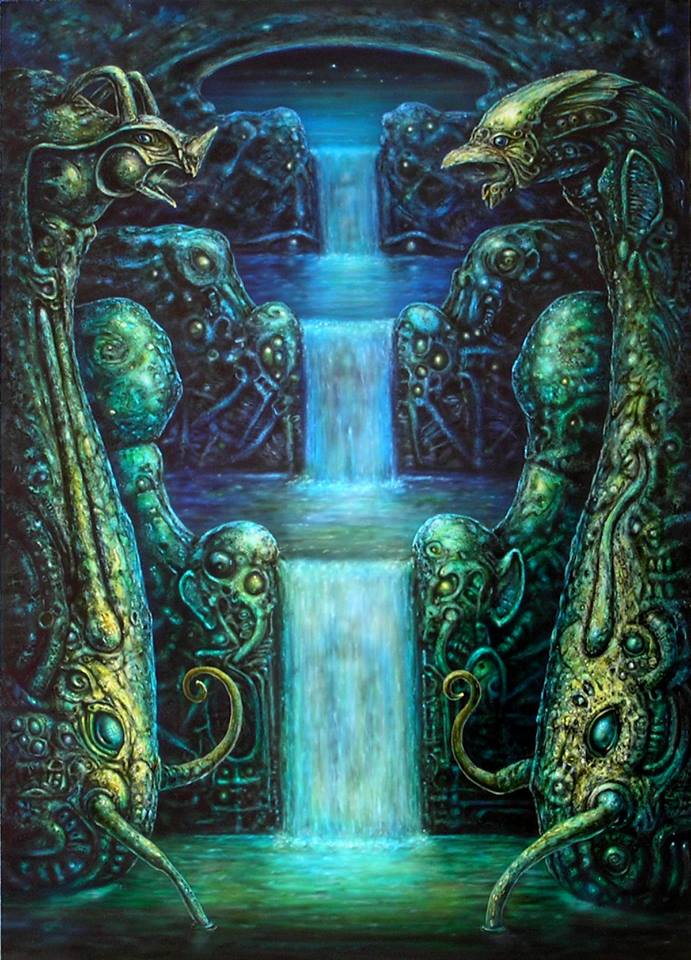


The descenionists hold that reality travels in the opposite direction. The dream flow ever downwards, each level more concentrated than the dreams of the previous level, acquiring more hidden and condensed meanings and potent symbols as the levels are descended. The stuff of dreams accumulates until it flows into the great original dream of MANA YOOD SUSHAI, a dream of unspeakable and searing reality that contains the potent distillation of all that has come before. Here it is said that a single grain of sand contains within itself heavens that would shatter the human intellect to behold. This version of the creed is attractive to mystics, great dreamers, and persons of strong fancy, who hold that the waking world is a pale shadow of their dreams, and that their fanciful dalliances are holy expeditions, bringing them one step closer to the Godhead.

There are those among each of these strange creeds with the longing for unknown experiences, who hold that the pilgrimage to the original dream is a sacred and inescapable duty. The ascensionists believe that a way must be found to travel backwards through the successive waking worlds toward the waking world of the first dreamers dreamt by MANA YOOD SUSHAI. The descensionists hold that a way must be found to penetrate ever deeper, forward, through the levels of dreams until one arrives at last at the opal gates of the great dream. As both factions admit, such doctrines are perilous, since man was not meant to experience the higher realities, which must in their potency be inimical to the weaker stuff of which we are made. Yet these would-be pilgrims continue to try, the ascensionists cultivating through meditation ever more vigilant hyperconscious waking states, while the descensionists induce through the use of hashish and lotus powder ever more febrile and lurid hallucinations. Thus far, to no effect.

The orthodox frown on all these efforts equally as idle depravity, and perhaps foul heresy. But the spread of the faith and the increasing popularity among new converts of the heterodox positions has stayed the hand of priests who, in any case, are not given over to much action, bent as they always are, on supporting the soothing reverberations of the great drummer Skarl, lest all reality be destroyed in a moment by the awakening of MANA-YOOD-SUSHAI's terrible consciousness.

Monday, December 2, 2013

Religions of Ghinor II

Nephtlys


Ralph McQuarrie
Nephtlys is the goddess of wealth, worshipped (in different congregations) by merchants and thieves alike. She is the spider mother whose endless hunger is so great that she perpetually consumes her ever-birthing children. This hunger is a symbol to her flock of the great striving and endless greed that is the meat of true happiness.

The priests of Nephtlys are the Tempters who lure unwitting prey to feed the hunger of their goddess. In Viridistan they do so literally. There the doors of the great temple are left open and unguarded at night, and splendid treasures beckon from the altar room of the two great webs. But only the desperate and the starving, or the most foolhardy thieves, take the lure. For ever pregnant Nephtlys often manifests physically to sate her appetite when warm flesh approaches her webs. Elsewhere a metaphysical interpretation of the priesthood’s role prevails. There the Tempters spin elaborate webs of schemes and bargains that serve to benefit the temple and ruin its enemies. They take special delight in demonstrating to the high-minded that they too desire to have more and outdo others.

In Wolsdag, a small but lavish temple to Nephtlys is nestled within the inner precincts of the guildhouse. It is staffed by Tempters of the Monopolist faction who provide loans, often at brutal rates. Those who default are offered a choice to pay off their debt: be sold to slavers, or perform services for the Guild. Such services are always of a dangerous, morally dubious, or unpleasant kind.


Manannan

Illustration by John Blanche
Manannan, the Ancient of the Seas, is popular among sailors and fisherman throughout the Wilderlands. The prophets teach that when the world was created by Manannan, a single great sea covered its surface, and man lived in peace and harmony in shining cities under the waves. But as a result of his transgressions, Mennanan raised the land as a foreign prison for man. That man breaths air, and walks on two feet is an alien condition, a curse that will be lifted on the day of reckoning when the waters once again cover the earth and the faithful are forgiven and welcomed back into the deeps.

The Temple of Menannan in Wolsdag, although small, is remarkable. Its rooms of worship are filled with curios brought by sailors from their many travels across the seas. Rusted anchors, nets, conch shells, whalebones, shark jaws, and stranger flotsam bedecks the walls and shrines. Murals composed of the powdered shells of luminous underwater creatures are kept lighted throughout the year, except during the Festival of the Longtide when the lights are put out, and their uncanny splendor is revealed. The basement of the temple contains underground access to sea caves along the coast. It serves regularly for the passage and temporary storage of smuggled goods, including those moved by the Enterprising Faction. For a fee the priests of Menannan can locate stolen, rare, or illegal goods, as well as pass on a great deal of information, or arrange for an ocean voyage. However, these services are usually available only to those who are vouched for by some known member of the community. 

Mer Shunna

Illustration by Chris Burdett
Mer Shunna is an extreme schism of the Manannuan faith. The Mer Shunna worship (so they believe) Menannan in the guise of Armadad Bog, the judge in the depths. According to their bleak doctrine, Armadad Bog is an unforgiving and merciless god. Mankind is thus forever damned by his transgression, and must wear for eternity the two-footed mark of his shame and condemnation. The religion centers on penitence, self-flagellation, and ritual enactments of the abasement of humanity before the blessed merfolk, beloved of Armadad Bog. Val-Ys is a holy month of penitence that culminates in the Mer-Moon Ritual, where young women are sacrificed in elaborate and haunting rituals in the light of the full moon, their life's blood spilling into the silver sea to feed the strange appetites of the merfolk who in auspicious years rise to the surface in a frenzy.

Owing to these elements of ritual sacrifice and self-mortification, this extreme faith is an outlawed heresy except in Viridistan, where it is the predominant interpretation of Manannuan faith. Wolsdag is home to a secret cult of Mer Shunna whose symbol is a silver forked tail. This cult maintains ties to slavers and commits black deeds.


Monday, November 11, 2013

Religions of Ghinor

The Temple of Pegana


The Precepts of the Faithful hold that MANA YOOD-SUSHAI is the slumbering god whose cosmic dreams sustain reality. Lulled into slumber by the divine drummer Skarl, when He finally awakens and rubs the sleep from his eyes this world will vanish. The followers of the Temple of Pegana work to forestall this day. To soothe his slumber they ceaselessly intone hymns, and utter gentle prayers, and burn sweet incense. All dreams are sacred to the priests of Pegana who record carefully in vast rolls of papyrus the most remarkable (and damning) dreams of their followers. This strange faith is currently popular within the City State of the Invincible Overlord. Its fortune has risen, owing to the power of their High Priest Mung to summon the dread Beast of Slumber, and is beginning inroads in the provinces. Torkamedes, the envoy of the Grim Duke in Loktole has erected there a lavish Temple of Pegana. Among the services they offer for a fee is the interpretation dreams: 10gp for an acolyte (10% accuracy), 50gp for a priest (20% accuracy), 250gp for the Canon himself (30% accuracy). Even when accurate, the interpretations are perplexing.


The Cult of Man


The Cult of Man is a proscribed millennial lay religion. Its original function was to celebrate and pass on the recorded history of the struggle through which humanity freed itself from the yoke of oppression laid on it by the entities calling themselves the Archivists. Through the centuries this history has become perplexing myth and the rites of remembrances obscure ritual. In its current form, the myth cycle teaches that the return of the Lords from the skies is immanent. Man must prepare himself for the final war, the result of which can only be ultimate liberation or unending servitude.

Although there is no official church hierarchy, there are some cultists who devote themselves entirely to the preparation of their fellow man. These are the fanatical Wayfarers, of whom there are two varieties. One kind holds that the Overlords, Emperors, Dukes and Chatelaines of this world are the bulwark of civilization, the principle of order through which alone humanity might marshal its forces effectively in the coming struggle. This faction seeks to uphold authority wherever it is found. The other faction holds that dominion is the way of the Archivist, and that if humanity is to triumph, it must relearn instead the ways of Man. These anarchical individuals work to undermine the harsh tyrannies that currently prevail in supposedly civilized lands. Whatever the doctrinal dispositions of its local adherents, the Cult of Man is resisted by authorities everywhere, owing to its imagery of revolution and liberation. It is openly practiced only in rural communities, outside the City States. Elsewhere the Cultists meets in secret, and recognize one another through a strange and ancient sign language that functions like a thieves cant.