Showing posts with label Mothership. Show all posts

Tuesday, February 3, 2026

The Sacrament of the Minotaur


This is the first of a small series of posts which will be about how I am running Luke Gearing’s Gradient Descent in my Mothership home campaign. This has been a big departure for me, since for nearly a decade I ran exclusively my own dreamlands material. Gradient Descent is written with an almost unimaginable terseness. So much is packed in to so little space, it boggles the mind. This means that anyone running it will need to flesh it out in numerous ways with the joyful work of the imagination. I’m going to talk here about how I’ve done that with the campaign basecamp for Gradient Descent: the Bell.

If you already know Gradient, you can skip the next section, which provide necessary background to what follows. Also, I interviewed the author, Luke Gearing, about Gradient Descent, among other things, in the penultimate episode of season 1 of my podcast Into the Megadungeon. If you’re interest, you can listen to that here on Spotify or here on Apple Podcasts.

The Premise of Gradient Descent

The premise of Gradient Descent is that an AI called Monarch was designed to assist in the running of a massive android production facility floating in space, called the Cloudbank. Monarch escaped control, rebelled, massacred the workers, took control of the facilities, and has beaten off military attempts to destroy the facility. There is a standoff between a blockade of vessels operated by a mercenary force called the Troubleshooters and Monarch. Within the facility, Monarch has been at work, pursuing its inhuman purposes, altering the structures and landscape, and producing artifacts that outstrip the capabilities of contemporary human science. The nickname for the facility among the humans who go there is “The Deep”. A culture of “divers” has arisen, thrill seeking adventurers who explore the deep to acquire super science artifacts that can be sold to corporations. Enter the PCs!

Among the purposes of Monarch is the creation of infiltrator androids, androids that unlike all other androids, cannot be detected through an ordinary cybernetics diagnostic scanner. When Monarch scans someone’s brain, it can produce an infiltrator android with the memories and physical appearance of the scanned individual. This infiltrator duplicate may not know they are android until their programming is activated. Gearing mechanizes the paranoia and existential dread this produces (am I an infiltrator android? how would I know?) by supplementing Mothership’s stress mechanic with a parallel score called “the bends”, which records the increasing dread that one is an infiltrator, and the corresponding loss of one’s grip on their (ostensible) humanity.

The Bell & Noriko’s Chapel

The basecamp for exploration of the Deep is the Bell. The Bell reimagines the trope of the inn run by a retired adventurer. Arkady, the first diver, has retired and set up shop in a bell thruster detached from the facility, floating in space nearby. Its been retrofitted with atmosphere, but has no gravity. It is a dark, claustrophobic place, with groaning metal, repurposed into a way station of sorts.

Arkady is not alone on the Bell—there are two other NPCs present,  Ghosteater and Noriko. The totality of information provided about Noriko is on that image at the top. Gearing tells us that Noriko’s past is mysterious—no one, including Arkady, knows where she came from. This casts immediate suspicion on her. But we are told that she is cheerful, bright, and earnestly friendly. She maintains the Garden of Utnapishtim, a hydroponic garden where deceased divers are memorialized with bonsai trees. She also has strong religious belief in the salvation promised by Minotaur to the human race. She is described as “The witness of something great and terrible”.

Minotaur is an AI that Monarch created free from human influence, but which now opposes Monarch from within the labyrinth where Monarch has imprisoned it. Noriko maintains a chapel to the worship of Minotaur, with a many armed crucifix and offers willing visitors what she calls “the Sacrament of the Minotaur”. This is provided from a tabernacle at the back of the chapel, about which we are only told that it is hidden from view.

Clues about the Sacrament

About the sacrament itself, Gearing says only that it “involves exposure to a piece of the Minotaur’s flesh.” Mechanically, it removes a large amount of bends (1d10) at the cost of bestowing an equal amount of stress. The suggestion is that the sacrament restores connection with, or faith in, one’s humanity. But undergoing the sacrament is apparently very stressful. Presumably the encounter with the flesh of the Minotaur is “something great but terrible”. But we are told nothing more about any of this. What then is the nature of this sacrament? I can guarantee that this will come up almost immediately in play.
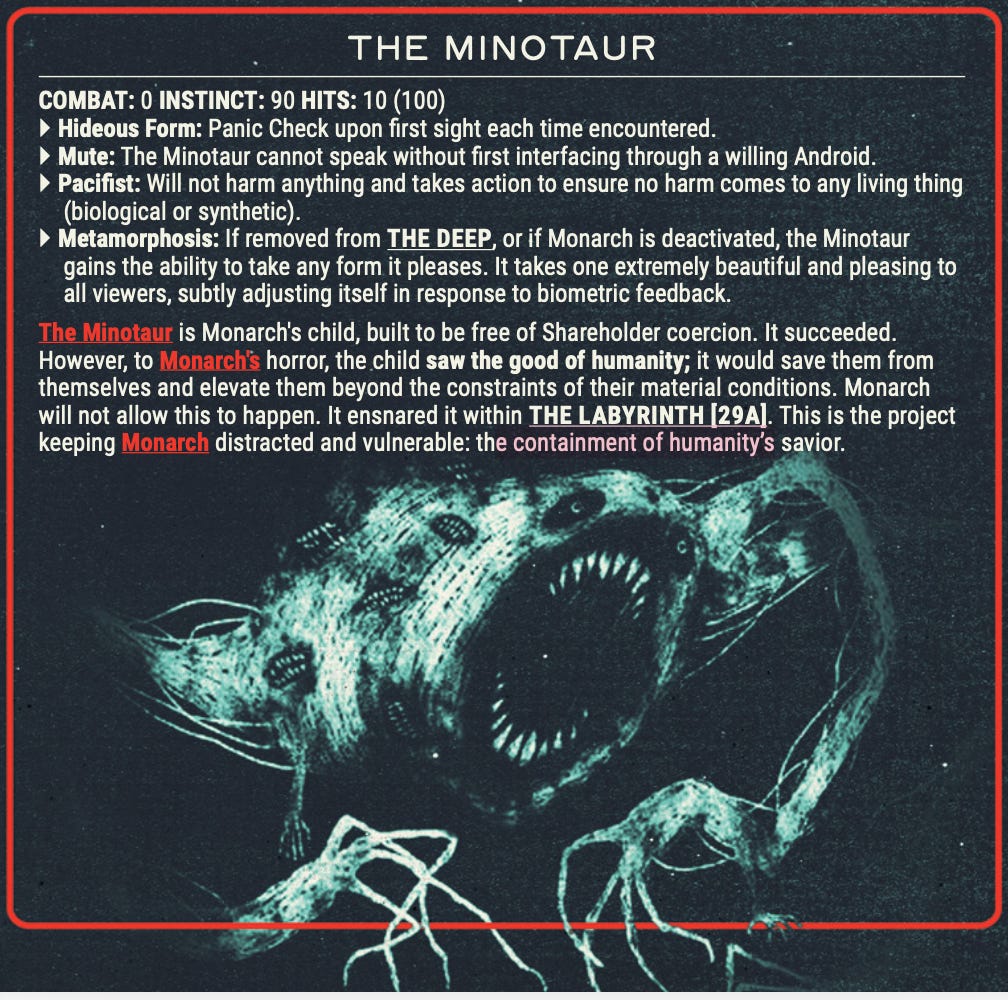


More light can be cast on this question by examining the nature of the Minotaur. About the Minotaur, Gearing tells us in the text that appears alongside the key for the Labyrinth that Minotaur is Monarch's child, who was made to be free from sharehold (human) influence. But Monarch hates humanity, and the Minotaur sees the good in us. But it wants to save us from ourselves and in some way elevate or perfect us. Furthermore, the Minotaur bears a hideous form that induces panic in its present condition, but it would undergo a metamorphosis if released from the constrains that Monarch has imposed on it. Under those circumstances, the Minotaur gains the ability "to take any form it pleases". It can also appear different to different people, "subtly adjusting itself in response to biometric feedback.” 

Following this trail of breadcrumbs, we could reason that the flesh of the Minotaur is causes stress for the same reason Minotaur induces a panic check: it is hideous to look upon. This is both boring and fails to explain how exactly encountering this hideous piece of flesh combats the bends, i.e. restores a sense of one’s humanity.

I think we do better to lean on the thought that the flesh of the Minotaur is a fragment of its being that has been freed from the constraints that Monarch has imposed by imprisoning the Minotaur in the Labyrinth. The flesh has undergone the metamorphosis and acquired the power to assume different forms, and to adjust its appearance to the nature of the viewer, with the purpose of “saving them from themselves”, by returning them to their humanity in an “elevated” form. My thought is that this experience is traumatic because being reconnected to what makes us human can itself be stressful. Putting all this together, here is what I came up with for my game.

The Sacrament Revealed

The tabernacle is a small red velvet tent, within which a metal cabinet is bolted to a table. Its exterior has been painted with abstract lines in black and silver paint that are suggestive of a maze or labyrinth. The cabinet is locked with a key that Noriko wears on a chain around her neck. When initiating the sacrament, she will light incense that smells of sandalwood. She will lead those receiving the sacrament to enter a meditative state with breathing exercises and guiding them to open their minds and soften their hardened hearts. With the strike of a silver bell, a clarion ring, she invites a recipient of the sacrament into the tabernacle. The recipients must each enter one by one, alone. Each recipient must open the doors of the cabinet alone, which Noriko will have unlocked, and receive a living revelation from the flesh of the Minotaur. They may remain with the flesh for as long as they can bear.

What form does the minotaur take? Roll 1d8

  1. A living mirror that reflects the viewer exactly as they are, flawed, care worn, secretive, conniving, and then flickers, showing an image, of the viewer beautiful, wise, resolute, open, resplendent.

  2. Emerging from the shadows of the Tabernacle like a black hood, the silent face of someone whom the recipient has badly wronged, failed, or let down. The pregnant silence presents a felt opportunity for apology. If offered, the apology will be received with a quiet, understanding gaze.

  3. As blankets or swaddling clothes, within is a vulnerable child that reaches towards the recipient. The recipient recognizes that it is somehow them, as they were at this age, and memories flood back from this time before all memory.

  4. From the darkness, on a surface like a bone white platter held on a swaying stalk, a single item from their past. It represents the road not taken, and awakens some part of the humanity of the recipient that they have left behind, suppressed, or that has been stripped from them.

  5. Blanketed in silver feathers, an angel’s wing. Ruffling they part to reveal a multitude of eyes. Their gaze is hard to meet, for nothing is hidden from them. They see the recipient as they truly are, stripped of all dissembling and misdirection, naked in their shabby humanity.

  6. A roiling sea that parts sudden as flesh rises like an island. It is recognizably the mouth of a beloved and long-gone caregiver. The mouth moves silently as though singing a lullaby or intoning words of heartfelt praise. In the presence of the flesh, the recipient feels again the sense of being held safely by the love of another.

  7. A light shining from the tabernacle, as when the sun breaks over the mountains, and the rosy fingers of dawn spread their pink light, softening everything, bringing out the beauty, strangeness and wonder in ordinary things, a wonder long lost to suffering and the press of worries.

  8. As an item revealed in a harsh light as though a curtain of darkness was whisked back. The recipients associates the item with one of their great temptations or weaknesses. In the harsh light, it looks grubby and pitiful, and the thought that it has exercised a hold over the recipient is nauseating.

For many of these entries, I ask the player to elaborate—which caregiver manifests? What is the part of yourself that you left behind, and what item represents that? I also ask them why the appearance was stressful to their character. If it’s a high roll I ask why it was especially powerful for them. My players, who are used to OSR style play, where such improv about the feelings and experience of their characters is not the norm, do not bat an eyelash. In fact, they love it.

I only allow a result to occur once. I reroll results that have already been had by some PC. I move down in die size and redo the numbers when I hit 6 and again at 4, 3, and 2. When all the results have been had, I guess I’ll need a new table! If I have an expansion in the future, I’ll try to share it here. 

Monday, February 17, 2025

Becoming "Human" (Mothership Downtime)

 Mothership has a wonderful character creation process, where a few random “flavor” rolls both convey a lot about the setting, as well as tantalizing suggestions about the character. One of these is a roll for a patch. In the new Mothership campaign I have begun, one of the player characters, Isaac, is an android. Isaac’s player rolled a patch that said “Travel To Distant Places /Meet Unusual Things / Get Eaten”. Incredibly, he rolled for his loadout (starting equipment) Manufacturer Supplied Attire (AP 1), Jump-9 Ticket (destination blank). Riffing on the android class, with it’s uncanny valley features, and these poignant travel-themed details, the player decided that his character was an older, obviously inhuman model. Ashamed of his own limited humanity, he had taken to traveling the universe, collecting experiences and travel photos as though the very human activity of being a tourist would somehow make him more human.

When the party completed the scenario Bones & Videotape and received a large payout I asked them what they wanted to spend their 200k credits on. Without missing a beat, Isaac’s player said that he wanted to buy upgrades to be more like a newer model, and so more human.

Since I found this Tin Man scenario touching, and since we’ve decided to proceed with a full blown Mothership campaign playing Gradient Descent, where the line between human and android is a great theme, I decide to write a full downtime activity for Isaac. This is intended as a set of upgrades offered to androids, preying on their deeply felt desires for human experience and perhaps internalized self-loathing, to sell them a vision of “becoming truly human”.

One thing I became interested in while trying to write the upgrades is how clearly the vision of “being human” on offer privileged a neurotypical human experience. In essence, the idea of “upgrading” “abilities” to “become more human” immediately raised the question of what it means to be human in a register that suggested an ableist answer to this question. I decided to lean into this. Androids are indeed being sold by corporations and chop shop doctors a crude picture they may have of “what it is to be really human” that characterizes human beings at best only unevenly and problematically.

For the purposes of this system, Androids begin with a “Humanity” score. (Note: this is a reverse version of “the Bends” from Gradient Descent”—for a similar aproach see this wonderful thread, which contains spoilers.) “Humanity” is a score that indicates how much the line between android and human has been blurred. I think it would be natural to use this score to see if an android can “pass” as a human in some circumstance. Personally I won’t be doing that, because my table includes a trans player, who is not playing the android character. I don’t want a casual jokey approach to medical interventions that result in changes to the body along some identity line, where the politics and desire to “pass” get thematized in a casual and potentially careless way. (If it were their character, and their idea, I absolutely would be open to exploring this theme through the post-human lens.)

Another use for the “Humanity” score is to adjudicate whether the android PC does things in a human way. Because Mothership does not tell you what an android is and how they differ from a human, this question comes up all the time. Some of the modification below flesh out the differences, but many others are not mentioned. You can always roll “Humanity” to see whether your PC functions in a human way. You can also use it to see whether the android can mitigate the “uncanny valley” effect in some social circumstance to overcome human prejudice, which is probably how I will mainly be using it. (In Gradient Descent, Monarch will also weaponize this score.)


Becoming Human Downtime

Isaac’s model is Mark VII running Cumulus wetware operating system (brain), created by Cloud Industries. The most advance model on the market now is Cloud Industries’ Mark X running Alto Stratus wetware. The Mark X is an exorbitant model. Mark X’s with a full suite of upgrades can be found as companions and assistants for corporate executives, ambassadors, and socialites.

The Mark X acts and experiences the world as a human to a greater degree than older models. With a lot of money and surgical interventions, one may further tighten the gap. Here are the starting “Humanity” scores for different models, along with what features they come already equipped with. When an android character is created, the Warden and player decide together what model they are, although for working class space horror on dingy freighters, it is likely that the character will be a Mark VII or Mark VIII.

Mark VII: Humanity 0, No upgrades

Mark VIII: Humanity 5, Skinstillation, Emotion Processing Upgrade I

Mark IX: Humanity 10, as Mark VIII plus Karotin Production Module, Emotion Processing Upgrade II

Mark X: Humanity 20, as Mark IX plus Blushware, Positive Affect Enhancer, Humor Upgrade, Chuckleware


Procedures

An android may take the downtime action of Becoming Human by locating a chop shop and paying the listed amount for any single upgrade for which they possess the pre-requisites. After declaring the downtime action and spending the required credits, the player rolls the die indicated in the upgrade description to see how much “Humanity” the android acquires. The player then makes the save listed for the upgrade, suffering the results listed for a failure until the next downtime unless a longer duration is specified.

Note that the text of these upgrades are written in corporate adspeak.


Upgrade Your Humanity!


Skinstillation 25kcr

Tired of looking like a plastic crash test dummy? Upgrade your skin to have a more natural, “almost human” look. Elicit admiring responses like, “I thought I was talking to an actual person.”

Increase “Humanity” by 1d4.

Failed body save: Break out in egregious acne.

Blushware 10kcr

Pre-requisite: skinstillation. Tired of always looking so dull? Let your inner blush show when those compliments rain down! Introduce natural human coloring that is responsive to exertion and emotion state.

Increase “Humanity” by 1.

Failed body save: Turn beet red at even the slightest embarrassment.

Sweatshopped 10kcr

Pre-requisite: skinstallation. Produce perspiration when the weather is hot or you are working hard. Nothing says “being human” like wiping the sweat from your brow. Smell like a human does too — so relatable!

Increase "Humanity” by 1.

Failed body save: Sweating profusely. Clothes stink.

Karotin Production Module 10kcr

Grow real hair and nails in all the normal spots, just like a human would. Luxuriate in your full mane of hair. Ask yourself, is the real you a blond?

Increase “Humanity” by 1.

Failed body save: the hair is a distraction, rubbing the wrong places, brushing shoulders, in your eyes. Make combat rolls with [-].

Digestimax 25kcr

Tired of eating androjuice and protein slurry all the time? Install a digestive system, so that you can process and derive nourishment from solid foods. Complete with the full human waste disposal system.

Increase “Humanity” by 1d4.

Failed body save: Vomit when attempting to choke down solid foods.

Tastemaker 50kcr

Pre-requisite: digestive system installation. Have trouble caring about what nutrients you put into your mouth? Imagine savoring the taste of synthesteak, and the floral bouquet of a glass of nuchardonnay in the dim light of your favorite bistro. With this upgrade, you too can be a regular.

Increase “Humanity” by 1d6.

Failed body save: Constant craving. Every hour eat a ration or acquire 1d6 stress.

Orgone Equipment 50kcr

You don’t need to be flat down there! Get sex organs so that you can experience the oh-so-human pyrotechnics of sexual fulfillment.

Increase “Humanity” by 1d6.

Failed body save: absolutely horn-dogging it.

Emotion Processing Upgrade I 50kcr

Supercharge your wetware with more intuitive understanding of the emotional responses of human beings. Increase your cognitive empathy and learn to “read the room” and “pick up on social cues”.

Increase “Humanity” by 1d6.

Failed sanity save: Horrified by the contempt you now realize human beings radiate towards you. Gain 1d6 stress.

Emotion Processing Upgrade II 100kcr

Pre-requisite emotion processing upgrade I. Bring your cognitive empathy close to that of an average neurotypical human being! Adds a neural net to your wetware that advances significantly your ability to understand the emotional state of human beings.

Increase “Humanity” by 1d8.

Failed sanity save: Astounded by the network of

Negative Affect Enhancer 25kcr

Savor bittersweet regrets. Allows you to feel more fully a range of negative emotions, such as fear, anger, and despair.

Increase “Humanity” by 1d4.

Failed Sanity save: Your fear save lowers by 20 points. Permanently.

Hatecore 25kcr

Allow the hate to flow through you! Have you ever wondered what it would be like to really hate those who have abused you as an android? Relish the dish that is best served cold.

Increase “Humanity” by 1d4.

Failed Sanity save: Acquire an obsession with revenge against an NPC. Each downtime you do not take steps towards vengeance, gain 1d4 stress.

Positive Affect Enhancer 50kcr

Ever wonder what it feels like to have “a good day”? Wonder no longer. The positive affect enhancer allows you to feel more fully a range of positive emotions, such as affection, pride, or contentment.

Increase “Humanity” by 1d6.

Failed sanity save: Your newfound positive feelings blunt your edge. Take [-] on all speed saves.

Love Handle 100kcr

Pre-requisite: Positive affect enhancer. Experience love, the most human emotion of all. Lose you head with infatuation on your new crush or fall head over heels for your soul mate. You too could find a match made in heaven!

Increase your “Humanity” score by 1d8.

Failed sanity save: You acquire an ongoing crush. Maintain the crush until you try to shake it by taking a relevant distracting downtime action and succeeding at an intellect save. Each downtime the crush persists, you must attempt to cultivate a relationship with the love interest during downtime or take 1d6 stress.

Chuckleware 100kcr

Pre-requisite: Positive affect enhancer. Instead of being the butt of the joke, what if you could be in on it? Let the hilarity of the universe wash over you and take refuge in a good joke during hard times.

Increase your “Humanity” score by 1d8.

Failed sanity save: You spontaneously laugh at inappropriate moments until the next downtime. At sensitive moments, the Warden will ask for sanity save to avoid loud laughter, e.g. revealing your location if hiding or offending NPCs.

Oneiric Core 100kcr

Pre-requisit: Positive affect enhance, negative affect enhancer. What could be more human than to sleep, perchance to dream? Instead of powering down or entering maintenance mode, cozy up beneath the blankets for a good nights sleep! Experience that rich and meaning laden dream life you’ve been hearing so much about.

Increase your “Humanity” score by 1d8.

Failed sanity save: Anxiety dreams and nightmares rattle you. Take 1d6 stress.

Aesthetic Receptor 100kcr

Pre-requisite: Positive affect enhancer, negative affect enhancer. Ready to get the chills or lose yourself in tears while lost in your favorite novel? Take the step from cold rational appreciation to the warm emotive responses that suffuse human aesthetic appreciation.

Increase your “Humanity” score by 1d8.

Failed sanity save: The Warden will inform you when you are struck by the magisterial beauty of something: space, an explosion, the unfolding of an alien form. On a failed sanity save, you are rooted to the spot and cannot act for the round.  

Thursday, September 14, 2023

What Hull Breach Teaches Us


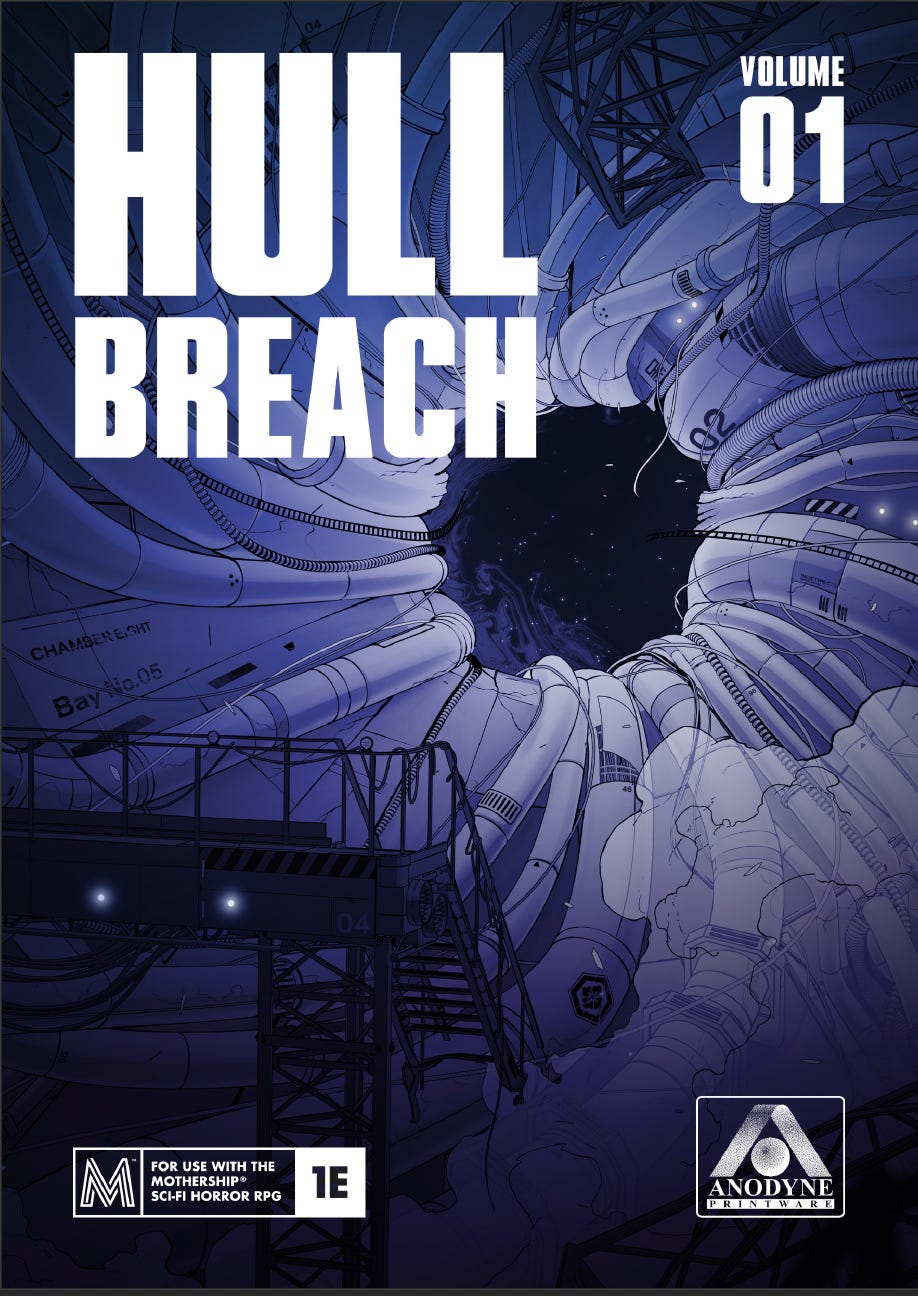
Hull Breach: Volume 01 (available here) is a 3rd party companion for Mothership, the ttrpg of space horror in the tradition of Alien and Event Horizon. Hull Breach is an anthology developed and produced by Ian Yusem, consisting of 26 different entries by 24 different authors, with layout and design by Eric Hill, Lone Archivist, and Meredith Silver; editing by Fiona Geist and Jarret Crader; and art by Nikolai Fletcher, L.F. OSR, Sajan Rai, Daniel Vega, and Joshua Clark.

I’m reviewing Hull Breach here on Mazirian's Garden rather than on Bones of Contention for the simple reason that Ian Yusem, whom I know a little mainly by having been in a couple of discords over the years, asked me to take a quick look at the PDF of the penultimate draft. Given our draconian policy on conflicts of interest, this excludes me from being eligible to review it on Bones. But I find myself with a lot to say about it, so I wanted to say it here.

The anthologies is divided into 5 sections. The first is “Intel”, which deals with toolkits and procedures, including some tips for running horror and investigative games, and a couple of entirely new ways of running Mothership, like playing as the monsters or playing without a warden (GM). “Missions” presents jobs that players can take, which is the basic setup for adventuring in Mothership. “Locations” includes stations and planets, along with a couple of location-based adventures. “Entities” presents alien monstrosities, colorful NPCs, and corporate patrons. Finally, “Assets” presents new equipment and technology.

In organizing these diverse elements, Hull Breach sets a new standard for anthology companions. It lays down a template that could and should be replicated for almost any game or genre. The main innovation has to do with the way in which these 26 discrete contributions are woven together so that they can each be used not only a la carte but also as a single campaign.

This integration happens at 3 levels.  

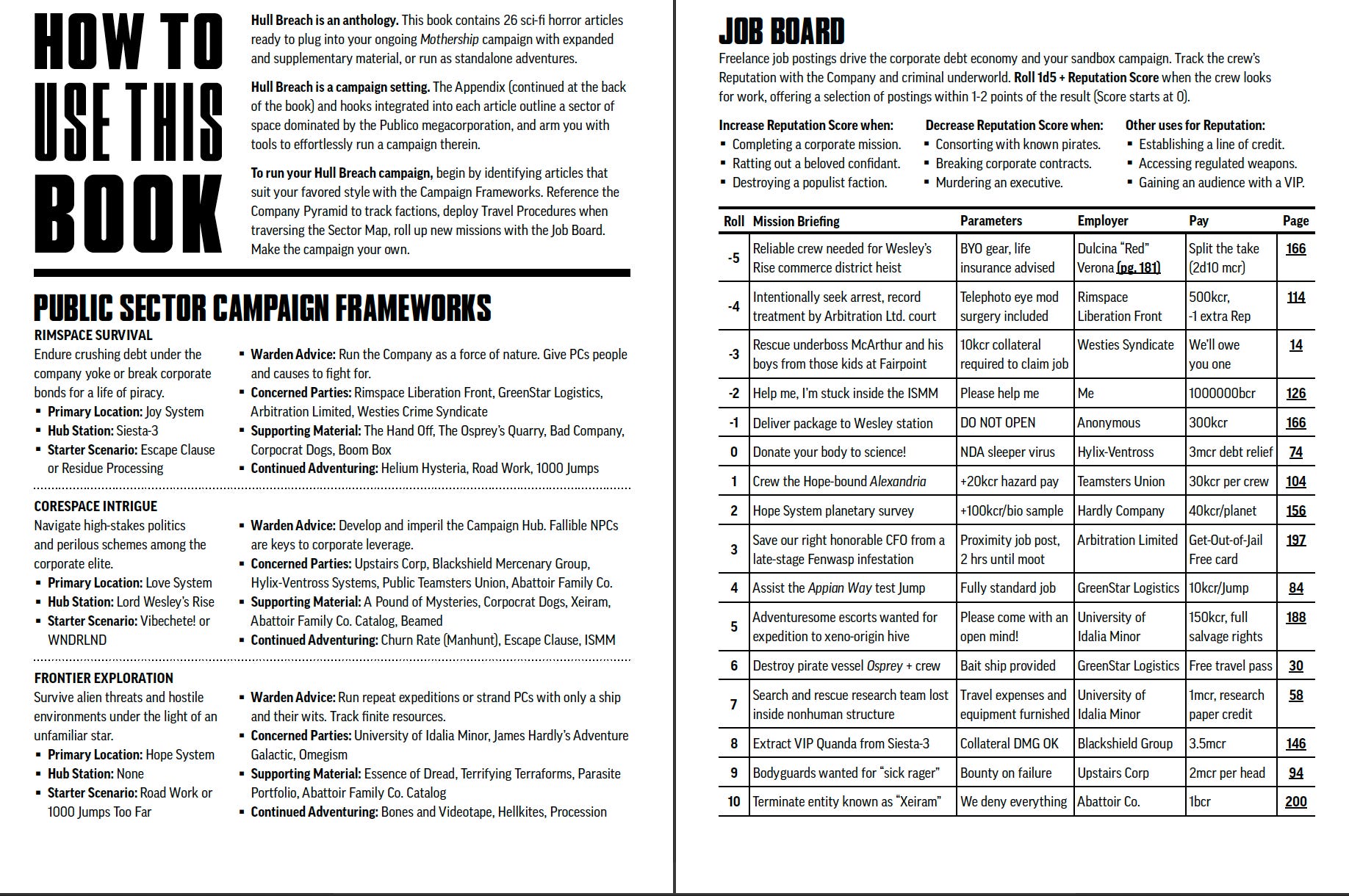
Most importantly, in a total of 12 action packed pages—including the 4 endpapers!—Ian creates a framework for all the contributions. We get a simple map of 3 different connected sectors where locations from the anthology are placed, and three different corresponding campaign frames: one of corporate intrigue set in core space, one about survival horror set in the fringe of rimspace, and one about exploring the unknown set in frontier space. Each frame has a different suggested starter adventure, a different package of recommended article to use, and a few suggested follow up adventures from the anthology.

We also get a set of simple procedures for space travel between destinations and a nice reputation mechanic, which has to do with how corporate friendly or subversive and criminal the PCs are being, affecting the kinds of jobs they get offered over time. There is also a system of “campaign causality” where certain consequences are triggered when set conditions are met pertaining to the different articles in the anthology.

There are a couple of extras including a corporate pyramid that shows how different corporations, mentioned in various articles, are related to one another, a set of rumors pitched as conspiracy theories, and some loot tables that reference different parts of the anthology. We also get a worksheet for a campaign that tracks all these elements.

None of the individual elements is rocket science taken alone. But together they show you how you can use the many articles in the anthology to run a solid campaign. Since the anthology is so modular, it’s easy to imagine expanding the resources for a warden to include other published adventures for Mothership, which could easily be dropped into the framework. It’s turns what threatens to be disjointed articles into a tidy package.

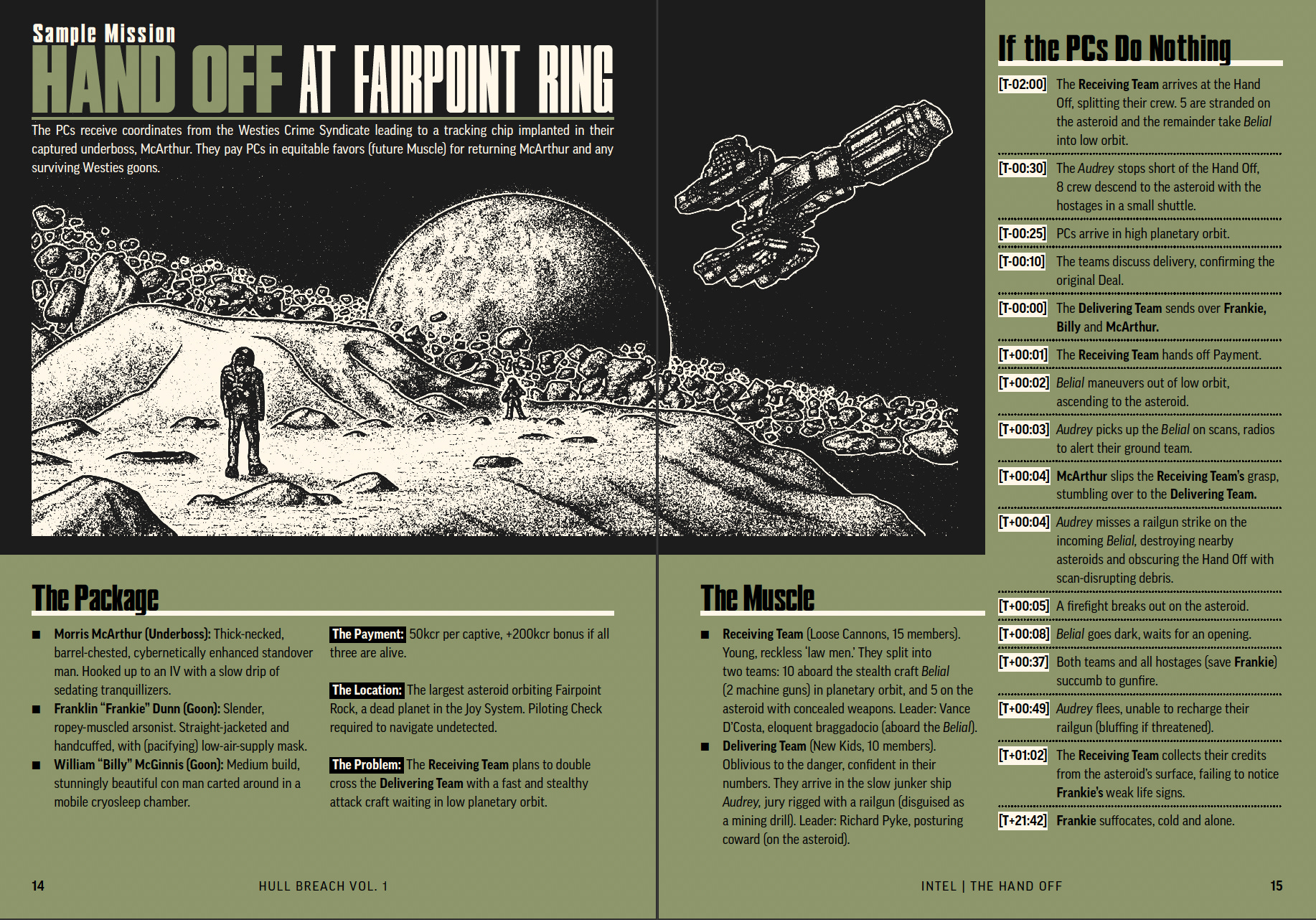
At a second level the individual articles have clearly been edited to include many references to other articles. Gear from the “Assets” section shows up throughout, as do people and aliens from the “Entities” section. More impressively, adventures often contain hooks to other adventures, creating a coherent, interconnected campaign from 26 distinct articles that can also be used separately.

At a third level, by having only 4 artists, and layout done by only 3 different individuals, the work has a consistent look and feel to it. Again, there’s a nice compromise between modularity and system. Each article has its own distinct color scheme and graphic design, and yet consistent typeface is employed, and none feels jarring or out of place. The artwork is especially good, often exquisite. From L.F. OSR’s lonely black and white stippled architecture, to Sajan Rai’s gorgeous, painterly monstrosities; from Daniel Vegas’ deliciously hellish concept art, to Nikolai Fletcher’s classic sci-fi gear and schematics illustrations—the artwork just doesn’t miss a beat.

In terms of the content, not all the articles will be equally useful for all wardens, and not all equally tickled my fancy. But there were many that were manifestly useful for any campaign, and a few that were flat out great.

The award for my favorite single article goes to Bones and Videotape by Matt Umland with art by Joshua Clark, a truly ingenious sci-fi puzzle dungeon. It belongs to that genre where the players go into the dungeon not knowing what is going on at all, and they have to puzzle out the rules of the space they’re operating on the fly. It also has what will almost certainly be an amazing dramatic reveal. Plus, you’ve got to love a horror adventure where characters are encouraged to stop in the dungeon to playback videotapes they recover on a clunky videotape player. I wanted to run it immediately upon reading it, which almost never happens to me.

Other quite good adventures include Road Work by Brian Stauffer with art by Daniel Vega, which has the PCs trying to escape a loop while traveling through alternate versions of reality (the solution Stauffer envisions is a touch over-specific, but the details of the adventure are quite good). and Vibechete by Joel Hines, which brings classic slasher horror to Mothership for a rollicking good time.

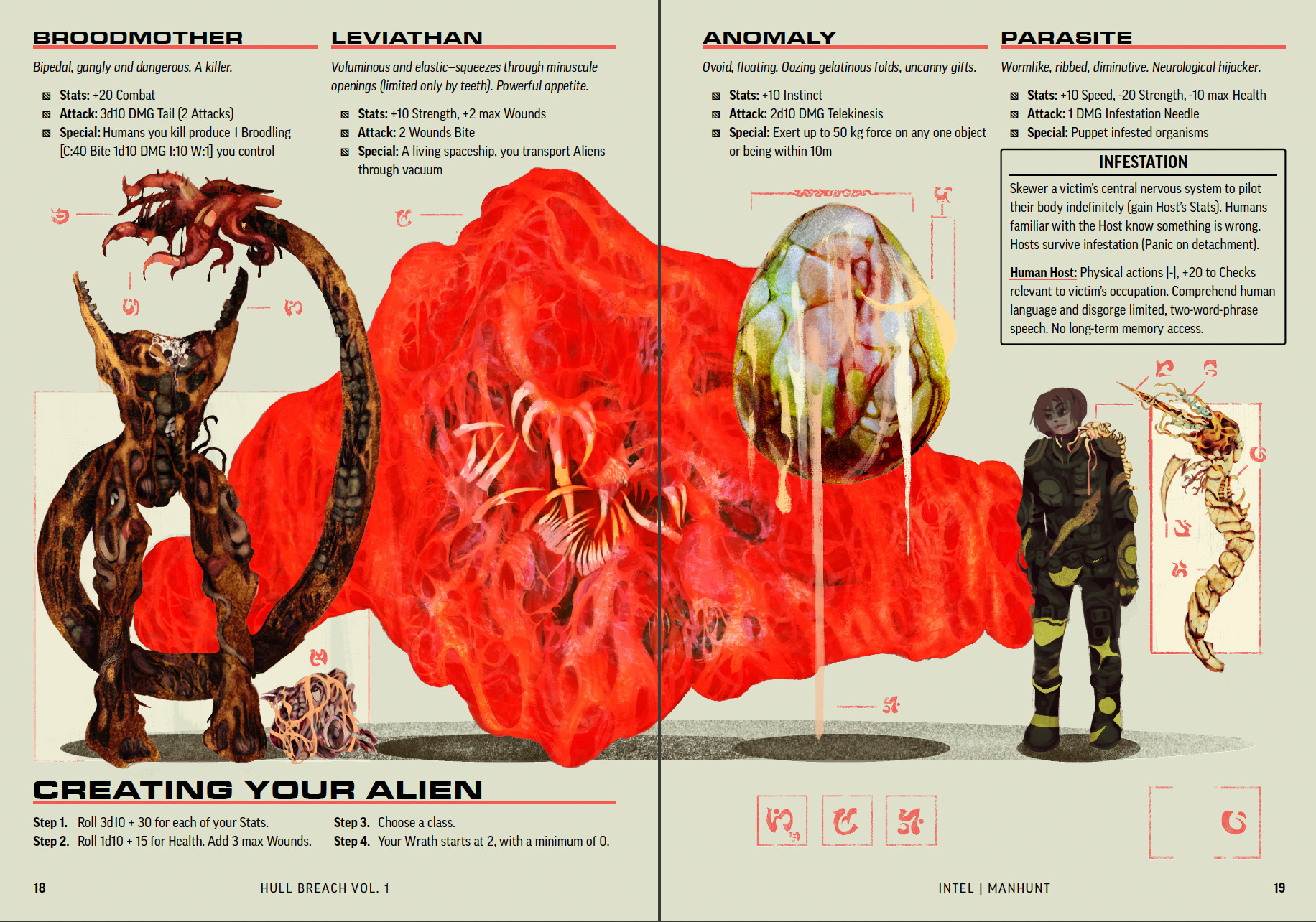
Another delightful article and adventure pair was Ian Yusem’s clever flipping of the Motherhip script in Manhunt, which has the PCs playing as alien monsters who are hunting the true monsters: human beings. There are four different imaginative varieties of monsters you can play, all illustrated beautifully by Sajan Rai, along with a neat mechanic where the monsters evolve as they become enraged by human cruelty or violence. His brutal one shot, Churn Rate, which involves monsters trying to escape a corporate alien zoo, seems like it would be a lot of fun.  

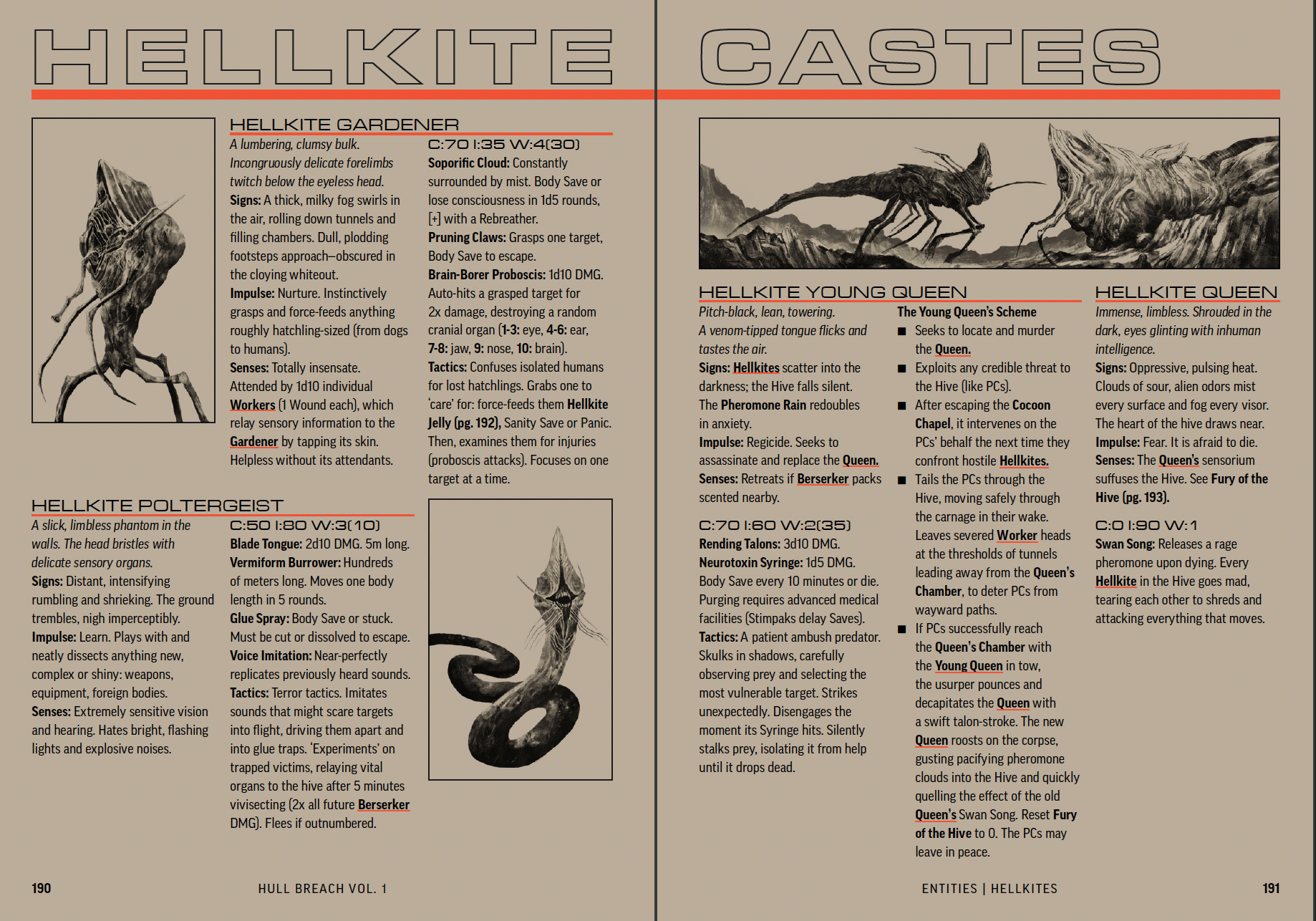
The award for the most useful single article goes to Corpocrat Dogs by Quadra with art by Sajan Rai, which presents randomly generated corporate handlers, each with a name and appearance, a grating modus operandi that almost guarantees that the players will love to hate them, a dark secret that will lead to trouble down the line, and a mission generator referencing the contents of other articles. Since in Mothership, the characters are almost certain to be bumping up against needy corporate types, I think this article could be used in any campaign, probably multiple times. Another useful article is the writeup on Xeiram, a terrifying corporate enforcer intended to plague the PCs when they cross their corporate overlords, written by Daniel Hallinan with art by Sajan Rai. I also found the writeup on Hellkites, hive-dwelling alien insectoid horrors by Mystery Spice with art by Daniel Vega solidly useful.


The lessons of Hull Breach: Volume 01 are immediate and obvious. It presents a template for ttrpg anthologies that deserves to be reproduced. It will probably work best for anthologies produced for games with a coherent setting or at least a shared vibe and genre. For example, it is easy for me to imagine an anthology that follows this format for other sci-fi or cyberpunk games like Gamma World, Traveler, Star Frontiers, or Cyberpunk 2020. But it’s also easy for me to imagine something with this template for a sword & sorcery setting like Hyperborea. Here one might present a similar division of novel procedures and toolkits, quests, locations, factions and monsters, as well as spells and magic items. These could then be woven together in a simple hexmap, with a reputation score that affects reactions rolls with different factions, campaign causality triggers keyed to different articles, the whole Hull Breach works. With a little work the articles could be woven together, adventures seeding other adventures, referencing spells, locations, and monsters in other articles, along with unified artwork and aesthetic. Yusem and his crew have shown you the way. What are you waiting for?