Showing posts with label the Hobby. Show all posts

Tuesday, August 8, 2023

Into the Megadungeon Episode 1 "Mysteries"


I am excited to share the very first episode “Mysteries” of my brand new podcast Into the Megadungeon, where I interview veteran GMs about their amazing megadungeon campaigns, campaigns focused on a single adventuring location with 100’s of rooms spread across many levels. It’s my way of exploring this largely lost play style and contributing to its possible revival. The podcast focuses on the actual experience of GMs at the table. You can expect to hear details about their campaigns, what they learned through play, some tips and techniques, and just maybe a bit of theory—but always grounded in practice.

We start in Episode 01 “Mysteries” with James Maliszewski, author of the blog Grognardia, whom I interview about his Dwimmermount campaign. Among other things, James and I discuss how a GM can make a single dungeon hold the interest and excitement of players. Without further ado, here are links to the podcast!

Episode 01 "Mysteries" on Spotify 

Episode 01 "Mysteries" on Apple Podcasts

Episode 01 "Mysteries" on Google


Reader’s Notes to Episode 01

With each episode, I will share “reader’s notes here. If you read these notes before listening to an episode, you’ll have everything you need to know to listen to the episode! For the curious, the links the notes contain can also be used as a springboard to learn more about the history and practice of megadungeon play.

James ran his Dwimmermount campaign as an experiment to learn about the original megadungeon playstyle practiced at the very beginning of the hobby. As part of that experiment he used the very first version of dungeons and dragons (OD&D) that had been designed specifically for this style of play. He mentions in passing several terms and names that refer to these older editions and early game products. (Don’t worry, in later episodes of the podcast I interview GMs who have developed brand new rulesets to run this style of game, as well as some who use fifth edition D&D to play megdungeon campaigns.)

Glossary of Names and Terms

A young Dave Arenson smiling.

Dave Arneson: One of the two creators of Dungeons & Dragons. Arneson ran the very first games of what would become Dungeons & Dragons, which explored the dungeons beneath Castle Blackmoor. This was both the very first tabletop roleplaying campaign and the very first megadungeon campaign. Castle Blackmoor was never published in its full form.

Gary Gygax: The other creator of Dungeons & Dragons. Gygax ran the second megadungeon campaign exploring the dungeons beneath Castle Greyhawk. Gygax went on to head TSR and authored several early rulebooks of D&D, as well as some classic modules. Castle Greyhawk was also never published in its full form. But Gygax wrote a wonderful little article in 1975 for Europa, a wargaming zine (amateur magazine), telling aspiring GMs what they need to do to set up their very own megadungeon that contains a tantalizing overview of the different levels of Castle Greyhawk. Check it out here.

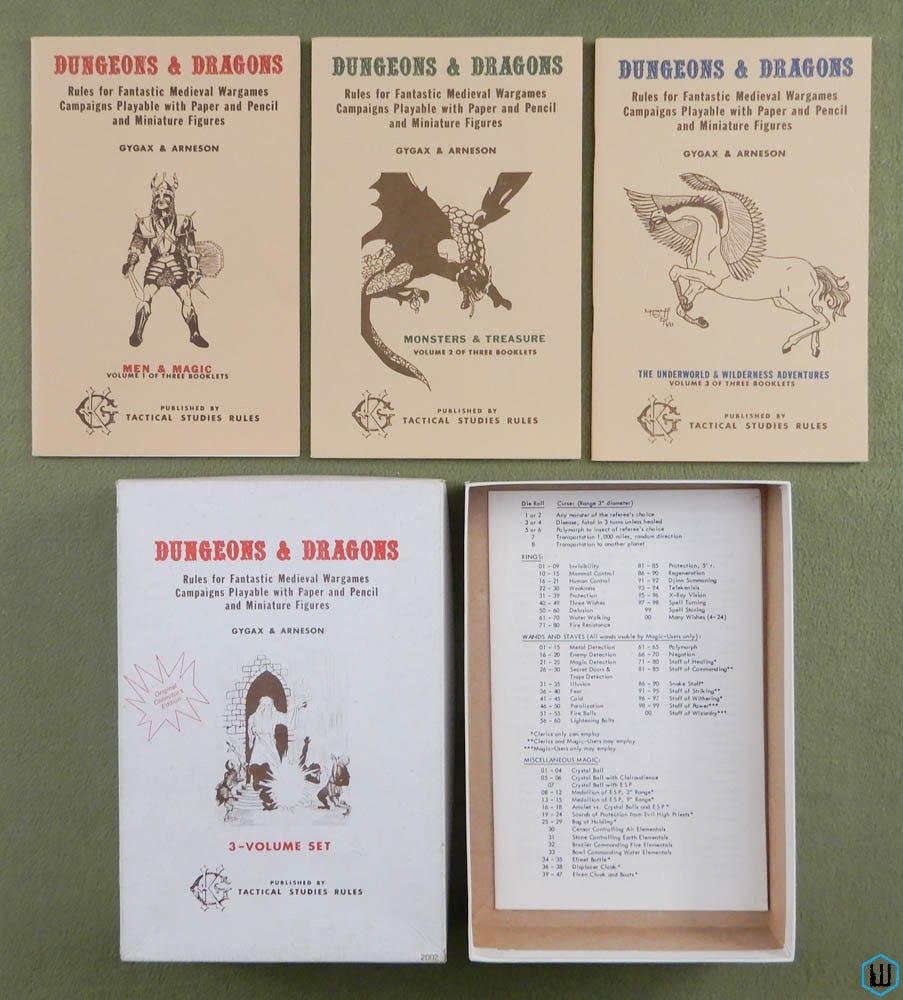
The contents of white box D&D.

Original Dungeons & Dragons: Also called “OD&D”, “0E”, or “white box”, this was the original 1974 edition of Dungeons & Dragons that came in a little white box. The box contained the three little brown books titled “Men & Magic”, “Monsters & Treasure”, and “Underworld & Wilderness Adventures”. Curious about the rules? A reader friendly, and cheaper, alternative which I heartily recommend is Fantastic Medieval Campaigns, which accurately presents the original rules in a clean and attractive modern format, available for free here.

Philotomy’s OD&D Musings: A free document by Jason Cone, AKA Philotomy Jurament, published in 2007 introducing contemporary players to playing with the Original Dungeons & Dragons rules. The section on “creating an old school dungeon” is pure gold and should be read by those interested in megadungeon play. It is available for free here

Supplement I Greyhawk: The first supplement for Original Dungeons & Dragons detailing the Greyhawk setting and presenting many optional rules that became staples of later editions of D&D including “variable weapon damage”, the thief (i.e. rogue) class, among others.

Supplement II Blackmoor: The second supplement for Original Dungeons & Dragons detailing the Blackmoor setting, the monk class, and a far out adventure, The Temple of the Frog, that combines pulp sci-fi and fantasy elements.

Supplement III Eldritch Wizardry: The third supplement for Original Dungeons & Dragons, introducing the druid class and psionics, as well as many of the demons and devils such as Orcus that have become staples of the D&D multiverse.


An image of the cover of Expedition to the Barrier Peaks, showing adventurers being attacked by alien tentacles.

S3: Expedition to the Barrier Peaks: A module written by Gary Gygax, where PCs explore a dungeon inside a crashed spaceship!

Tekumel: The richly imagined campaign world of M.A.R. Barker, based on non-European inspirations including meso-American and Indian sources. TSR published an early version of rules for play in this campaign world, Empire of the Petal Throne.

Clark’s Third Law: Arthur C. Clarke, British science fiction author, enumerated 3 laws over the course of his writings about speculation and future technological change. The 3rd law is, “Any sufficiently advanced technology is indistinguishable from magic.”

#Dungeon23 Challenge: This Sean McCoy’s challenge to create a 365 room megadungeon dungeon in 2023, one room per day. You can read about the original challenge here. I highlighted some of the most dynamic entries I was able to find in the early weeks of the challenge in posts here.

Grognardia: This is James Maliszewski’s prolific blog, dedicated to all things old school gaming. I recommend reading James’ Dwimmermount posts to get a sense of how the campaign developed from modest beginnings to a dynamic campaign exploring the secrets of an entire setting. You can find the blog here, and the Dwimmermount posts are collected here.

As always, if you would prefer to receive these podcast announcements and reader's notes directly to your inbox, then please consider subscribing to my substack, Missives from Beyond the Veil of Sleep, which you can find here. 

Monday, July 31, 2023

The Problem of Spotlight Management in OSR Games


I listened to the “expert delve” segment of this episode of Fear of a Black Dragon (starts around the 28 min mark) with great interest. Jason and Tom were discussing “spotlight management”, that is making sure that each player gets roughly equal time in the “spotlight”, i.e. being the one who gets to contribute to the game, by saying what their character does, and so on. 

Almost all the techniques they mention involve situations where the PCs are in different places doing different things. Their advice is excellent: to consider narrative beats, to switch from one PC to another at cliff-hanger moments (i.e. moments of high drama) that keep people engaged, and so on. They also talk about systems that incorporate different turns more more systematically. Although I could be better, I’m not the worst at what they are talking about. For example, during my downtime segments in my face-to-face game, where PCs break up to all pursue individual projects and activities, I try to move the spotlight around intuitively using something like the ideas they float. I think it works. 

But outside of downtime, in the OSR style games I run, the party is almost never separate. “Never split the party” may be a tired trope, but it’s also sensible practice in old school games. You might think, great, if they're together then it will be much easier to keep everyone equally involved, since the scene is shared. In a more narrative heavy game that was focused on individual characters as individuals, or on their relations to one another, that would be true. In such games, you can move the spotlight around in a single situation by simply asking each players in the situation what their characters do, or how they react to the situation, what they're feeling about it, and so on. 


But the way I run the game, outside of downtime, the focus tends to be on collective problem solving. The players tend to talk freely amongst themselves about what they are going to do as a group at each step. Sometimes people don’t even say what their separate characters are doing, but announce what the group is doing. And this is how I like it! In the games I run, the focus is not on individuals taken separately, nor on their relation to one another, but rather on the exploration of fantastic and perilous spaces by the group collectively. I always allow this kind of collective deliberation, even when it's utterly implausible in the game: in the heat of combat, in the middle of a high-stakes conversation, at any point really, since what I’m here for is the cooperative problem solving that is the heart of the particular flavor of challenge based, sandbox play that I like. 


The problem is that what controls the spotlight under those circumstances is not me, the GM, but rather the social dynamics of the players' freeform collective deliberation about what to do. In order for me to move the spotlight around in that process, I need, essentially, to intervene in the group's deliberations. But I don’t have a good way of systematically doing that. It's hard to know what the proper technique to intervene to move the spotlight without disrupting the freeform deliberation among players. 


I’m blessed in my current face to face group in that no one dominates the conversations. They manage the spotlight relatively well. (The problem is MUCH greater in online play, I’ve noticed, probably because normal conversational dynamics break down over videoconferencing.) But even in my current face to face game, there still is one player who is a bit more passive than the others—despite being a very canny player. But he just doesn’t speak up as much in the group's collective deliberations. 


I can rectify this to some extent, insofar as often characters will act individually, especially when we’re focused on tight scenes where it’s less about what decision the group is making and more about what contribution to a shared effort each character is making. In those circumstances, I can ensure that the spotlight travels to the quieter player. But this is a far cry from the kind of “spotlight management” that Jason and Tom are talking about. If I'm going to be real, it’s more like spotlight damage control. 


I actually have no idea how to solve this problem. I’m tempted to say that without changing the kind of game I’m playing, there’s really no way to manage the spotlight in the core experience. I hope that’s not true, but I’m afraid it is. Any ideas?


Tuesday, January 17, 2023

Dungeon23 Roundup #4: Comics Extravaganza!

So, Dungeon23 is rolling along. I haven't posted a second batch myself for reasons I'll mention at the end. But that doesn't mean I haven't been eagerly reading along! There are some really wonderful things, including some real surprises. One of the real joys here is discovering new people and new blogs. 

First up, I think needs to be the fact that Amanda Lee (@annabelle_lee), author of Garbage Barge and Vampire Cruise, made this glorious thing. (This covers the first two weeks.) It makes me kind of dizzy to look at it but I love so much.


Michael at Sheep and Wizardry is off to a rollicking good start with The Sunset Palace of the Starry Sultan, built and rebuilt by each successive monarch, creating an "ever-expanding labyrinth of tangled opulence and pointless pomp." I love the idea that you would start a delve into this megadungeon by sneaking through the tiny occupied portion of the palace. His first post has some neat character backgrounds that deftly build a playable 1001 Nights pastiche. His second post has really great faction play right from the get go including a treasure guarding mummy and his goose, agents of the Gutter Kings (in service of the Crown of Buttons!), a cult of star seekers, and more. This looks like it will be a fun and meaty dungeon. 

Arnold at Goblin Punch did it again. This post details The Flying Birdcage, a whole house inside a flying birdcage located in the complex form week 1. The Flying Birdcage is probably the most interesting and clever form of quick transportation (a staple) around a megadungeon I've ever seen. I would be SO EXCITED to have unlocked the secrets of the birdcage if I were a player. (Since publishing that he's gone on a bender of rapid-fire posts about dwarves, puzzles, and other setting elements like it was 2015. I think we can say now that Goblin Punch is back baby!)

Speaking of ways into and around the dungeon, in his inaugural post, Rowan at Dodecahedron details 100 flavorful dungeon entrances. Many of them are secret entrances or have some kind of gimmick that makes them enjoyable. "A bronze statue of a massive fish, mouth agape, emerges from a river. Ladder rungs within the statue lead down through the stonework cylinder that supports it." It's a real treasure trove of ideas that may be of use.  

Nick at Underworld Adventurer has produced some real gems in their second meaty post about their megadungeon. Probably my favorite bit comes in the very first room of the post, which is a hall of portraits of past head wizards of the Transcendental Congress. Each has an illustration, and a personality, and is ready to bargain their secrets for something from the dungeon! A lot of lore baked into immediately engaging weird NPCs that also manage to point deeper into the dungeon. 


Speaking of Dungeon23 with a comics-vibe, I've been enjoying Tobias Redesäter's (@radesater@dice.camp) stuff on Mastodon. It's a megadungeon where you slip in through a crack in a bear cave and soon find yourself in a room where a blue goddess has been chained up! It's full of neat illustrations and little cool tidbits. 


If you're on Mastodon definitely give him a follow and check it out. If you do, keep an eye out for the Nest Eagle. He seems like someone groovy to meet in a dungeon.

I know I've been highlighting Zedeck's Dungeon23 stuff a lot, but you really have to check this one out in particular. You can see it with an explanation here. If you get bitten by an eel in the previous dungeon, you get transported to the eel's dream here, a kind of dungeon perhaps built out of the traumatic memories of the eel. This one really hits home for me, because I once did a hexcrawl through an area that was contaminated by the "undermind" of the Parapraxis, a Phantamorian vessel that was spilling an NPC's unconscious into a valley. But, of course, it wasn't the mind of a freaking eel! 


A brief roundup of other delightful things. OBVIOUSLY, OBVIOUSLY you need to be following Jonathan Newell's Apocalypse Archive posts, the second set of 6 rooms dropped here. If you want a more classic AD&D vibe location with a map that looks straight out of a TSR module, check out the debased Monastery of St. Amruss at Foot of the Mountain Games Adventure here. 

You might wonder what's happening with the Catacombs of the North Wind, my Dungeon23 project. (The intro post is here, and the first 7 locations are here.) Because of the way I design locations I needed to do some research for inspiration, and also decide on some bigger picture questions, like what the different regions of level 1 of the dungeon will be. Slowly things have been taking shape in mind, but I'm not quite ready to start mapping and keying the next bit yet. I'll share some of the weird research I've slowly been doing for inspiration another time.  


Sunday, January 8, 2023

Dungeon23 Roundup #3: What Riches!

 We've reached the end of the first week of #dungeon23! I will be posting the results of my first week on here, on Monday! So stay tuned for that.  This has been an intense work week for me (I also had COVID over the holidays, which didn't help. I'm fully recovered now, thankfully.)  So I'm fearful that dungeon23 activity may have slipped by me that I otherwise would have loved. But even in my rattled state, I saw a whole bunch of things that tickled my fancy. I'm also delighted that the blog sidebar is working how I wanted it to work: as a veritable treasure hoard of Dungeon23 blog material. Remember if you have a blog and are doing Dungeon23 on the regular, shoot me an email at throughultansdoor AT gmail. Let's dive in!

The awesome blog Goblin Punch by Arnold K., another staple of the mid to late OSR, had more less gone dark last year. Arnold announced that he's bringing it back for dungeon23! Not only is he back, but his inaugural post for dungeon23, The Mushroom Garden, is a masterclass in designing dungeons. I myself learned from it. What's really wonderful is that Arnold talks you through what he did in the post, so you can see how he builds in mysteries, faction play, puzzles, hidden areas, all over the span of a tightly connected 7 rooms. Whatever else you read, you really should read this. It does raise the question whether perhaps people might want to do their dungeon design in groups of 7 rather single rooms serially. (That's how I'm doing it.) 

Another blog that the sirens call of dungeon23 has coaxed back to life is Roles, Rules, & Roles, a staple of an even earlier geological period of the OSR that I used to read a fair bit. Roger G-S is doing a bronze age hexcrawl that I've been digging. Check out how much is going on in this single hex, including the "damnation tomb" of Narshish. He's doing one of those a day! 

I was completely BLOWN AWAY by Jonathan Newell's dungeon on Bearded Devil. He has two entries so far. The first is his introduction to the Apocalypse Archives a terrifying science fantasy dungeon that lies beneath his fabulous city of Hex. The Apocalypse Archive is a repository for spells and artifacts the impossibly ancient and powerful Librarians considered reality-endangering. It is also a place where space and time are coming unravelled in maddening ways. He introduces the Apocalypse Archive with a series of tables about the different afflictions--Anacrhonosis, Dreams of the Dead City, and the Melchior Effect--that affect delvers into this perilous dungeon. The tables are a lovely spin on the idea of the dungeon as a hostile space that one finds in the "mythic underworld" conception of early D&D. They're also a nice example of how, for example, you can introduce setting, lore, and atmosphere through random tables. The second entry discusses the first six rooms. The whole thing is suffused with a bleak alien grandeur. It also includes some wonderful terrible lore about the Final Star, a sentient solar deity consuming reality that the librarians opposed. I'll definitely be following this project closely! 

Just look at how pretty this map is so far!

 Here are a few more things that have brought me joy in no particular order. I enjoyed the first 7 rooms of this creative funhouse dungeon at The Viridian Scroll. The truth is that if you want to hew closely to Sean's original vision for  #dungeon23, then a funhouse dungeon like this is probably the way to go. The concept of this Soviet space dungeon for Mothership built to preserve the consciousness of Soviet leaders by Emmy Verte at Spooky Action at a Distance is SO GOOD; I can't wait to see more. The writeup of the first areas above Andrew Devenney's The Great Cuttle, a dungeon inside a giant alien cuttlefish for his Rainy City setting was fantastic: as dungeon entrances go, this one is a great little environment. I also really liked this partially submerged level by Skullboy at Better Legends. I think that dungeon is going to be delightful. 


Stay tuned for my first week of my very own dungeon23, covering the first 7 areas of the Catacombs of the North Wind! I'll be posting it very soon, maybe even tomorrow. [Edit: Here it is! Check out Below the Wall of Cusp detailing areas 1-7 of The Catacomb of the North Wind.]


Sunday, January 1, 2023

Dungeon23 Roundup #2: Go!

So here we are on the first day of #dungeon23! 

The energy in the lead up to #dungeon23 is really exciting, but so much is happening so quickly that I don't think I can claim to sum it up here. Take this as one readers report of the things which caught my attention before whirring by as we approached the starting line of #dungeon23. 

One thing I love about dungeon23 is the way it feels like the kind of collective undertaking that was going on during the heady heyday of OSR blogging. So one thing that's brought me special delight is seeing some bloggers who were active in that earlier period throw their hats in the ring for dungeon23. 

James Maliswieski of Grognardia fame announces he'll be doing dungeon23 in this post. He will be documenting the Vaults of sha-Arthan, "deep, ancient labyrinths" that hold "the secrets of the deific Makers" in his developing science fantasy RPG, The Secrets of sha-Arthan. James has long experience running and designing megadungeons. I used to read his Dwimmermount play reports avidly. I've also always loved the way science fantasy lies beneath a swords and sorcery surface in his games, and I expect we'll see that here too.

Another exciting development, James Garrison of the amazing Hereticwerks blog is back in action and doing dungeon23. Hereticwerks was one of my absolute favorite blogs during the mid-OSR, a big source of inspiration for me when I was starting up this blog. The city of Wermspittle was like a labyrinth of glorious posts, each one a rabbit hole of hyperlinks in which one could lose oneself for an afternoon. (I think the first rabbit hole to pull me in was the series of posts about roofcrawling in Wermspittle--table II is my favorite.) Well, James announces that not only that Hereticwerks is back, but that he'll be doing dungeon23 here!

If you can't tell that I'm already vibrating with excitement here, things really kicked into overdrive when Nick K. the DM of the megadungeon campaign I'm currently playing in that's blowing my mind, The Twilight Age,  announced that they will be doing dungeon23 on their blog Underworld Adventurer. Nick is a comic artist and they casually dropped photos of a treasure trove of illustrations and "doodled" megadungeon maps they were sitting on that might get pulled into action here.   

Meanwhile, Zedeck Siew continues to drop whole adventure locations on his tumblr blog Zedeck Siew's Writing Hours with first a city, Queen's Rest, and then the city's lighthouse, home of a clockwork sorcerer, and now the prison of the Moon Maiden! For me the biggest surprise of this isn't the rich imagination in this, and the sense of place that pervades each location, which I've come to expect from everything Zedeck does, but rather that it turns out that Zedeck is, in addition to everything else, a really great cartographer! What a little book of treasures this will be when he's done. 


 Since I enjoyed The Visitor's Guide to the Rainy City and its follow-up, I was delighted to see that Andrew Devenney announces that his dungeon23 megadungeon, The Great Cuttle, will be inside of a giant cuttlefish. Of course it will be. 


I was tickled to see Dyson of Dyson Logos mapping fame announce on Facebook that he would be doing a Tekumel dungeon for dungeon23. He teased this lovely illustration.


In comments to the post, he wrote a little more explaining the idea: "Tumissa is a city dedicated to Vimhula (dark god of fire) in the Empire of the Petal Throne / Tekumel setting. Tekumel cities often have massive underground areas because they are supposed to renovate the whole city every 500 years - adjusting to how the city has changed in that time (tearing down old temples to build new temples, fixing infrastructure, moving clans / temples / etc that have fallen out of favour away from the core of the city to be replaced by those who are currently more powerful, etc)."

Zedeck drew my attention to this little gem by Victor J. Merino. Give him a follow on Twitter or Mastodon. It's a parking garage themed dungeon, with a sacred library of demonic texts in the treads of tires. 


I found this post by Josh McCrowell over at Rise Up Comus both useful and inspiring. It announced two amazing dungeon23 projects, one a 78 room tarot-themed dungeon, maybe a supplement for the megadungeon ruleset His Majesty the Worm that Josh has been working on a for a long time now. The second was a 100 depthcrawl exploring your eccentric halfling uncle's mansion! But, as if that announcement wasn't enough, he gives us 23 dungeon features you can employ when your imagination idles, along with flavorful examples. A great resource for megadungeon stocking. Here's just one to give you a taste:


In more personal news, my son, 13, told me he would be doing dungeon23 with me. So I gave him a journal for Hannukah to do it in. He tells me his megadungeon is going to be called Mons Formicdean: a megadungeon in an anthill of giant ants. It's an idea he had a long time ago, when my wife showed us the images of sculptures created by artists pouring molten lead into ant colonies, which is amazing if the ants are gone, but when they're not an act of horrific destruction. Somehow the artistry of nature bent to cruel purposes seems like fertile ground from thinking about a megadungeon. I'm excited to see where he takes it!


My frequent collaborator Gus threw me a lovely illustration of the approach to the Catacombs of the North Wind that I'll be using for the first week of entries. So I'm excited about that. As usual his illustration pushed me to imagine the place more fully. I'll be sittting down today to work on it along with my son.

One last observation. Something Zedeck wrote struck a chord in me. He points out that since a lot of authors who publish are doing #dungeon23 (like Zedeck or me) it can seem not a DIY communal outpouring, but a grindy race to publication that only the most productive will win. To hold this specter at bay, here's what Zedeck is doing: "I’m keeping my #dungeon23 with no plan and no outline. I’m keeping it in my notebook. I am not digitising the text. It must remain uneditable. It must remain as sketches and notes.This way it doesn’t trigger my brain to go: “Okay, you are writing (ie: working) now." For now, it remains un-instrumentalisable. Unseen and unable to serve the market. Once I’m done with it, who knows? But while I do it it remains play, a way for me to serve myself."

I probably will put mine in cleaner form up on my blog, but I have similar thoughts. I know that a "daily challenge" is not everyone's cup of tea. Speaking for myself, it's actually not my cup of tea either! I've literally never done a daily challenge. What is my cup of tea is doing something with his hobby I love in solidarity with many others. Seeing the collective brilliance, feeling the comaradie of it all. So I'm going to focus on that, rather than "hitting challenges". For folks who aren't interested in "doing" the challenge, but would like to contribute, I would recommend dipping in and out of it when the fancy strikes. Just share some dungeon keys or maps, or other ephemera that fits - anytime. That's probably, speaking realistically, is what I'll be doing when all is said and done. 

I'm taking the opportunity to put the material I create up on my blog to share, for free with everyone, rather than locking it away in published zines as I have for a while now. Publishing stuff about Zyan has been a double-edged sword for me, because it's felt at times like it's made it so that I share less on my blog. Well, dungeon23 for me is an opportunity to break that cycle. Whatever I end up making, and I imagine I'll veer between a couple of dungeons before all is said and done, it'll be a bit of Zyan from me to you without the mediary of the market.


Friday, December 16, 2022

Dungeon23 Roundup #1

We're still in December 2022, but dungeon23 is already popping! If you've been under a rock and somehow missed dungeon23, then read about Sean's challenge here. Basically, it's a journalling challenge where everyone is working on a megadungeon, one room a day, for a year. I posted here about the Catacombs of the North Wind, the dreamlands dungeon I'll be doing. Here's the roundup of stuff that's caught my attention so far. 

TOOLS

First folks have been putting together some significant resources. A lot of people are using this as an excuse to buy a fancy planner (*guilty*). But @sivads_sanctum pointed out that a likely more effective technology may already exist for almost $0. To wit, 

Truth bomb

People have also been pulling together digital assets, which could be printed out and put into a binder like that or printed and bound in some more fancy way. Or even left digital. First up is Gus L's contribution, The Dungeon23 Workbook. Which you can find FREE on All Dead Generations here. It's a google doc, so it's easily customizable. Just duplicate it and you can alter the text as you see fit. It's got a groovy cover, which Gus says is a reworked WPA poster with an adventuring party snuck in. 


This looks amazing

The pages of the workbook are neat. There are periodic pages for maps of whole levels and encounter tables. But then you get one page for each room, so less cramped and more organized than Sean's teeny tiny planner. The rooms have the dungeon name, your name, the level, a room map, info on the lighting (crucial for dungeon crawling), a description, and then a spot for a couple of features to be listed OSE style. Monsters and treasure too. This is a perfect system for digitally sharing, i.e. tweeting rooms, if that's your thing btw. It's a neat little package:


 In a similar spirit Pandion Games has put together a Dungeon Year Design Journal on itch for PWW here. It's pretty groovy. You can download it in a bunch of different formats, including landscape and portrait and different sized paper. It's got big double-page dot map spreads, and single pages for rooms like Gus's but with less structure: encounters, notes, connections, and maps. There's also an alternative minimalist version that replicates the structure of Sean's planner. 


Lone Archivist has a really groovy dungeon23 asset pack with some very nice looking logos that you can download here and slap onto thing. It looks like Lone Archivist is going to have stickers soon too, STICKERS. I mean look at how good this looks:

This is just one of several gorgeous variations

In general, it looks like a great place to go for the accumulating resources on itch.io will be Andrew Duvall's page, which you can go to here. Poke around there to find some more stuff. But now, into the dungeon itself.

ADVICE


People have begun doing some good posts about advice. Of course, the OSR in the heyday of the blogosphere produced tons of relevant stuff. The best collection of links by far that I know of is this one by Ava Islam at Permanent Cranial Damage. If you want a reading list, Ava's got you covered. 

My favorite blogpost with advice so far is Kyana's post at the always wonderful Noise San Signal blog. You should read the whole thing for her process and thoughts. Kyana is approaching dungeon23 as an opportunity to work up a bunch of small, 7-room locations, rather than a megadungeon. She's got a lovely scrap-booking approach, which people should really think about doing. There's no reason we can't integrate collage, stapled maps, even painted swatches in Kyana's case.  

I also enjoyed the first in a series on megadungeon design by Dave McGrogan. He helpfully distinguishes 3 themes to think about in designing your megadungeon: historical, structural, and aesthetic that can guide your creation. 

DUNGEONS! 


To find lots of stuff on either Mastodon or Twitter, just search the #dungeon23. So far, my favorite specimen by far is Zedeck Siew's  Last Voyage of the Sea-Queen Lessa, which you can see here. It's a funky vertical shrine housing a ghost ship. Thematically, it vibes with the dungeon I'm working on. Zedeck's adventure is a lovely tidbit that you could run pretty much as is. Go to his Tumblr blog now and check it out.  


I'm also enjoying watching Gus' early efforts take shape, which you can follow @RatkingRpgs on twitter and probably eventually on his blog All Dead Generations. But I mean, just look at this thing:


Finally, I've been enjoying the posts by Chris Bissette on Mastodon (@loottheroom@dice.camp) who has been posting about the first rooms of his new megadungeon, and @goblin_archives on twitter. Goblin Archive's project looks fun:


The Feed


My offer still stands to include your #dungeon23 stuff in my occasional roundups, especially if you have a blog. If you send me a blog (throughultansdoor AT gmail) that's doing #dungeon23 stuff on the semi-regular, I'll probably drop it into #dungeon23 bloglist on the right here. But whether or not I do that, I'll certainly put it into my own RSS feed and draw attention here to anything I find that's neat on here. Also tag me on Twitter or Mastodon if you see something neat. 


Wednesday, December 7, 2022

DUNGEON23

 So Sean McCoy posted this on Twitter. 


He wrote about it more on his substack here. Sean is calling the challenge #Dungeon23. The challenge is to write one room a day, one level a month, for a total of 365 rooms spread over 12 levels. I'm going to be doing a version of it (more on what I'll be mapping in a minute). A lot of other people on Twitter also said they were in. If enough of us do it, this could be the first REALLY big collective event in the OSR since the heady days of Google plus. I mean sure, there have been lovely game jams and a lot of collective projects around particular game communities (Mothership, Mörk Borg, Mausritter, etc). But this hobbyist, let's-do-a-thing-together project sure would be a lot of fun. 

Now I know there's a certain sort of person (OK, it's me) who is perhaps inappropriately motivated to begin a project by the thought of getting a fancy journal. Luckily Sean has us covered because he is rocking a Hobonichi Techo Weeks 2023. As he explains, they're nice because they have graph paper and a facing space for a key broken down by each day of the week. I think one minor challenge will be that the map for each level will be spread across a bunch of 7-room page spreads, but I think we can figure it out. The monthly spread looks like a good place to do a big d30 encounter table for the entire level. 


You can get the Hobonichi Techo Weeks on Amazon and on Jet Pens for about $25. I got the one in light purple because it is well known among all opium dreaming wizards that lavender is the true color of dreams. Sean's yellow looks real nice too, a sort of rich ochre. Or just do it on your tablet or a Mead notebook or whatever will be convenient and easy.

What will this amount to? Well, I think if enough people do it, we can share our scribbles around in whatever form we feel comfortable. Scans, photos, little PDFs, word docs, whatever it is. Sure, you could post them in Twitter threads or on Mastodon, or (heaven help you) on Reddit. But I would humbly suggest that you consider posting them on a blog. Don't have a blog? This is a golden opportunity to start one! Make it about going through this process. Write one post every week just sharing the results of your journalling. If you blog about this, reach out to me on Twitter or by email (throughultansdoor AT gmail DOT com) and I will put your blog in my RSS feed and do megadungeon roundups on my blog or social media accounts.  

What might come of this in the broader sense? Imagine if we got to a place where you could mix and match from a whole host of little bit sized megadungeon bits that people were passing around. For one thing, it might get a whole bunch of people actually playing megadungeon campaigns, and so thinking and talking about them. I think there's a lot of innovation to be had in the wild space of the megadungeon. It has that fun double quality of being a strange old form that was left behind early in the hobby, and also a space of innovation in a certain phase of OSR design. It would be fun to bring it back to life now and see what new places we could collectively go with it.

In my journalling, I will mainly be focusing on The Catacombs of the North Wind. It's one of three large dungeons in Zyan. I'll write about it more soon. But here's the gist. The Sky Singers were the settlers of Zyan. For centuries they were explorer merchants, princely conquerors, nomads of the Endless Azure Sea, famous for sailing aboard a fleet of flying galleons. The Sky Singers received from the spirts of the air a title over Zyan and a new-founded glittering monarchy. In exchange, they agreed to ground forevermore their ships. The six of the great flagships of the fleet served as butchered hecatombs to this treaty, their remains interred with mystical rites of remembrance in the whistling catacombs that riddle the cliff face of the rock of Zyan. The lower levels of these catacombs are open to the Endless Azure Sea and were once a sacred playground of the spirits of the air. Here lie the Chambers of Audience, the long slumbering meeting grounds for the ambassadors of Zyan and the Court of the North Wind. When I run out of steam on the Catacombs of the North Wind, as I surely will, I will likely to something more straightforward, perhaps a classic sword and sorcery megadungeon. 

 My Hobonichi Techo Weeks is on its way even as we speak. It starts in January, so I'll be beginning Sean's challenge on New Year's Day. I hope you join us!


Sunday, October 2, 2022

My Process

Since I'm getting a dungeon into publishable form right now for a new project, I thought it might be useful to share a little bit about my process for creating adventure locales. I’m pretty sure that my way of doing this is idiosyncratic. For reasons I will explain, it could never work for a “professional” ttrpg writer, someone who mainly writes on commission for other people or who produces game material outside of extended play. So, your mileage may vary. But I hope it’s interesting nonetheless and maybe useful to someone somewhere. 
The most important thing to say about my process is that all my writing arises from material that I prepare for play in my own campaigns. The kind of gaming I’m into is long running open world sandbox campaigns set in evocative worlds. So, for me, an important part of the background is that before I create an adventure locale, I already have in mind some pretty distinctive setting concept, e.g. a door has opened to a flying city of the dreamlands. This means that when I create adventure sites, the question I’m asking is what sort of adventure site would go in a setting like that? It also means that everything I make is designed for play and arises from the actual necessities of my gaming table. 
With these preliminaries out of the way, here are the stages of creation for me. I’m presenting them in a faux chronological order, although the process is not always so linear.

1. Generate a Concept


All my adventure locales have a high concept around which they are strongly themed. The ruins of a puppet theater where people were punished with trial by puppet. Museum tombs of the butcher priests. The drowned castle of a biomancer. An upside down jungle teeming with alien life. If I have two adventure locales, and they remind me of one another in concept, then I work hard to change one of them until they are thoroughly distinct.  
Everything is organized around this concept. This one-off concept helps me at every step to imagine the dungeon: its nature, contents, and factions. It’s because I have the concept clearly in view that I can begin to create the locale. Without it, I’m lost. How do I come up with these concepts? Well, the concept of an adventure locale comes to me as a flash. To that extent, there is no way I come up with them. 
Usually, at first, I imagine one or two kernels around which the pearl of the adventure locale forms. For example, it might be a vision of the approach to the location. Take the chum spouts at the entrance to the Catacombs of the Fleischguild where effluvia of the endless sacrifices the butcher priests perform in Zyan above is disgorged from grimacing stone faces into the sewer river. Jeweled flies swarm across the red slick of chum in which viscera bobs. This was the first thing that came to me when I thought of the concept of the catacombs of the Fleischguild. 
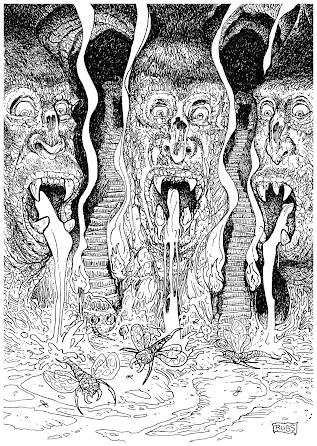
Russ Nicholson's representation of the chum spouts!


Or perhaps I start with the idea of one or two set-piece rooms like the ruined stage of the theater infested by white swine, which I think was the first idea I had about the Ruins of the Inquisitor’s theater. In each case this vision came to me because I had a strong concept that suggested them. If there’s going to be a ruined punishment theater, then of course there’s going to be a ruined stage. So that stage needs to be something special and big. Around these starting ideas thoughts begin to coalesce. 

This part is a little embarrassing to admit. But I know that things are going well at this stage if I fall in love with the idea of the place. There is something almost adolescent and melodramatic in this experience for me: I fall into reveries where my mind exults. This is, if I’m going to be frank, the main pleasure I get in prep—and it’s a substantial one. When combined with the pleasures of play it’s enough to keep me hooked on GMing ttrpgs.  


2. Draw a map


Since dungeons, certainly, and adventure locales in general, are usually spaces to be explored, for me the map is crucial. I like to draw the map with only the concept and a few rooms in mind. I try to make the map properly Jaquaysed, with multiple looping paths, changes of terrain, and so on. This creates interesting spatial relations between different locations, suggesting locales and tensions between factions, harder to access areas, etc. 
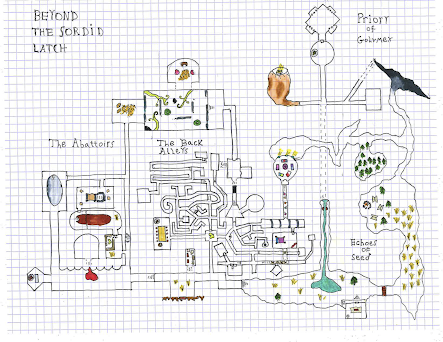
An unpublished level from the Abyssal Dungeon


Although I'm no artist, I try to make it look visually interesting. I end up drawing a lot of rooms that look kinda weird without knowing yet what exactly might be in them. Sometimes I draw some contents for the rooms, although since I key the map later, many things keyed aren’t represented on the map. There’s something about these handmade maps that really provides a scaffolding for my imagination. I often color them in using my children's art markers. 
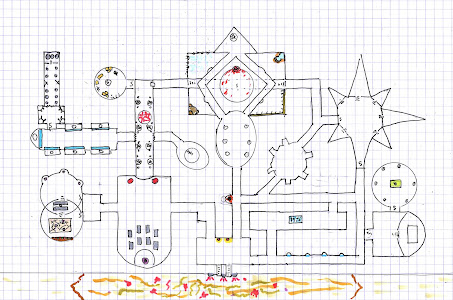
My original map for the Catacombs of the Fleischguild

If it’s a hexmap, I do much the same thing, but this time using Hex Kit. I own ALL the tilesets, so I have a huge array of visually arresting material to work with. Again aesthetic considerations dominate to some extent. Since Hex Kit is a digital tool and so easily altered, I find that this process involves a lot more revision as I go.  
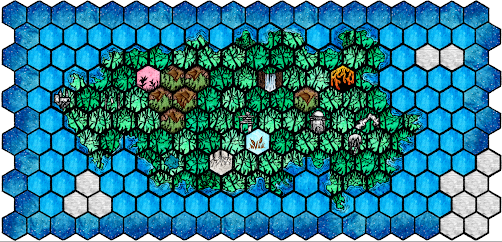

The Depths, Level 2 of the inverted White Jungle


3. Look at Visuals 


Often when I'm preparing to stock the map, or even before, I gather a trove of images. Frequently, I have some images in mind from the very beginning as part of the concept of the place. Indeed, my current (not yet public) project was born from a single illustration by Liz Danforth that captivated my imagination as an adolescent. Since I can’t quite talk about that yet, consider these images from Lotte Reiniger’s masterpiece The Adventures of Prince Achmed which I had in mind from when I started thinking about the Ruins of the Inquisitor’s Theater. These images were the source of the shadow puppets and the weaver of shadows in that dungeon. 
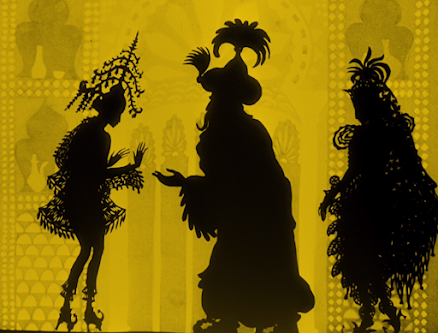


While Prince Achmed is a movie that I had seen previously, my main tools for this stage of the process have historically been searches of online repositories of images like Tumblr and Pinterest. Tumblr, which was fantastic and is now a bit of a ghost town, but it never had a good way to organize saved images. So I used the “like” button for years for this purpose, but it’s hard to search through images you liked. Pinterest even if a bit let brilliant, is easier to work with. Here you can create different boards. If you click on a pin you like, it will recommend similar pins. Over time you feed can become mildly interesting too. 
To get a sense of this, I have a tumblr which you can look at here. Here are my pinterest boards. Take a look at this one on bio-occultism that I started when I was working on the Submerged Spire of Sarpedon the Shaper (also very relevant to the Catacombs of the Fleischguild). It now has more than 2000 pinned images. For the stocking of interesting treasure, this Pinterest board titled "artifacts" has served me well. Ever wonder how I avoid basically ever giving gold pieces as treasure in my published adventures? Look no further than this Pinterest board. It’s all there, more than 1600 pins. Feel free to use it for all your treasure needs!
 

4. Draw on Memories of Place 


Besides past media, like novels and films, another resource I draw on sometimes to get the vibe or feel of a place right are captivating memories of different places I’ve been. I suppose the ultimate exercise in this well-spring of adventures rooted in place is Patrick Stuart’s Silent Titals that presents a fantasy version of the Wirral. Zedeck Siew has written about this as well in the context of A Thousand Thousand Islands. Most of the stuff where I’ve done this the most heavily have not yet been published. Since I was a city rat growing up exploring NYC, and then was got obsessed with the falling down, labyrinthine splendor of hilly Pittsburgh where I lived for the better part of a decade, a lot of this stuff finds its way into the city of my setting, Zyan Above. 
But I can give a modest example from my published work. The Catacombs of the Fleischguild is infused with the eerie vibes of visiting the Museum of Natural History with my father as child. The strange stillness of those dioramas behind glass. The cool air and quietness. The weird greenish, dim lighting. The hall of totem poles. Artifacts of unknown religious significance displayed on velvet cloths. The datedness of the place, as though it had come out of another time. The colonialism that infused it all without context.


5. Key in preparation for play


So far, everything I've described is fun. But I find the initial keying of a dungeon and the initial creation of random encounters to accompany the key just awful. I can usually only do it under the yoke of necessity, desperately as the players approach. I run out of imaginative steam very quickly. 
Usually I can do 4 or 5 new keyed rooms maybe per session, which is often just enough to stay ahead of the players. I write up full room descriptions. Here’s what I do. I try to mention only salient, observable things, in the first paragraph. I think of this as putting things on the menu that then players can follow up by asking questions or observing the things more closely. So I keep the descriptions very brief in that first paragraph, only naming the thing, or perhaps mentioning what would first strike you looking at the thing. I save additional information for later paragraphs, following the same order of presentation in the initial paragraph. If I mention the book case first in the opening paragraph, then I discuss the bookcase first in the second paragraph.
This structure works for my brain at the table. I can scan the first paragraph easily and describe the room to my players. I can then look down to remind myself what comes next when they follow up on things. Here’s a dirty secret: I often literally use the first paragraph as read aloud text to my players. Yes, I sometimes employ the much hated read aloud text. I think it works in my game because the descriptions in that first paragraph are very short and to the point. I try to make them evocative, employing turns of phrase and adjectives that paint a vivid picture where I can, but I keep them very brief. For the great majority of rooms that I don’t manage to fully key for a session, I just maybe just jot down a few words or a sentence for those that are near enough to where the players are exploring that they might come up in play.
When I’m stuck keying, which I very often am, I find it helpful to go for a run. It doesn’t work on an exercise machine, which is monotonous suffering that makes thinking impossible. Something about running a route I know well draws me inward and allows my mind to turn creatively. It’s almost the only thing that I can consciously do to “force” the issue. I actually do a lot of philosophy when running too, so it works for me for anything that requires creative thought.
My encounter table is similarly created in fits and starts. It begins with 4 pitiful entries. Maybe the second session it bumps up to 5. Finally four sessions in I get it up to a semi-respectable 6 so that I can finally use a six-sided die. 
I find this whole process quite stressful. Although I love playing, I hate the prep for playing at this point, because it always feels like I'm running something half-baked and I so often come up imaginatively empty. It’s primarily this stress, when combined with a couple of sub-par sessions that leave a bad taste in the mouth, that have caused me to back away from GMing in those periods where I felt that I needed to take a break. 
So prep is a double-edged sword.


6. Run it again 


At the end of that process, I usually have a dungeon that's about 2/3 written up. Now that I have a rough draft of the key for most of the dungeon, I often run it again for a different group. (I've had 3 dreamlands campaigns, two of which are currently running.) At this point the prep is more leisurely. Each session I "finish" 3-4 rooms that are unfinished or polish something else up, or expand the encounter table by a couple of entries. Since I can just run it without doing much work, this second time through is relaxing and basically stress free. Prep here is fun again, since I can fill in keys at my leisure and expand on things when as suits my fancy. I also know the dungeon very well and have it at my imaginative fingertips. This is part of the reason that I run my stuff more than once: I get the fun without the stress. 

7. Rewrite it for Publication


After some time has passed since the second run, I ask myself what would be required to make the adventure location publishable. The main goal of this process is to dial up what's neat about the adventure location up to 11. In other words, I try to lean in to the concept of the location and what is unique about the adventure. I take the opportunity to remove the things that don’t fit with the theme. I also replace the the bits that sagged in play with something more exciting that better fits the concept, and to fix any problems. Often unique mechanics that would support this concept in play occur to me at this point. I also take the opportunity to pep everything up a bit, swapping whatever small bits is mundane with something evocative. There are many little flourishes and new ideas that work their way in here. This part is fun too.  
When I start commissioning art, or when Gus does his wonderful maps for me, there's also some real creative synergy that emerges. It was Gus' map of the Sewer River that inspired me to really do up the sewer river properly for Issue 3. Sending me that map was throwing down a creative gauntlet. Similarly, Huargo's art has led me to subtly shift course a number of times. 


8. Playtest the finished product 


Ideally, I playtest it again at this point for a 3rd group. If I were a real professional, I would have other people playtest it for me, since that’s obviously the best practice: seeing how well it runs at other people’s tables. But I’ve never done that. Chalk that up to my being a DIY solo author. 

That, in a nutshell is my process. What's your process? Does it resemble any of this? How does it differ? Drop it in the comments!