Showing posts with label Rules. Show all posts

Sunday, April 3, 2022

Ages of Life

I'm now middle-age. I've developed an interest in ways of folding this experience into gaming. In particular, I've become interested in the starting age of player characters, less the aging process over the long term and more what it means to pick up and play a character of different ages, although I would be very interested to see serious attempts to bring that into gaming. 

Here are some features of aging from my own experience that seem possibly relevant to starting characters. I don't want to suggest these are universal, but they're certainly some aspects of how aging feels to me. 

  • I know more than I did when I was young, having acquired greater skills, both in terms of breadth and depth. I've even learned from some of my mistakes. 
  • I have developed deep relationships that take time to develop, including parenting children and building a marriage and some very long lasting friendships, although I've lost many more friendships to drift and family relationships too over the years in some cases to death. 
  • Although I'm lucky to be about as healthy overall as I was when I am young,  my body is subject to constant injuries and indignities that remind me I can't handle what I used to. I'm very aware that pushing it physically might injure me. Even when I'm doing something rugged, I feel fragile. 
  • Mortality is on the brain. I can survey all too clearly the delimited vista of the finite time remaining to me. For this reason, I am forced to accept that there are a lot of things I'm just not going to get to do in this life. 
  • This is part of the reason that I no longer have a shapeless and endless hunger to learn and experience new things. I know I have to pick and choose. 
  • I have a vivid sense of how hard it would be to pick up and start something altogether new this late in life, especially a career. I have always felt profound admiration for people who do this late in life, but now I can vividly imagine what that would take, especially when it would involve starting something new alongside those who are young, as beginning a new career at the bottom inevitably would. "I'm too old for this sh**," is a sentiment I get.  

I'm sure there's a lot more I could say that could be relevant to gaming, for example about intergenerational relationships, understanding better where my elders were coming from than I could when I was young, and a lot of other things. But this will do for now.

With this stuff in mind, let's look at the way a few old school or OSR systems handle the starting age of player characters. 


Advanced Dungeons & Dragons 1E


In AD&D 1E there are five age categories (DMG pp. 12-13): young adult (15-20), mature (20-40), middle-aged (40-60), old (61-90), and venerable (91-120). Starting age is determined randomly at character generation based on your class, which give you a base starting age a die roll on top of that. For example, a fighter is 15 + 1d4 years old, whereas a magic-user is 24 + 2d8 years old. 

Given the starting ages and ranges specified, if you're a fighter or a thief it's fixed that you'll be a young adult, close to maturity. If you're a cleric, monk, or ranger you will be mature. And if you are a magic user you will be mature, possibly within striking distance of being middle-aged. In this system, the effect of the age categories is solely to modify your stats, like so. 

Young Adult: -1 Wisdom, +1 Constitution
Mature: +1 Constitution, +1 Strength
Middle-aged: +1 Wisdom, +1 intelligence
Old: -2 Strength, -2 Constitution, -1 Dexterity, +2 Wisdom, +1 Intelligence
Venerable: -3 Strength, -3 Constitution, -2 Dexterity, +3 Wisdom, +2 Intelligence

Why do different classes start at different set ages? I assume because we assume people start "training" for their class in childhood. It takes longer to learn to be a wizard, but not very long to learn to be a fighter or thief. By this logic, if your fighter or thief were older, they would be higher than 1st level. 

I find these choices unnecessarily confining. They bake some boring choices about worldbuilding into character generation. Why assume that everyone is training from youth? Can't an adult like Bilbo become a robber when some dwarves unexpectedly knock on his door? Can't someone pick up arms later in life after having done something else? And why assume that "wizard training" takes decades? Can't someone start as a young apprentice magician, like Ged? Or as a young monk? 

Furthermore, the effect of belonging to an age category is solely an effect on base ability scores. There's some truth to this, insofar as my constitution is not what it once was, and perhaps I'm a little wiser than I used to be. But there's an awful lot it leaves out. This system is not about the life the character has already built as someone mature before they begin adventuring, with their acquired relationship, resources, and skills. Nor is it about the advantages of youth, the hunger for new experiences, boundless vitality. Nor are the penalties for aging about one's relation to mortality, or about the difficulty of starting something new, or about what one has lost and left behind at that age, and so on.

Given the  effects of belonging to an age category, we can't just fix the prior problem by allowing players to choose their character's starting age, because all that will do mechanically speaking is encourage min/maxing. Since the only effect is on stats, fighters will choose maturity, and magic users and clerics middle or even old age. The effects of age just aren't very interesting, with optimum trade-offs for each class based on their favored ability score.  

Although these rules were published when Gary Gygax was 41 years old, they don't really strike me as the kinds of rules someone who had personal experience of aging would write. Or at the very least they seem close to the least interesting possible translation of that experience into game terms. 


Traveller


In Traveller, the starting age of your character is determined entirely by the clever career mini-game that's involved in character generation. In the system presented in Book 1, everyone is basically ex-military. At the start of the process your character is age 18 and has no skills. (Your stats are determined by 2d6 down the line.) The character generation minigame follows you career through the service until you "muster out". 

You enlist or are drafted into one of the branches of the military for 4 year terms, with a roll to determine if you have the chance to re-enlist at the end of each term. So the minimum starting age for a character is 22 if they are unlucky enough to fail to re-enlist even once. Each 4 year term you serve comes with at least one new skill (often multiple skill) and possible chances to be promoted, which brings additional skills and benefits when you muster out at the end of your service. But each 4 year term also comes with a non-negligible chance of being killed, with a greater probability in the more dangerous branches of service. 

If you manage to re-enlist three times, getting yourself to starting age 34, you check to see whether various stats decrease. For each term you re-enlist you check for further decline of stats, meaning that as you manage to survive and climb through a successful military career into the 4th, 5th, 6th, or even 7th term (very rare), your stats are likely declining along the way. On a 2d6 system, each point lost is significant!  

When you muster out or retire you get benefits based on how many terms you served, and what your rank is at the time you leave. You might leave with a large load of cash, or free passage on a starship, or with a fat pension that pays out annually, or if you enlisted as a merchant, even a ship of your very own. The importance of the skills gained through winning at these gambles and so aging is amplified by the fact that Traveler has no real character advancement mechanic. So the skills one has at the start of the game are very likely the skills one has throughout the campaign. As a result, being older is MUCH better than being younger, although it may come with some decline in stats.

The end effect of all of this is that aging represents successful advancement along a career trajectory that involves training and access to more resources. It is a pure positive up until 30. To age is to have increasing skills, respect, and financial resources. Past 30 one faces trade-offs with randomized stat loss, but the effects are likely still quite positive.The mini-game aspect means that one is invited to gamble, pushing length of service against the possibility of being killed in service, which nicely represents the hazards of a lengthy term of service in certain branches of the military, or against losing stats if you manage to re-enlist a whole bunch of times. 

Mortality figures in this system, but only in terms of death in character generation. Physical decline is rolled into the gambling aspect of the system in pleasing ways. But the primary driver is the idea of how important it is to have had a successful military career before you start adventuring. Although Traveller does not have levels or experience points, to be an older starting character in Traveller is essentially to start as what would be in other systems a higher level character in a system without any real possibility of further advancement. All the leveling happens in the game happens before you get to the table.

I like the Traveller system a lot. But for one thing it's focused on an ex-military style game, and works less well outside of that context. And for another, it represents aging in a way that is relentlessly positive. If you've managed to live this long, then you're likely to be that much more formidable. Because what you used to do is super relevant to the new career you're embarking on, the skills translate seamlessly. Think how different the system would be if the four year terms represented stages in your career in a secretarial pool, moving up a corporate ladder, or as a teamster. 


Beyond the Wall


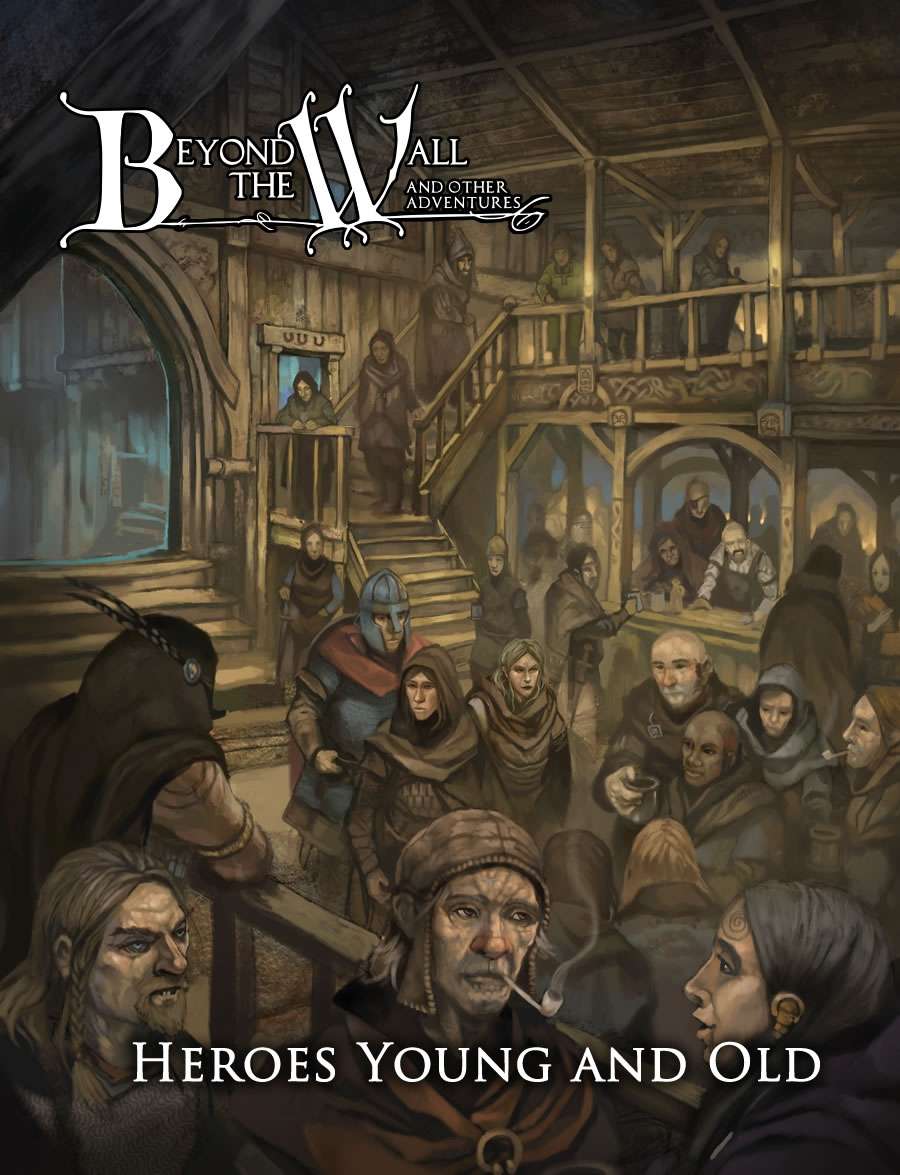
Beyond the wall is interesting on age (actually, on almost everything). Since it takes its flavor from coming of age fantasy books like The Chronicles of Prydain, or The Wizard of Earthsea, the default assumption is that the player characters are youths who are just coming to adulthood. However, Beyond the Wall: Heroes Young and Old introduces the possibility of playing an older character. 

Beyond the Wall, like Traveller, uses a lifepath character generation minigame. Unlike Traveller, the lifepath in Beyond the Wall includes collaborative setting creation. Character generation begins by picking a class. You then select a playbook, which tells you what background you have. So, for example, if you are a fighter, you might pick between the "village hero" or "would be knight". This playbook assigns you starting stats (e.g. the village hero has 10 on strength and constitution and 8 on everything else). It then comes bundled with a set of tables that tell you about experiences you've had, and what you've gained (or lost) from them. Some of these tables are shared across playbooks representing facts about childhood, and some are playbook specific. As you roll on these tables your stats will go up and you will also acquire various skills. 

The tables also serve to introduce NPCs who are meaningful to you, and give you the chance to contribute facts about the starting village for the campaign. Importantly, they also involve a mechanic whereby the player character to your right shared certain experiences with you that affect both of you. So your final stats and skills from a record of experiences that get weaved together with locations, NPCs, and facts about the setting that you develop together through character generation. It also explains how the party members are tied to one another through shared coming of age experiences.

Instead of quantifying age numerically, Heroes Young and Old folds age into class selection by introducing a separate elder playbook for each class. The assumption seems to be that there will be at most one elder in the group. The elder begins at 2nd level. They share the same common tables with the youths, but their playbook-specific tables introduce novel materials. One table represents an adult relation to another person in the village, subtly different than the the playbooks of youths. Another discusses the characters previous adventures, or past military experience, or mastery of sorcery that brought them to 2nd level. The final one explains how the player to their right became their pupil. So these tables introduce an intergenerational connection, and it assumes that your elder character is a mentor to one of the other player characters, and likely by extension to the group as a whole.

Given the coming of age focus of the game, Beyond the Wall: Heroes Young and Old introduces a subtle and interesting use of age as a mechanic. It represents the aged as more experienced and skilled than the young, and it gives both the character and the group a subtly different relation to the world of adults. It also ties the party together with intergenerational bonds, by representing the older character as a mentor to one of the younger characters. To balance all this out, it gives them character slightly lower stats over all, perhaps in some way to represent what they've lost along the way, or perhaps merely for the sake of game balance. 


Observations


One assumption that Traveller and Beyond the Wall share is that characters who are older have already had experience adventuring. This is implicit in the AD&D rules as well insofar as the assumption is that you've been training since childhood, and your starting age is determined by class on the basis of how long that training took. If you could start older in AD&D, you would logically start the game further down the same path, i.e. at a higher level. 

Note that things go in a very different, and potentially more interesting, direction if we assume that all starting characters are 1st level characters with 0 experience, but we nonetheless allow them to be different starting ages. In that case, you can start the game as a middle-aged apprentice wizard, or as an aged spinster newly turned to thievery. This of course raises the question what these older characters were doing before they started adventuring.

One thing that Traveller and Beyond the Wall do well is give play to the idea that an older character brings with them the experience, relationships, and knowledge they gained throughout life. I like that and want to hold onto that. But if we ditch the assumption that this takes the form of a previous adventuring (or a military) career,  what you bring to the table will have to be something different than what you get through increasing experience in your new class. In terms of downsides, perhaps we could capture the feeling, or anxiety involved in feeling too old to start afresh, especially among younger people. 

One thing that all three systems fail to do pretty much anything with is the sense of physical frailty and mortality that comes with aging. The closest they come is simply decrease starting attributes. This just sort of makes your character worse. It doesn't bring home mortality or vulnerability in any very strong way. Traveller does, of course, have the wager against death in service, but that's a vulnerability that exists only during character generation, i.e. offstage. Is there some more interesting way we could bring the sense of mortality and physical vulnerability into play?

A New System for Ages of Life


When you generate your character, select one of three ages of life: youth, adult, or aging. Each has benefits and drawbacks. 

These mechanics use a new saving throw against death that I took this saving throw from Gus L's HMS Apollyon Player's Guide. The way it works is this. When a character falls to 0 hit points or below, they roll a save against death by rolling 1d20 trying to hit the target number specified by their save. If they make it (roll equal or higher to the target number) they return to 1 hit point immediately and may continue acting, but their save permanently goes up by 1 point, becoming harder to make each time. If they fail, their character dies. (As an aside, this mechanic introduces a wonderful sense of drama at the table. Everything stops for that single roll, with all eyes riveted to the d20 clattering across the table. It's the most high-stakes roll anyone could make.)  

The system also uses a bonus to experience points. It is intended to replace rather than complement the "prime requisite" mechanic from older editions of D&D. (Additional XP for high stats is boring, especially where high stats already bring substantial other benefits.) 

Finally, the system refers to skills. I actually find it works best in games that don't have a skill system or have very freeform systems. However you resolve such matters, it's important that you treat the skill seriously. The starting skills possessed are a whole range of things connected to a line of work that represent serious knowledge about that subject matter derived from training and long experience. 

Youth 


You have the vitality and hunger for experience of youth. You are adaptable and learn quickly like a sponge. But you have not done much in life yet. What you know is mainly what skills your class provides you.
  • Death Save: 8
  • + 10% on all experience points gained

Adult


You had a trade before becoming an adventurer. The skills from your past life may come in handy from time to time.

  • Death Save: 10
  • Choose a former profession. You are skilled in all matters pertaining to that profession. Begin with the tools of your trade, whatever those might be. These can be substantial and valuable. A trainer of horses might have a horse, a jeweler might have jewel cutting tools and small bag of cut gems, a midwife might carry tinctures, herbs, and other medicinal remedies. 

Aging


You had another life before becoming an adventurer. It’s hard to teach an old dog new tricks, but you bring more to the table than your younger comrades.

  • Death Save: 12
  • -10% on all experience points gained
  • Choose a former profession. You are skilled in all matters pertaining to that profession. Begin with the tools of your trade, whatever those might be. These can be substantial and valuable.  
  • Begin with one loyal companion. This companion could be an animal, like a hunting dog, trained monkey, or horse; or a a human companion: a fastidious butler, bodyguard, thug, or sub-apprentice. If they are an animal, they are attuned to your reactions and cleverly trained to follow simple instructions the way a remarkable dog or horse might be so trained. If they are a human they may be the equivalent of a skilled hireling. Either way, this companion is utterly loyal and need not make morale checks. Describe the nature of your character's bond with this companion. If they are human are they your son or daughter? Or a very old friend? Someone who was in your service in the older profession?  

I have now playtested this system a bit. In play, it allows players to trade off flavor and backstory for the character against the straightforward mechanical benefits of youth, and also allows you to build some "character concept" even in systems that work with very basic class selections. It also induces a vivid sense of mortality, since the number for the death save looms so large at the table. 

Of 6 PCs to date, we had one wonderful aged character, a fighter named Jonah who had been a sea preacher in a former life. His loyal companion was a seagull. We have also had several adults, including one cleric of Mother Winter who had been a midwife in her previous career. Her skills in herbalism and medicinal remedies frequently came in handy. It's been a lot of fun, especially since I'm playing at the table with folks who themselves range from adults to aged. 

Have you seen starting age handled in interesting ways in other RPGs? How about the aging process during play? What other good materials are out there for thinking about how to meaningful incorporate this basic dimension of human experience into our games? Drop it in the comments.

Sunday, November 7, 2021

House Rules for New Face to Face Elspeth's Letter Campaign


I'm starting up a new face to face campaign with a co-worker and some people from the neighborhood. I'm using (play testing) Elspeth's Letter, a stretch goal in the form of an alternative campaign premise from my last Kickstarter. It is going to be released soon in expanded form with full art as the inaugural issue of my new zine Pale Echoes that presents alternate frames in the waking world for dreamlands campaigns. The basic idea is that one of the players is the godchild of Elspeth. They receive an inheritance of Elspeth's house, which includes a ticket to the dreamlands by using the memories of a dead dreamer (Elspeth). 

These rules are close to Swords & Wizardry in some way, but really they're an amalgam of three things: Gus' HMS Apollyon Rules for stat modifiers and the death save, Errant for inventory, Jorune: Evolutions my evolving Jorune hack for the general 2d6 mechanic, and White Box for the idea of white spaces.

Generally speaking, my idea here is that I control the setting and world of the dreamlands. Players do not have any input on that. That is my domain--and I am relying on an asymmetry of knowledge. (Indeed no one in this group has ever read my zines or blog!) But about the dreary waking world, my stance is that I know little beyond some barebones elements I'm contributing about a town near Elspeth's house. If I knew these players better I might even suggest a session 0 where we designed the waking world together. Instead I'm choosing to use "white spaces" (a concept from White Hack) during character creation that allow the players to contribute elements of the setting for the waking world. 

To be clear, I threw these rules together hastily. They represent a compromise between keeping things familiar enough for players who have played recent versions of D&D and my own predilections. They are just a set of house rules for what is likely a temporary return to face to face gaming. They aren't like my work on Jorune: Evolutions, where I'm trying to come up with a system that works from the ground up to do what I want it to do.


Stats


Roll 3d6 down the line. Swap one roll if you want to. 

Strength: How physically powerful you are
Wisdom: Attunement to spiritual things (NOT how "wise your choices are")
Intelligence: Facility with book learning (NOT how "smart you are")
Dexterity: How agile or dexterous you are
Constitution: How hardy you are
Charisma: Your leadership ability (NOT how "persuasive your in speech in game is")

The crucial point of the NOTs is that you are not to play your stats, and in particular, you are not to try to use them as a basis to make bad decisions or play suboptimally in the game. 

In the spot for bonuses and penalties next to the state:
If you rolled 6 or less write -1 next to that stat
If you rolled 15 or more write +1 next to that stat

For each +1 or -1 you have on a stat give your character an adjective. So if you rolled 5 on dexterity, you might be lumbering or butterfingered. If you roll 15 on charisma you might have gravitas. This is solely for flavor. 


Races


Most versions of D&D have various races you can play. In this game, all the player characters are human. There are no other “races” to play in the waking world. Other kinds of playable beings may or may not be unlocked as a result of your adventures in Wishery.

Classes


Fighter: Violence is your specialty. Choose your flavor of fighter--this will affect your class-related skills. Perhaps you are a mercenary, knight, soldier, swashbuckler, pirate, etc. HD 1d8 Damage with weapon: 1d10. Armor allowed: any.

Magic-User: You are a master of the occult. You can cast powerful enchantments but are not much use when it comes to the arts of war. Perhaps you are a diabolist, enchanter, witch, gentleman scholar, etc. HD 1d4. Damage with weapon: 1d4. Armor allowed: none.

Cleric: You are blessed by a god or divinity and may perform miracles. You also possess some fighting ability. Perhaps are a monk, divine, savant, miracle worker, preacher, paladin, etc. HD 1d6. Damage with weapon: 1d6. Armor allowed: any.

Thief: You possess a rare set of skills, such as stealth, sleight of hand, and lock picking. You strike from the shadows. Perhaps you are a con-man, assassin, spy, specialist, etc. HD 1d6. Damage with weapon: 1d8. Armor allowed: light. 


Age of Life


Pick an age of life. One player, Elspeth’s godchild and heir, must be a youth. All others may choose an age of life as they prefer. Write this age category down in the line for age on your character sheet


Youth: You have the vitality and hunger for experience of youth. You are adaptable and learn quickly like a sponge.

  • Saving Throw 8
  • + 10% on all experience points gained

Adult: You had a trade before becoming an adventurer. Your skills my come in handy.

  • Saving Throw 10
  • Choose a former profession. Add +1 to any roll that falls within that skill set. Begin with the tools of your trade.

Aging: You had another life before becoming an adventurer. It’s hard to teach an old dog new tricks, but you bring more to the table than your younger comrades.

  • Saving Throw 12
  • -10% on all experience points gained
  • Choose a former profession. Add +1 to any skill or ability roll that falls within the skill set of that profession. Begin with the tools of your trade.
  • Begin with one loyal companion. It could be a hunting dog, trained monkey, horse, fastidious butler, bodyguard, thug, or apprentice.

Saving Throw


You have only one saving throw the value of which is set by your age of life. It works like this: If your hit points reach zero or lower, roll a saving throw on 1d20. If you roll equal to or higher than your saving throw, your character is saved, return to 1hp. Whenever you make a saving throw, increase your saving throw number by 1.

Stat or Skill Checks


To make a stat or skill check roll 2d6 and add your modifier. 

Normal: 6- failure 7+ success 
Challenging: 6- failure 7-9 partial success 10+ success
Difficult: 9- failure 10+ success

We use a freeform skill system. For skills that your character isn't trained in make a roll with a -1. (Highly specialized skills cannot be used if untrained.) If are trained in a skill roll without modifier. If you are skilled add +1 and if you are a master add +2. Unless you are a thief, your starting skills are limited to those fitting your class and former profession. For class specific skills treat the modifiers this way: Levels 1-4 trained, Levels 5-8 skilled, Levels 9+ master. Use your description of your class to specify your skills. Any skills that fall under former professions are at the trained level. 

What would normally be saving throws in old editions of D&D are instead difficult or challenging stat checks. So a saving throw against dragon breath would require a dexterity check at difficult level to take half damage. If it was a young dragon, or I was being a softie, perhaps it would be challenging dexterity check with full damage on a failure, half damage on a partial success, and no damage on a full success. 

Most downtime actions use a 2d6 mechanic modified by a stat bonus. They are, in effect, often (although not always) stat checks.

Note 1: You can learn and improve skills through my system of downtime activities.

Note 2: This is a bit simpler than the challenge rating I use in Jorune: Evolutions, which involves two different categories of rolls and a difficulty modifier. I want to see if this simpler system works. On the whole I prefer the rules to be simpler where possible. 

Former Professions


If adult or aging choose a former profession, from this list or anything you can think of. The setting in the waking world is a dreary faux Europeanish setting that spans anachronistically medieval Europe to the renaissance and beyond, with a sprinkling of magic, divinity, and the occult. So, any profession that could fit with that very broad vibe will be admissible. Write down your former profession on your character sheet.

Some will want to use this choice mainly to add flavor to their character. But it can also be used to add some skills that wouldn’t normally come with your class. For example, want to be a bard? Be a troubadour turned fighter, thief, or cleric, depending on what bard aspect you want to emphasize. If a cleric, since you can settle the details of your faith too, make it a god of song and you magic can all come through performance! Or if you want to be a ranger, choose a fighter with a past career of woodsman. Want to play a spellsword? Be a magic-user with a former profession of duelist. The tools of your trade and how the skills might work can be decided together at the table. 

Alchemist/Herbalist
Astrologer/Fortune Teller
Baker/Cook
Barber/Surgeon
Beggar/Mendicant
Blacksmith/Ferrier/Locksmith
Burglar/Cutpurse/Smugglar
Butcher/Tanner
Carpenter/Wheelwright/Cooper
Charlatan/Snake Oil Salesman
Explorer/Scout/Mapmaker
Duelist/Rake
Peasant (i.e. farmer)
Sailor/Fisherman/Pirate
Gambler/Card Sharp
Grave Digger/Ditch Digger/Stevedore
Haberdasher/Tailor/Seamstress
Hunter/Trapper/Furrier/Woodsman
Lawyer/Clerk/Scribe
Locksmith
Midwife/Masseur
Miner/Mason
Minstrel/Thespian/Troubadour
Scholar/Natural Philosopher/Historian
Orator
Painter/Sculptor/Poet
Preacher/Priest
Hermit/Monk/Cultist/Cantor
Rat Catcher/Poisoner
Servant/Butler/Maid
Shepherd/Swineheard
Soldier/Mercenary/Archer/Guard
Squire/Apprentice/Indentured Servant

Determine How You Know One Another


In this game, you are a group of comrades who have come together around Elspeth’s godchild to pursue adventure and who work as a team. Everyone must have a tie to one other person in the group. What is it? We should probably wait to decide this together at the table.

Blood relative
Childhood Friend
(Former) Lover
Mentor/Mentee
Thrown together by circumstance
Shared trauma
Business partners
Coworkers
Coreligionists
Met in a jail cell
Fought together in war
Common political cause/common enemy
Etc

The Death of Elspeth's Godchild


I probably don't even need to say this on this blog, but I will mention that Elspeth's Godchild does not have plot armor on this premise. If they die, then the player of the godchild designates another PC as the heir and they are now the inheritor of Elspeth's estate. If there is a total party kill, the estate has passed to an heir in the new group that is rolled up. (The player who dies may also opt to collectivize the estate to the group, if they do so then the group must pick a legal name for their adventuring party.)

Thieves


Whatever the description of their class, all thieves possess the following skills. Every time you advance a level assign an additional +1 to two of these skills. Every time you acquire a level you will add two more +1’s. Unlike other skills (including other skills from your class description), the maximum plus you can have to any one thief skill listed below is +3 rather than +2.


Stealth
Climb Walls
Pick Pockets
Pick Locks
Find/Remove Traps
Hear Noise
Read Languages

Clerics


Choose Your Deity: This is the mystical source of your power, usually a god or religious principle of some kind. I do not have a pantheon for the dreary waking world, so you may imagine any deity or mystical power you like. Here are some very generic types of deities if you would like a list:


Hearth
Harvest
Fertility
War
Death
Fortune
Reason
Balance
Art or Craft
Toil
Light
Darkness
Trickster
Wisdom
Justice
Heavens
Undeworld
Famine
Wind
Flame
Winter
Summer
Spring
Autumn
Nature
Beasts
Immortality
Murder
Vengeance
Charity

Name your deity. Answer the following questions (more will come up over time in play). What does your holy symbol look like? What do miracles granted by your deity (spells) look like in action? Think of one rite, sacrament, or holiday associated with your deity.

Magic-Users


If you are a magic-user, select three spells contained in your starting spell book from the Old School Essentials List: two first, and one second level spell. Of first level spells you may book may contain only one of the following (objectively best spells): light, sleep, and charm person. I do not have a view about how the dismal magic of the waking world works. Think of your spell book as a way to contribute to this aspect of the setting.  The spell book is not a little black book that you write your own spells in it. It is a significant magical text that is known in the game world. Name and describe the spell book that contains them. It has a title and appearance, and embeds the spells in some broader subject, speculation, art object, or discourse. Also decide what the spells you have selected look like in action. To acquire new spells you will need to research them in downtime or to learn them from spell books you acquire.

Equipment


We are using a slot-based inventory, which is influenced by Ava Islam's Errant.


In hands: Two slots
Handy: Four slots
In pack: Six slots

Anything that is in hand or handy can be used without spending an action. Anything in your pack you must take an action to get out. You can fill a slot with a bundle of four small items of the same or related things. (I.e. quill + bottle of ink, 4 flasks of oil, etc.) Jewelry, clothing, and knick knacks do not fill up a slot. A slot can also hold 100 coins.

You get the following items based on your class. If you have a former profession, also write down the tools of your previous trade.

Fighter: Chain Armor (AC 15), melee weapon, and either shield (+1 to AC) or missile weapon
Thief: Leather Armor (AC 12), melee weapon, missile weapon, thieves’ tools
Cleric: Chain Armor (AC 15), melee weapon, holy symbol
Magic-User: Spellbook and either melee or missile weapon

A note about weapons and armor. Rather than using different damage for different weapons, and only allowing some classes to use certain (more damaging weapons), we’re going to use weapon damage by class. So, you can imagine the weapons you use to be just about anything. We are using ascending armor class so higher is better as in 5E, with the normal 1d20 + attack bonus roll to hit a target number set by the armor class.

Fighter: Weapon damage 1d10; Armor allowed: any
Thief: Weapon damage 1d8; Armor allowed: leather
Cleric: Weapon damage 1d6; Armor allowed: any
Magic-User: Weapon damage 1d4 Armor allowed: none

In addition, pick one starter pack:

Scholar: Pack, scroll-case with 3 rolls parchment, ink, quill, charcoal, small mirror, candle in holder, matches
Explorer: Pack, Lantern, 2 flasks oil, matches, rope 50’, caltrops
Specialist: Pack, 3 torches, matches, rope 50’, mallet, 5 metal spikes


Experience Points and Advancement


We will be using the experience tables listed in Old School Essentials. You will receive experience points for the following things.

• Each character will receive 200 experience points for your first session in a new place of adventure in Wishery. (There will be experience points awarded for other exploration related goals to be introduced later when the opportunities are uncovered.)
• Each character will each receive 600 experience points for accompanying Elspeth’s barge on its funeral procession. You will receive these experience points only if the barge completes the procession and goes over the falls intact.
• Your party will receive 1 experience point for each gold piece worth of treasure you bring back from Wishery to the waking world. This be divided between the characters on the adventure. So if there are four players and you retrieve 600 gp worth of treasure, you will each receive 150 xp.
• These are the only things you get experience points for. Note that you get no experience points for combat. Violence is an important tool at your disposal, but it does not provide any reward in itself.

When you gain a level, you acquire one more HD of hit points. You may add a +1 bonus (or cancel a -1 penalty) to one of your stats at 4th, 7th, and 10th level. The maximum stat bonus is +2. 

Attack bonus progression works like this:
Fighter: +1 AB on even levels. Max +6.
Cleric and Thief: +1 AB on odd levels starting at 3rd level. Max +4.
Magic-User: +1 AB at 4th, 7th, an 10th. Max +3.  

Otherwise, except for thief skills mentioned above, you advance as per old school essentials. Note that advancement in other forms is also possible through the robust system of downtime activities that will you to acquire skills, craft splendid items, research magical spells, do non-magical research, build institutions, and the like. 

Sunday, August 8, 2021

Using Landmarks in Wilderness Travel


 I've been continuing work on my Jorune: Evolutions ruleset. Recently I've been working on wilderness exploration rules. One thing I've been thinking about, spurred on by some of Gus L's recent dungeon theory, is how different the role of "the map" is in wilderness exploration and dungeon or adventure site exploration. The size of the hexes means that the kind of navigation of a concrete space involved in dungeon crawling doesn't apply. There are some approaches to wilderness exploration that chase that level of concreteness by using "zoomed in" sub hexes that allow one to establish a more concrete topography, or that abandon hexes altogether, using a ruler to map movement across a fairly detailed map. Personally, this doesn't work for me for two reasons. 

The first is that it makes the construction of the map a daunting task. I now need to not only assign a type to the hex, and stock it with features, but construct sub-hexes with detailed topography and geography that allow me to locate those features in the hex. This basically ensures that I will never be able to prep a sizable map. 

But this is connected with a second issue about the point of navigating space. Why is the navigation of space interesting in a dungeon crawl? Having read Gus' reflections and run many years of location-based adventures in the retro-game style, I can think of three reasons. These don't apply to every location-based adventure in the mode of dungeon crawl, but I think the best feature all of them.

  1. Players engage in meaningful choice vis-a-vis navigation of the space as part of an economy of risk and rewards. They decide whether to push further at risk of random encounters, or whether to turn to the left towards the ominous clanking sounds, or whatever it might be. It sustains meaningful choices.
  2. Another way the navigation of space matters to dungeons is the way factions inhabit the space. We might think of this is the social dimension of space in the dungeon. Factions operate in different areas, which they often "hold", and they have interests in other areas, some of which opposing factions might hold, or which are otherwise inhospitable. This means the players enter into a current unstable equilibrium or conflict space that is intimately connected to the spatial layout of the location. People in one part of the space want things from other parts of the space, and the players can interact socially with this nexus of often opposed desires.  
  3. Another thing is that in a good dungeon, space is part of a puzzle to be solved. One figures out how to get from A to B optimally, for example, finding a quick way to lower levels, or learning how to directly access some place that could previously only be reached laboriously, or finding the way into some sub-level or hidden area. This is a satisfying achievement.
It's hard for me to imagine how trying to zoom in on a map of an appropriate size for extensive wilderness travel is a good way of capturing this. I'm not saying it's impossible, I'm just saying it would require some set of systems that it's hard for me to imagine. Even with "zoomed in" topography, you still probably never going to get to a place where players are making tactical choices about what route to take on each day of travel. 

But I think you can capture a decent amount of it if you lean in to the abstraction and "zoomed out" scale of wilderness travel. To get 1. you need to some regular way to represent risk and rewards trade-offs in wilderness exploration. In the dungeon this is provided in part by wandering monster checks, which happen at the level of the turn (or every 3 turns). It's important that it happens per unit of movement so that there's a tradeoff with exploring the map and hazarding encounters. In the wilderness you want something similar. 

So it's better if you don't have 1 check per day, but rather a mechanic that says: want to explore another hex? OK, roll the encounter die then. Similarly, it would be good to build in other choices that the parallel the dungeon like the choice whether to "search" for "hidden" features, i.e. explore the interior a hex in exchange for hazarding encounters. It's also good if you have mechanics for forced marching that require you tradeoff extra movement for acquiring exhaustion. 

Similarly, it's good if you have an encumbrance system that forces choices about what to carry, with rations and acquired loot being the obvious things about which you must make tradeoffs with adventuring gear. So you'll need rules for starvation and foraging too. It would be good to build in some choices about when you start looking to make camp, and probably about how good a camp you can get set up. 

Number (2), the social dimension, is easy. What we want is a hexmap as a social space of factions in opposition that want things from other places on the map. This is less a matter of rules and more about hex stocking. But we'll certainly want to use reaction rolls for wilderness encounters and have explicit rules about parlaying to make that option salient to players.

Number (3), about space as a puzzle to be solved is harder in a "zoomed out" wilderness map. What could it mean? Do we introduce a system of easy travel from some hexes to other hexes? Shortcuts built into the flow of the hexmap? That might work. But in this post I try something different instead, leveraging something unique to wilderness travel, namely mechanics about getting lost, to create an economy of known landmarks to navigate by. By creating archipelagos of landmarks to uncover in a sea of wilderness, the party can learn through exploration how to create routes from one destination to another and make tactical choices about movement. 

Instead of aesthetically pleasing maps that mix a medley of different terrain types, the system in this post works best for the exploration of discrete wilderness regions that is a single base type of terrain. Mirkwood Forest; The West Trinnu Jungle Lands; The Mermist Swamp. Hexes are differentiated not primarily by terrain type, but rather by landmarks that are treated as icons on the map. Furthermore, this is not a system for traveling across friendly lands or for one-shot journeys from point A to point B. It's written for play that begins and ends in a safe home base, from which multiple sallies into the perilous wilderness can be made, so that learning the terrain over time has major advantages for the group. It also will work best with a shared electronic map resources like Hexographer or Hex Kit that allows for easy placement and deletion of hexes, although you could certainly make it work with a few sheets of blank hexpaper too. 

A lot of the rules here are widely used. The innovation, I think, comes mainly in terms of the use of landmarks. But someone has probably already thought of something similar, so feel free to link below. Note that these rules presuppose 2d6 stat and skill checks, with a max positive modifier of +2 and max negative modifier of -1. 


Encumbrance

The gear you carry on a mission is a resource. Jorune: Evolutions uses a slot based encumbrance system that tracks how many significant items you are carrying. It is important that you list items on your character sheet in the order of accessibility, with lower numbers being more accessible than higher numbers.

Clothing, jewelry or knick-knacks, and your pack do not fill slots. Armor, on the other hand, does occupy slots: (Light 2 , medium 4, heavy 6). Small items of the same kind can be bundled in 4s. Each brace of ammunition counts as one slot. Large or bulky items occupy two (or more) slots.

  • 10 + Str Mod + Size Mod items or fewer: unencumbered
  • 11-15 + Str Mod + Siz Mod items: encumbered
  • 15-20 + Str Mod + Siz Mod items: heavily encumbered
Animal Encumbrance:

  • Thombo/Horse: 20 Slots Unencumbered/21-25 Slots Encumbered/26-30 Slots Heavily Encumbered. Carrying a Rider=10 Slots. 
  • Bochugon: 40 Slots Unencumbered/41-50 Slots Encumbered/51-60 Slots Heavily Encumbered. Carrying a rider=10 slots.

Encumbered: Reduce travel movement by 1 hex. -1 to physical stat checks, physical skills, and combat rolls. Make a stamina check after a day of travel. On a 6- acquire one level of exhaustion (§2.7)

Heavily Encumbered: Reduce travel movement by 2 hexes. -1 to physical stat checks, physical skills, and combat rolls. Test stamina at -1 after a day of travel and at the end of each combat in which the character participates. On a 6- acquire one level of exhaustion.

Travel Speeds


All travel is represented by movement across a hexmap representing a wilderness region to be explored. Travel speeds are measured in hexes. There is base travel speed depending on your method of travel. Note that everyone must employ a certain mode of transport to benefit from the higher travel speed. Travel speed is not variable by terrain type, since we assume a single base type of terrain. In regions where movement is easy, hex sizes are assumed to be larger (3 miles). In regions that are harder to move through, hex sizes are assumed to be smaller (1 or 2 miles depending on how hard the terrain is). 

Base Land Travel Speeds:

  • On Foot: 5 Hexes
  • Bochugon: 5 Hexes
  • Thombo:  6 Hexes
  • Horse: 7 Hexes
  • Encumbered: -1 Hex
  • Heavily Encumbered: -2 Hexes


When the party has exhausted its movement on foot, the party may choose to continue pushing further. For each hex the party moves into, each character must test stamina or acquire one level of exhaustion. When mounted, the mounts make the check instead of the humans. For each exhaustion check after the first, roll a wound check for the mount to see if it dies.


Exhaustion


It is possible to face exhaustion when encumbered, starving, engaging in forced marching, or hard labor. In such circumstances, test stamina. On a 6- you acquire a level of exhaustion. Each level of exhaustion fills 5 equipment slots. When the character surpasses extremely encumbered, their character can go no further without rest.

To recover a level of exhaustion, you must camp and have access to whatever can address your condition (sleep, food, etc.). Upon wakening test stamina. On a 7+ remove a level of exhaustion. Some forms of exhaustion, including exhaustion from wounds, cannot be recovered through camping.

Travel Roll


Upon entering a hex, one player makes a travel roll (1d6). The travel roll is a version of Necropraxis' Hazard System. It is heavily influenced by Ava Islam's reworking of the overloaded encounter die for Errant. 

  1. Encounter
  2. Sign
  3. Mishap
  4. Flora or Fauna
  5. Local
  6. Discovery
More on the travel roll in another post. For now, it's enough to know that each of these results will have their own table. We all know about encounters. Signs are traces that foreshadow an encounter. If an encounter or sign is rolled in the next hex, then there is an encounter with whatever left the signs discovered in the previous hex. Mishaps are little travel difficulties that accumulate if multiple mishaps are rolled. Flora and fauna are animal encounters or the discovery of limilates or other interesting plants. Local is some region specific event or phenomenon. Discovery means stumbling across some notable feature of the hex. 

Hex Features and Landmarks


Most hexes will have 2-3 features that are like the layers of an onion, representing the more and the less obvious notable features in a hex. (I'm influenced here by Hot Springs Island.) These features can be landmarks, resources, anomalies in UVG's sense, adventuring locations, and so on. Landmarks are the anchors of exploration. They generally represent easily identifiable terrain features that allow one to locate oneself clearly on the map. In easily navigable terrain, all hexes will have a landmark in them. In more difficult terrain, like trackless wastes or dense jungle, perhaps every third or fourth hex will have a landmark in it. 

Features are always discovered in a fixed order from most to least obvious. This means that in traveling across already encountered hexes, one will sometimes stumble upon something previously undiscovered. If there is no feature left to discover in a hex, then when a discovery is made, the Sholari announces that the hex is fully explored and this is noted on the map.

Note that not all keyed features of a hex are landmarks. This might be because the feature is more difficult to find in the hex or because the feature is found in multiple hexes. If they're not landmarks, they're things in the hex that are not good resources for navigating by. 

Exploring a Hex


The party may opt to use one movement to explore a hex. Doing this gives them a very good chance of discovering a feature of the hex. If there is a landmark in a hex, then the landmark is always the first discovery. In fact, the first search will automatically reveal any undiscovered landmark in the hex (no roll necessary). 

If there isn’t an undiscovered landmark remaining in the hex, the party rolls an exploration die to see if they turn up anything through their search. In doing so, they hazard an encounter. If they roll a discovery, then the party uncovers the next feature of the hex in order. Once again, if they roll a discovery when no features remain, the Sholari will inform the party the hex is fully explored. 

  1. Encounter
  2. Sign
  3. Flora or Fauna
  4. Discovery
  5. Discovery
  6. Discovery
There are some instances where a landmark is so obvious that it can be identified by anyone passing through the hex,  and so does not require a discovery roll to uncover.

Getting Lost


Each day the Sholari makes a secret survival skill check for the relevant wilderness type to see if they get lost using the wilderness survival skill of the mission member with the highest score. This is a 2d6 check modified by skill level in the relevant type of wilderness (untrained -1/trained +0/skilled +1/master +2). On a 6- they become lost. Since no one starts higher than skilled, and since becoming a master in a skill is not easy, this means that people will often get lost. (This is an intentional design choice that emphasizes the importance of uncovering landmarks, more on which shortly.)

If lost, the Sholari will dice to see in which hex of the day's travel the party goes off course. The Sholari will then roll 1d6 to see which way the party moves out of that hex. (Note there is a 1 in 6 chance that becoming lost has no ill effect if they end up moving in the intended direction.) All further moves after that point reorient the hexfaces so that the erroneous direction is treated as the intended direction. 

Suppose the party goes awry in a particular hex, intending to move north. This in the normal key:


Suppose the Sholari rolls 6. Instead of Moving N the party goes NW. For the remainder of the day's moves, the Sholari moves the party using this reoriented hex key for movement. 


Note that if the party stops traveling for the day before that hex comes up, then they do not become lost. 

While lost, the Sholari will refer to the hexes on the shared player-facing map as though the party were moving along the intended route, while tracking the real location of the party on the private Sholari map. If the party is lost on a second day, the Sholari will repeat the process, starting from the party's erroneous orientation and then swiveling the departing hex face once again by rolling 1d6.

The party can definitively realize it is lost in two ways. The first is by succeeding at a survival skill check for a new day after camping, representing the fact that they realize they were not quite traveling in the right direction the previous day. The second is when the party fails to reach a known landmark they expect to reach along their intended route. At this point the party may move using the regular hex key with any moves they have left from their current location and try to find their way back to terra cognita.

When the party enters a hex with a landmark they have previously discovered they stop being lost. As long as they have not been lost for multiple consecutive days, the party will be able to reconstruct their movements, and the Sholari may now tell the party the hexes the party moved through while lost on the normal map, and will place any landmarks they discovered along the way on the map.

While lost, if the party believes themselves to be in hexes they have previously explored that do not contain a landmark, they may try to locate themselves by exploring the hex to try to discover features with which they are familiar. In such circumstances, rather than revealing the next new feature of the hex, the Sholari should first give them features from the hex key they have previously discovered. If it's a unique enough feature found solely in that hex, then the Sholari may declare them no longer lost.  

If this sounds complicated, I provide an illustrative example at the end of the post. I promise that it's not as complicated as it sounds in play. Also, if it's not already apparent, discovering landmarks to tether your wilderness travel is utterly crucial in this system.


Camping


If the party wishes to camp in the wilderness, the mission member with the highest wilderness survival skill rolls a check for the group in their effort to find a suitable camp site. In inclement weather, this check receives a -1 penalty. For the result, consult the following table:

  • 6-: Uncomfortable camp: Party takes disadvantage on their grit roll and receives -1 on stamina checks to recover from exhaustion.
  • 7-9: Suitable camp: Party rolls for grit in the morning as usual.
  • 10+: Choose 1
    • Comfortable camp: Party rolls for grit (hp) with advantage in the morning and receives +1 on stamina checks to recover from exhaustion.
    • Hidden camp: As a suitable camp, but the party does not check for an encounter during the night.
Note that one may make a camp at any point in the day. If the group sets up camp and still has moves remaining, they may explore the hex or hunt and gather. They may also try to find a better campsite, expending a move to have a different player roll a second wilderness survival check in the hopes of finding a better campsite. The party may repeat this process as many times as they have moves.

Hunting and Gathering


At the cost of one hex move, and a roll of the travel die, the party member with the highest survival skill may test survival to hunt and gather. If the terrain is lush they may add +1. If the terrain is barren -1.

  • 6-: the party comes up empty handed
  • 7-9: one half the party (rounding up) need not consume rations for the day
  • 10+ no one in the party need consume rations for the day

Starvation & Dehydration


If when the party camps, they do not have sufficient rations for everyone then someone must go hungry, or the party must ration their food spreading the effects more evenly. If someone goes hungry they make a stamina check. On a 6- they acquire one level of exhaustion. On subsequent days they test stamina at a cumulative -1: on a 6- they acquire another level of exhaustion. Levels of exhaustion acquired in this way go away when the exhausted individual eats a full meal and camps for the night. Each meal eaten removes one level of exhaustion, at a maximum of one per day.

Rationing spreads the check to more people but gives a bonus to the check corresponding to the number of people with rations.

  • Two people splitting 1 ration: each checks stamina at +1
  • Three people splitting 2 rations: each checks stamina at +2
  • Four people splitting 3 rations: each checks stamina at +3


Example

We're sorely in need of an example of travel using landmarks, and the procedures for getting lost. Suppose the Sholari's map of a certain region of the West Trinnu Jungle Lands looks like this (I used Hex Kit as the program):


Let's suppose that off the bottom of the map that white is grasslands, and so a change of terrain where the map ends. Keep in mind that the "blank" hexes each have their own keys with 2-3 features to be discovered, some of them significant. All that is represented on the map visually are the landmarks. Let us suppose through exploration, the players have uncovered this many of the landmarks on the map:


The players are now planning an expedition. They are marching on foot beginning in hex 0610. They are not encumbered and so have a base move of 5. They would like leisurely to travel on to the NE to hex 0710 with its unmistakable brown fens. Then they will continue NE into hex 0809 and 0909, before turning north to end up at the Great Gate in hex 0909, where they can take the extra time to make a nice camp or further explore the hex. The next day they're hoping to cautiously strike out  into terra incognita in the unexplored hexes around 0908, because they have heard that skull dungeon is somewhere to the east of the Great Gate. In short, the players are being cautious, using two known landmarks to navigate, and giving themselves time to make a nice camp and do a bit of exploration. Let us assume they also have one PC with them who is skilled (+1) in jungle survival. The following narrative focuses solely on movement and so I pass over the adventures they have along the way as a result of their travel rolls, encounters, and so on.

At the start of the day, the Sholari rolls a jungle survival roll 2d6+1=5, which means the party will become lost somewhere along the way. Since the party is only traveling 4 hexes today,  the Sholari rolls 1d4 to see what move they go off track. The Sholari rolls a 2. So the party moves into hex 0710 with the brown fens successfully, seeing the landmark they expect there. But with the next move, they go off track. The Sholari rolls 1d6 to see which they move with 1=North. So instead of moving into hex 0809 they move into hex 0709. They then continue straight into hex 0708. (They do not discover the muadra encampment in the hex, because they didn't roll a discovery on their travel roll and did not choose to explore the hex.) They then in their last move turn what they believe is N, but is in fact NW, ending in hex 0607. Arriving in the hex, they do not see the landmark they are expecting to find there (the Great Gate) and so realize they are lost. 

The Sholari no longer pretends they know what hex they are in. They tell the players they are lost and do not know what hex they are in. They deliberate about what to do. They know they are within 3 hexes of the brown fens 0710, and quite possibly within 2 hexes, depending on where they went awry. They have one move left for the day. They reason that they have enough rations for two days, and a very good chance of making their survival roll the next day (72%). Their plan is to explore the hex they're in to see if they can uncover a landmark or some feature that might be familar, and then make camp for the night. Their search discovers a feature rather than a landmark and some adventure is had before they make camp.

The following day, they make their survival roll and head due south from their current position, exploring each hex as they move through it. They move to hex 0610 and explore it, turning up a previously unknown features. They then move south to hex 0609 and explore again, this time finding something that sure seems familiar from their previous explorations--a small copse of a rare limite (a psycedelic herb), lit by the unearthly light of glowferns. The Sholari then reveals to them where they are in the map. The party breaths a sigh of relief and uses their last move to return to the brown fens in 0710 to deliberate about what to do next.


Sunday, April 18, 2021

Injury and the Abstract Combat Round


Let me give a natural description of how combat works in D&D. Each person gets to make (at least one) to hit roll against an enemy per round to see if they can damage them. How high they have to roll to hit depends on how well-armored their enemy is, because being well-armored protects one from injury. If they do hit, they get to roll to see how effective their blow was by rolling damage. Different weapons do different damage, since some are more deadly than others. These weapons injure people more seriously in the way that getting hit by a sword (or a chainsaw) is likely to injure you worse than getting sliced by a switchblade. Inexperienced characters are easier to kill because they "can take" or "withstand" less damage than more experienced characters who have many more hit points and "can take" many more blows.  

Here are two common dissatisfactions with D&D style combat. The first is that there's something weird about how you can stab Lancelot with a knife 24 times with no chance of killing him. It suggests video game thinking, as if he had a life bar that could be "full" or "empty", a life bar that grew with each level, and shrunk eat time you got hacked with a sword. (Indeed, it may well have been the source of that video game thinking in part.)

One might object to this on grounds of realism. This might be a big deal for you. It might be hard for you to maintain suspension of disbelief with all these stabbings. Or, you may be into military simulations, and think this is missing out on the fun of simulating combat. Personally, I happen to not need that much realism in combat to sustain my immersion in the fiction of the game, and I'm not into military simulations. My objection to this picture is rather an aesthetic one, both a repulsion to the aesthetic of the life bar, as well as to the associated picture of people taking and dishing out endless beatings, like when the Hulk fights Thor. 

The second objection is to gameplay and the role it grants violence. Standard D&D makes fighting weirdly predictable, even with swingy D&D dice. As a seasoned player, I can weigh the odds, and engage with confidence that I have a big HP cushion to count on, sauntering into a fight with confidence that it'll be four or five or ten rounds before I need to reassess. 

We might want a game where the stakes to violence were potentially higher. Where death or actual injury with consequences were constantly hazarded by fighting. We might want this for a variety of reasons, for example, if we wished violence to play a different role in our game, or if we thought it would be more fun if things stayed on the knife's edge--at least when knives were involved. 


The Old School Fix


One old school reply to at least the first aesthetic objection is to emphasize the abstract combat round. In old editions of D&D (OD&D for example), a combat round lasted one minute. During that one minute all kinds of swashbuckling, ripostes, presses, and close shaves get abstracted down to a couple of rolls. Elaborating on this abstracted round, we might say that hit points and damage are equally abstract, and that they do not consist literal stabbings and such, but represent an abstract combination of luck, grit, pluck, fortitude, situational advantage, and skill that have to be overcome for a side to prevail in the course of a fight. Armor makes it harder to prevail against someone in this way, and being better at fighting makes it easier.

I think this is aesthetically much better than the picture on which every successful roll is a literal blow that lands on your opponent. But in conversation recently, Anne Hunter mentioned that although people say this all the time, no one playing retro-games really thinks about it this way at the table. This struck me as true. I got curious why. Here are some speculations.

(1) The names of things are misleading. You roll "to hit". That sure sounds like a sword swing connecting. Furthermore, only if your blow "hits" do you do "damage". That sure sounds like injuring someone. Spells that give you back hp have names like "cure light wounds" "cure moderate wounds", etc., and are described as "healing". That sure sounds like it's making literal wounds vanish! 

(2) There are mechanics that only make sense on the picture of actual individual swings and actual wounds. For example, for every single shot you fire with a bow you mark off a single arrow. So every shot is literally firing a single arrow. This suggests strongly that a hit really is getting hit by a specific arrow. Or again, in old editions of D&D, i.e. AD&D 1E, if you lose hp then you need to recover it slowly by resting for days (1-2 hp a day) in the way that suggests recovering from actual injuries. 

(3) But I think the biggest culprit here is how as players and DMs we describe combat and enter into it imaginatively. aPhilotomy is a proponent of the abstract combat round solution. Here is a nice quotation from Philotomy's OD&D Musings about the importance of giving the right descriptions of combat in order to support the abstract combat round approach to hp.  

I agree with Philotomy that we need to change our descriptions if we're to have an abstract combat round approach to hp. But I'm skeptical that merely sprinkling in DM narrated description now and again is going to get people out of the concrete headspace. 

The problem is that when I, the DM, ask you at the start of a round, as the rules require, "What are you doing this round?", it's utterly natural for you to say, "I'm going to stab him with my sword." And then you roll to see if your proposed action succeeds, and then if it does succeed, you roll further to see how effective it is. So if you hit, you naturally imagine yourself as in fact stabbing someone, and you imagine them as taking more or less damage from being cut by your weapon. 

Ron Edwards call this sequence of description and dice rolls, "fortune at the end". The idea is that you appeal to fortune after you have fully described what you are doing. The fortune shows you if the described action succeeds, and if it does, how effective that action is. He contrasts this with "fortune in the middle", where you describe a general goal, but then roll and narrate what actions you perform to fit the outcome of the die roll. I'll come back to "fortune in the middle" in a little bit.

The point for now is that the "fortune at the end" kind of sequential ordering, when combined with the names for the rolls and the variable weapon damage, really pushes players to imagine that their character is trying to stab their opponent all right, but the opponent turns aside the sword (if the player misses), or that the player's character does in fact stab them (if the player hits). I mean, that's what you were trying to do, and you either succeeded or failed with your binary to hit roll followed by a damage roll based on how lethal your weapon is, right? So naturally, that's how you'll be imagining the situation. There's a constant pull away from abstraction if we enter into the situation imaginatively, as we are constantly invited to do by the rules.

The point is that these three things, the language, nuances of the rules, and the structure suggested by the sequences of declaring and then executing actions, and the way this invites us into the shared imaginative space, all work against the abstract combat round type of approach to hit points.


The New School Fix


Suppose we eschew the abstracted combat round and stick with the surface logic of striking blows in D&D. What can we do? John Bell in conversation pointed out to me that Justin Alexander interprets the strange ability of heroes to absorb so many more stabbings in a different way. Individual blows really are individual blows and damage really is damage. But your hit point total represents your general fighting capacity, and damage is indexed to that. It's true a sword is (potentially) twice as effective as a dagger against Conan, but given his honed instincts, training, and the luck he makes for himself, the best you're going to do with the first eight sword blows is scratch him. He's just that good. By contrast, for a 1st level recruit, a sword will still be twice as effective as a dagger, but a single blow from a sword might very well kill them. Here's a nice quote: 


I think this makes a kind of sense, and it's probably about as good as you're going to get while sticking with the logic of individual blows and effects suggested by a straight reading of D&D's mechanics. It's true that it has a couple of problems, like why can the cleric heal a grievous wound for the peasant, but not more than few scratches for Conan? Better fighters need bigger miracles? 

But the real issue for me is that it doesn't address my objections. This is not to say it doesn't work--it basically works, it's just if you want what I want from a game it's not going to satisfy. It leaves the endless pounding aesthetic in place, and leaves combat (starting at mid levels) in that weirdly predictably not-very-scary space. Again, I'm not saying you can't die with this kind of hp inflation, you can, but combat's got a weird "we've got this" type logic most of the time. 

By the way, I facetiously called this a New School fix, but the truth is that this is, arguably, to a certain extent how even OD&D is handling things from Supplement I forward, basically as soon as variable weapon damage gets introduced. Certainly there's a ton of this kind of thinking in AD&D 1E. So it's an especially clear statement of a rationale for something that's not very new after all.


Making it Abstract FOR REAL


My proposal is to fix the problems I mentioned so that we might take the abstract combat round more seriously. I'm going in the "old school fix" direction, although it takes me is to place where we use certain narrative practices that are not very well entrenched in retro play. I'd also like to try to make combat more a space of real injury and also stretch the peril characteristic of low levels to cover a lot more of the progression curve. I'd also like to stay away from the superheroes trading blows upon blows aesthetic. 

Language

Let's start with language. Let's make it more abstract. Instead of calling it "to hit roll" let's call it a "combat roll". Instead of a "hit", let's call it a "success". So you "succeed" or "fail" at your "combat roll". Instead of "rolling damage", let's call it "rolling effectiveness", or "rolling effect". If you succeed at your combat roll, then you roll to see how effective that was success was. 

Grit

Here's a  bit of language that bleeds into more significant rules. Instead of calling them "hit points", let's follow Logan Knight (at one stage of his development) and call the counter ticking towards death "grit". The basic idea is that grit will track some abstract combination of honed instinct, resolve, situational upper hand, minor wounds, and the like. Think about grit as a tracker leading towards actual wounds. (If you are familiar with Apocalypse Worlds and Blades in the dark, think of it as a "clock".) When the grit tracker is depleted then actual wounds and death ensue (knives in bellies). If you haven't read Logan Knight's original post on Flesh and Grit, as well as his more evolved rules here on this I recommend you do so, as my whole approach takes inspiration these, and mechanically speaking, just ring a couple of changes on them. In fact an even better version is in Ava Islam's Errant here and a post where she unpacks her reasoning here.

To make this work, we need to distinguish mechanically bonafide wounds from the kind of thing grit tracks. We can have real recovery rules for wounds, but a different recovery mechanic (more like long rests in later editions of D&D) for grit. I'll present a system below drawing on Knight and Islam's approach. 

Keep Grit Dice Low

We'll need to keep grit low throughout the duration of a campaign if things are to stay on the knife's edge. In Jorune: Evolutions, you can only gain a Grit Die (GD) through what I used to call "Big Ticket Sandbox Advancement", and now call Signature Achievement Advancement (diegetic accomplishment of some task that makes you a badass). Since signature achievements are hard to accomplish, characters will likely remain at 1 GD for a while. Also, the system maxes out at 4 GD as the most a player can ever get. So we'll never get into superhero range, although 4 HD could arguably represent a Conan figure pretty well.

Ditching Variable Weapon Damage

Let's also decouple "effectiveness" from how big a blade a weapon has. In other words, let's ditch variable weapon damage and go back to OD&D pre-supplement 1's flat 1d6 for damage. This will help a lot with abstraction and is exactly what Jorune: Evolutions does. Variable weapon damage probably does more than anything to push us to imagining combat rolls as concrete blows that injure our foes to a greater or lesser degree. (There are other, more interesting, ways to differentiate weapons that I discuss here.) 

Sundry Rules Modifications

Perhaps we can handle the ammo question the way Gus L does (and many others) with a usage die for ammunition. This will drive us towards abstraction and away from arrow counting. With different healing rules for grit and real injury this will smooth over the "cure light wounds" difficulty. 

Describing Combat

Now for the harder bit: how to describe and imaginatively enter into combat. The most interesting change will be in how we describe and think about combat narratively by replacing "fortune at the end" with "fortune in the middle". 

Players will still be asked what they want to do at the start of the round. They still say what their character is going to be doing in combat that round, like trying to kill someone or attacking with a sword. But combat as it actually unfolds will be described differently. I think we need to bring the players into combat imaginatively in a different way to make this work by asking them the right kinds of questions as DMs. 

I'm thinking of the way even in retro gamist heavy play, DMs will often ask a player to describe how they kill someone, giving narrative control over the moment of victory to the player, asking "What does it look when you take them out?" Here I'm envisioning something similar but re-centered on an abstract understanding of grit. 

Suppose the player succeeds at a combat roll and rolls a 6 (max) on the effectiveness die. The DM might say, "Wow, that was pretty effective. Tell us how you're gaining the upper hand." Or, supposing the grit counter has ticked low for the enemy as a result of the roll, we could go with the more melodramatic: "Tell us how we know that the hour of your enemy's doom is approaching." 

This will encourage players to enter into a space where they think of the struggle of combat as leading up to grievous injury, rather than consisting of a mechanic series of blows. It may also add a bit of (welcome) flavor to what is famously kinda dry combat in OSR games. 

Now, to make this work, the rule will have to be that the player may not describe the opponent as suffering a (real or serious) wound when all we're talking about is the loss of grit, since that hasn't happened yet. Furthermore--and this is the really tricky bit--there needs to be an understanding that what is described doesn't constitute fictional positioning with mechanical benefits. There already are mechanics for combat in place.  

So, for example, the player can't say, "I split his breastplate and give him a gash from shoulder to rib." That would be a wound, so the DM might say, "Well you didn't wound him yet, so let's say you actually dent his breastplate, and you hear him groan and gasp in breath as his ribs bruise." Players will pick up on this soon enough and it will effect how they imaginatively enter the combat space, "I beat him back and the best he can do is frantically parry my blows".

A harder case: what if they say, "I strike him hard, and he tries to parry, but the blow knocks the sword across the room"? The problem is that some weapons and unarmed combat have rules for disarming people, and so this is already covered by the rules elsewhere. They can't get that condition "for free" through narrative control. You don't want players "double dipping", both gaining the benefits of an effective blow that significantly advances the tracker towards wounds and death, and also gives them further mechanical benefits. Trust me, if players have this power in a gamist space where they're required to "try to win" it's not going to work. 

As a DM, I would redirect this description in a "yes and" way, "Amazing. But he's not disarmed per the rules, so he dives for his weapon and retrieves it, sweat forming on his brow."   

Whether as DM you allow the cinematic narration to bleed into tactical advantage via fictional positioning will be delicate. Probably you can't stop it altogether, and you'll just have to use your judgment and not let it get too far. For example, take a still more subtle case. Suppose a player describes bashing against someone and driving them back towards a canyon behind them. It's a judgment call whether you redirect that in a "yes and" sorta way. 

If you allow it, it will have tactical consequences, for example, about the possibility of someone trying to grapple the foe and toss them over the edge in later rounds. But the flip side is that opponents can wriggle out, or gain some fictional positioning, when they score effective attacks too. So it's a two-way street and given the right dynamics at the table, this might be pleasing.  

What I would say is that it's a judgment call, and something to be worked out in practice. Generally speaking, my advice would be that the DM should use the abstraction and narrative flavoring to try to keep separate directly mechanical effects from narrative descriptions via gentle "yes and" redescriptions where necessary. 

This approach will work best with theater of the mind play, where tactical maps are used (if at all) only roughly to indicate where people are at in a fluid situation. This approach requires a degree of abstractness that is a poor fit with five foot squares and the like. The mantra is to make combat mechanically abstract, as a counter towards wounds and death, and then allow narrative descriptions to shape the space of our shared imagination by asking questions that lead away from the concrete narration of trading blows. 


The System 


Here's a first pass at implementing the approach I've been outlining in this post for a particular game, Jorune: Evolutions. A classless OD&D inspired sword and planet game. 

Combat

  • To attack in Jorune: Evolutions make a combat roll, which is 1d20 + Modifier (Strength for Melee, Aim for Missile Weapons) against the target's AC. 
  • If you tie or beat the AC this is a success. 
  • On a success, you make an effectiveness roll which is always 1d6. 
  • Subtract the effectiveness roll from the opponent's grit, which is a tracker towards wounds and death. 

Wounds and Death

Grit never falls below 0. When it reaches 0, the target makes a Stamina check, which is 2d6 + their stamina modifier. (These are like deathblows in the video game The Darkest Dungeon if that helps you, except that the blow that takes you to 0 also induces one.) Note that starting stamina modifiers range from -1 to +1 and never go higher than +2.

6- Target slain.

7-9 Target wounded.

10+ Only a scratch. 

Wounds

The wounded target receives a -1 for the duration of combat to all rolls (including future stamina checks, effectiveness rolls, etc). 

Consult the effectiveness roll of the attack that wounded the target. 

(1)-(3) The target gets to describe the wound received.

(4)-(6) The attacker gets to describe the wound dealt.  

Such descriptions can have consequences for healing, and also fictional positioning, although for mechanically speaking, the total effect is -1 to physical rolls. 

Here's a chart:


Recovery


All GD can be recovered with a full night's sleep. Whatever your grit score upon falling asleep, roll all your GD afresh as you would normally upon wakening.  

Wounds on the other hand heal more slowly and perilously. The penalty to rolls persists until proper healing can take place over downtime. 

During the Adventure

If a party member is wounded, reduce overland travel for the wounded by 1 hex per day for each wound they received. Having to camp in the wilderness with wounded party members is not a good situation. When the party makes camp for the night, the person with the highest medical score must check to treat their wounds:

6-    The wounded must check vs. stamina or acquire an infection
7+   No infection

Infection: Open a three step infection tracker and give it one step. On three steps the character dies. Each night a further stamina check must be made. (There are limilates and the like that can help with recovering from infection.)

6-    Add a step to the tracker
7-9  Remove a step from the tracker
10+ Remove two steps from the tracker


During Downtimes

Resolving Infection

If the party has not yet camped, when the party returns to the village, you should first test for infection by having the member of the cohort with the highest medical skill make a check as above. (The party may also recruit an NPC to treat the wound if someone has a relationship with the NPC.) Resolve the rolls for recovering from the infection all at once using the above rules with one exception. 

Surgery

If the character reaches three steps on the infections tracker while at the village, the player can opt to undergo surgery. The person with the highest medical skill in the cohort then makes a medical check. 

6- Death
7+ Recovery with permanent injury

The player may decide what the permanent injury is. It must have a mechanical effect of some kind, and needs to fit the description of the wound. 

Rest and Recuperation

Once it is determined that the character will live and whether they have suffered permanent injury, the character must rest. They may not go on missions or perform downtime actions for 1 week for each wound received. If they underwent surgery, add 2 additional weeks to their recovery. During this time, the player of this character can play with their alternate character during recovery time. (Here modest troupe play makes these injury rules workable and perhaps even fun as a change of pace).