I'm very excited to release Episode 2 of my podcast Into the Megadungeon. In this episode I interviewed Nick Kuntz about their megadungeon campaign, The Twilight Age. I've known Nick for a long time. They were one of the players in my long-running original Ultan's Door campaign, playing primarily as the saucy teenage gonif Mia. During the early hellish days of the pandemic Nick launched their megadungeon campaign, which I've played in now for a few years as the wizard Phasmo.
We talk about a lot of things in this episode, including the rewards and challenges of magedungeon campaigns with large player rosters; the importance of factions in megadungeons; and how megadungeons can function as "little persistent worlds", where the stories that emerge are less about protagonists and more about an abiding place.
Without further ado, here is the episode on the largest of the podcast platforms:
First off, Nick is starting a megadungeon newsletter! You can read the first issue and subscribe to it here. The first issue, accompanied by Nick's illustrations and maps, "Let the Adventure Begin!" talks about megadungeons as a "good enough" art form, and discusses of Jack Kirby's comics on Nick's faction design. The first issue of this newsletter is the ideal pairing for this episode of the podcast.
If you want to see what a functional megadungeon campaign blog actually looks like, I recommend highly Nick's Underworld Adventurer blog for their Twlight Shores campaign. Check out some recent session recaps, or peruse the archives for house rules and setting elements! (Attentive readers may even discover the fate of the Eye of Terror discussed at some length in the episode.) For those more interested in Nick's illustrations, check out their instagram account here.
For more on large player rosters, I highly recommend watching this video by Ben Milton at Questing Beast. Milton here talks about how the presupposed play style of early editions of D&D involved an "open table" with large player rosters. While you're at, it's also worth your time to check out the "Open Table Manifesto" by Justin Alexander.
For more on emergent stories, you could read this post I wrote on the topic. Nick is arguing that large player roster games megadungeon campaigns supercharge this feature and take it in an interesting direction. This was probably the biggest revelation for me to come out of playing in Nick's game.
At one point Nick refers to an old campaign, where six months of play emerged from a random encounter roll near a castle that resulted in a jousting challenge. For the charming jousting minimgame in OD&D (Original D&D) check out Fantastic Medieval Campaigns Appendix A, pp. 188-189, available for free here.
Finally, Nick refers at one point to the fact that a beholder in OSE is called an “Eye of Terror”. “OSE” stands for Old School Essentials, a retroclone—a repackaging and modern presentation of an older ruleset—of B/X D&D, the Basic/Expert edition of D&D written by Tom Moldvay, Dave Cook, and Stephen Marsh. The Open Games License (OGL) allows reprinting of older ruleset like this, but reserves some terms as proprietary to Wizards of the Coast, including “beholder”, which OSE renames “Eye of Terror”. You can learn more about Old School Essentials here.
You can find a full text trasncript of Episode 2 “Little Persistent Worlds” here.
I am excited to share the very first episode “Mysteries” of my brand new podcast Into the Megadungeon, where I interview veteran GMs about their amazing megadungeon campaigns, campaigns focused on a single adventuring location with 100’s of rooms spread across many levels. It’s my way of exploring this largely lost play style and contributing to its possible revival. The podcast focuses on the actual experience of GMs at the table. You can expect to hear details about their campaigns, what they learned through play, some tips and techniques, and just maybe a bit of theory—but always grounded in practice.
We start in Episode 01 “Mysteries” with James Maliszewski, author of the blog Grognardia, whom I interview about his Dwimmermount campaign. Among other things, James and I discuss how a GM can make a single dungeon hold the interest and excitement of players. Without further ado, here are links to the podcast!
With each episode, I will share “reader’s notes here. If you read these notes before listening to an episode, you’ll have everything you need to know to listen to the episode! For the curious, the links the notes contain can also be used as a springboard to learn more about the history and practice of megadungeon play.
James ran his Dwimmermount campaign as an experiment to learn about the original megadungeon playstyle practiced at the very beginning of the hobby. As part of that experiment he used the very first version of dungeons and dragons (OD&D) that had been designed specifically for this style of play. He mentions in passing several terms and names that refer to these older editions and early game products. (Don’t worry, in later episodes of the podcast I interview GMs who have developed brand new rulesets to run this style of game, as well as some who use fifth edition D&D to play megdungeon campaigns.)
Glossary of Names and Terms
Dave Arneson: One of the two creators of Dungeons & Dragons. Arneson ran the very first games of what would become Dungeons & Dragons, which explored the dungeons beneath Castle Blackmoor. This was both the very first tabletop roleplaying campaign and the very first megadungeon campaign. Castle Blackmoor was never published in its full form.
Gary Gygax: The other creator of Dungeons & Dragons. Gygax ran the second megadungeon campaign exploring the dungeons beneath Castle Greyhawk. Gygax went on to head TSR and authored several early rulebooks of D&D, as well as some classic modules. Castle Greyhawk was also never published in its full form. But Gygax wrote a wonderful little article in 1975 for Europa, a wargaming zine (amateur magazine), telling aspiring GMs what they need to do to set up their very own megadungeon that contains a tantalizing overview of the different levels of Castle Greyhawk. Check it out here.
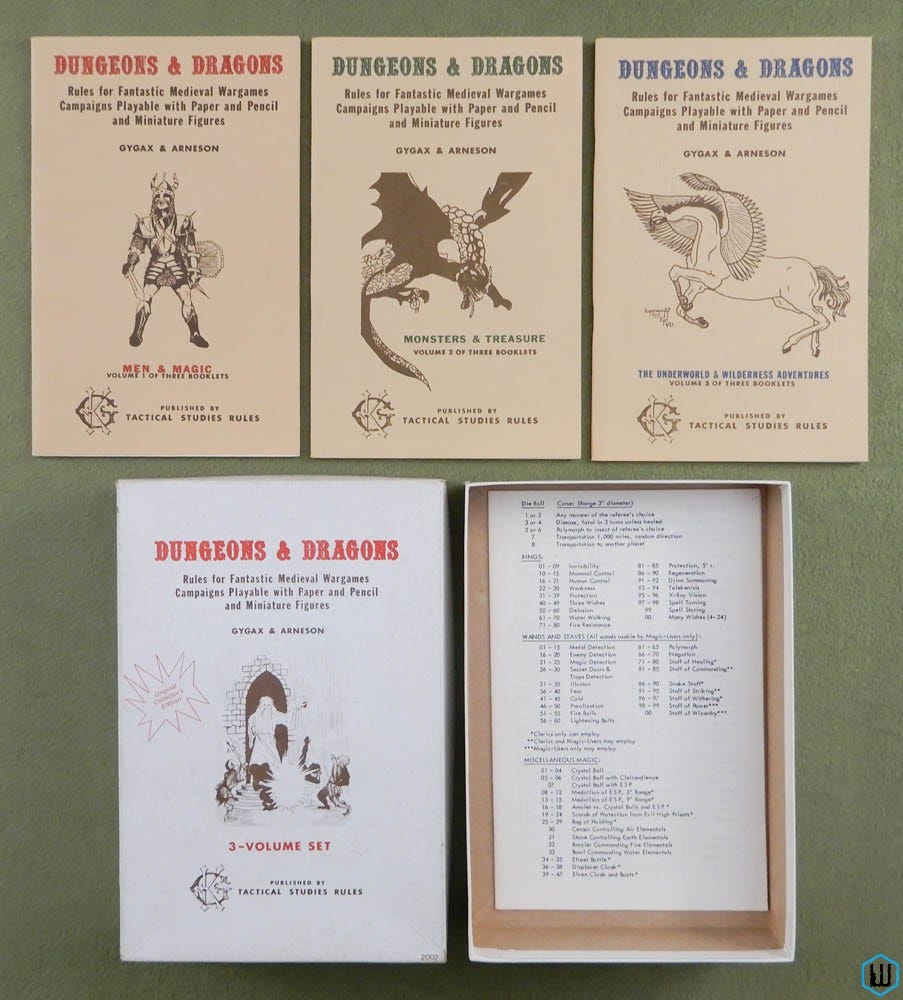
Original Dungeons & Dragons: Also called “OD&D”, “0E”, or “white box”, this was the original 1974 edition of Dungeons & Dragons that came in a little white box. The box contained the three little brown books titled “Men & Magic”, “Monsters & Treasure”, and “Underworld & Wilderness Adventures”. Curious about the rules? A reader friendly, and cheaper, alternative which I heartily recommend is Fantastic Medieval Campaigns, which accurately presents the original rules in a clean and attractive modern format, available for free here.
Philotomy’s OD&D Musings: A free document by Jason Cone, AKA Philotomy Jurament, published in 2007 introducing contemporary players to playing with the Original Dungeons & Dragons rules. The section on “creating an old school dungeon” is pure gold and should be read by those interested in megadungeon play. It is available for free here
Supplement I Greyhawk: The first supplement for Original Dungeons & Dragons detailing the Greyhawk setting and presenting many optional rules that became staples of later editions of D&D including “variable weapon damage”, the thief (i.e. rogue) class, among others.
Supplement II Blackmoor: The second supplement for Original Dungeons & Dragons detailing the Blackmoor setting, the monk class, and a far out adventure, The Temple of the Frog, that combines pulp sci-fi and fantasy elements.
Supplement III Eldritch Wizardry: The third supplement for Original Dungeons & Dragons, introducing the druid class and psionics, as well as many of the demons and devils such as Orcus that have become staples of the D&D multiverse.
S3: Expedition to the Barrier Peaks: A module written by Gary Gygax, where PCs explore a dungeon inside a crashed spaceship!
Tekumel: The richly imagined campaign world of M.A.R. Barker, based on non-European inspirations including meso-American and Indian sources. TSR published an early version of rules for play in this campaign world, Empire of the Petal Throne.
Clark’s Third Law: Arthur C. Clarke, British science fiction author, enumerated 3 laws over the course of his writings about speculation and future technological change. The 3rd law is, “Any sufficiently advanced technology is indistinguishable from magic.”
#Dungeon23 Challenge: This Sean McCoy’s challenge to create a 365 room megadungeon dungeon in 2023, one room per day. You can read about the original challenge here. I highlighted some of the most dynamic entries I was able to find in the early weeks of the challenge in posts here.
Grognardia: This is James Maliszewski’s prolific blog, dedicated to all things old school gaming. I recommend reading James’ Dwimmermount posts to get a sense of how the campaign developed from modest beginnings to a dynamic campaign exploring the secrets of an entire setting. You can find the blog here, and the Dwimmermount posts are collected here.
As always, if you would prefer to receive these podcast announcements and reader's notes directly to your inbox, then please consider subscribing to my substack, Missives from Beyond the Veil of Sleep, which you can find here.
I listened to the “expert delve” segment of this episode of Fear of a Black Dragon (starts around the 28 min mark) with great interest. Jason and Tom were discussing “spotlight management”, that is making sure that each player gets roughly equal time in the “spotlight”, i.e. being the one who gets to contribute to the game, by saying what their character does, and so on.
Almost all the techniques they mention involve situations where the PCs are in different places doing different things. Their advice is excellent: to consider narrative beats, to switch from one PC to another at cliff-hanger moments (i.e. moments of high drama) that keep people engaged, and so on. They also talk about systems that incorporate different turns more more systematically. Although I could be better, I’m not the worst at what they are talking about. For example, during my downtime segments in my face-to-face game, where PCs break up to all pursue individual projects and activities, I try to move the spotlight around intuitively using something like the ideas they float. I think it works.
But outside of downtime, in the OSR style games I run, the party is almost never separate. “Never split the party” may be a tired trope, but it’s also sensible practice in old school games. You might think, great, if they're together then it will be much easier to keep everyone equally involved, since the scene is shared. In a more narrative heavy game that was focused on individual characters as individuals, or on their relations to one another, that would be true. In such games, you can move the spotlight around in a single situation by simply asking each players in the situation what their characters do, or how they react to the situation, what they're feeling about it, and so on.
But the way I run the game, outside of downtime, the focus tends to be on collective problem solving. The players tend to talk freely amongst themselves about what they are going to do as a group at each step. Sometimes people don’t even say what their separate characters are doing, but announce what the group is doing. And this is how I like it! In the games I run, the focus is not on individuals taken separately, nor on their relation to one another, but rather on the exploration of fantastic and perilous spaces by the group collectively. I always allow this kind of collective deliberation, even when it's utterly implausible in the game: in the heat of combat, in the middle of a high-stakes conversation, at any point really, since what I’m here for is the cooperative problem solving that is the heart of the particular flavor of challenge based, sandbox play that I like.
The problem is that what controls the spotlight under those circumstances is not me, the GM, but rather the social dynamics of the players' freeform collective deliberation about what to do. In order for me to move the spotlight around in that process, I need, essentially, to intervene in the group's deliberations. But I don’t have a good way of systematically doing that. It's hard to know what the proper technique to intervene to move the spotlight without disrupting the freeform deliberation among players.
I’m blessed in my current face to face group in that no one dominates the conversations. They manage the spotlight relatively well. (The problem is MUCH greater in online play, I’ve noticed, probably because normal conversational dynamics break down over videoconferencing.) But even in my current face to face game, there still is one player who is a bit more passive than the others—despite being a very canny player. But he just doesn’t speak up as much in the group's collective deliberations.
I can rectify this to some extent, insofar as often characters will act individually, especially when we’re focused on tight scenes where it’s less about what decision the group is making and more about what contribution to a shared effort each character is making. In those circumstances, I can ensure that the spotlight travels to the quieter player. But this is a far cry from the kind of “spotlight management” that Jason and Tom are talking about. If I'm going to be real, it’s more like spotlight damage control.
I actually have no idea how to solve this problem. I’m tempted to say that without changing the kind of game I’m playing, there’s really no way to manage the spotlight in the core experience. I hope that’s not true, but I’m afraid it is. Any ideas?
I was on Google + for five years. I met so many of you wonderful people there. We shared practices, information, and bits of wonder, frozen starlight, passed gleefully from one outstretched elfin hand to another. I learned how to play Dungeons & Dragons with you, in rewarding and novels grownup ways. But now Google + is gone. So I made you this mixtape. I think you'll recognize some of the songs. I hope you like it.
At long last, I return the Google+ mixtape, my homage to the OSR scene on Google+. This mixtape seems unfortunately timely once again as the app formerly known as Twitter--poor substitute for Google+ that it ever was--wobbles on its last legs. You can "listen" to track 01 here and track 02 here. In track 02, I pointed out that gaming groups on G+ were essentially superbands. All the players were DMs in their own fearsome games. Numerous campaigns were run where every participant was the most committed member of another group. I pointed out that you can also trace patterns of influence between them, which is connected to my point that the OSR was, more than anything, a play culture.
As Google+ lay on its deathbed, I frantically helped people to download the G+ communities that had served as the home of their amazing campaigns. I took the opportunity, with permission of course, to interview the players in the campaigns, with the idea of sharing some inside reflections on the longer running campaigns of G+, some better known, and others less. As it happens, I got hung up for TWO YEARS writing the post for Track 03, which was originally to be on Chris Kutalik's Hill Cantons campaign and the superband of players inaccurately called "The Nefarious Nine". But on some solid recent advice, I have decided to unstick myself by shuffling the order of the tracks. So I have elected to bump up the Savage World of Krül, the campaign of Robert Parker, player of the unforgettable ne'er do-well Manzifrain in Chris Kutalik's Hill Cantons campaign. (Now that I am unstuck, you will hear more about Manzifrain soon enough.)
Without further a'do I present to you:
The Best Kept Secret of Retro-Games
Having played alongside him during my brief stint in the Nefarious Nine, I can say that Robert Parker is an interesting player. In fact, he's the dream player for the kind of DM who is in to deep world building. For him, the great joy in playing in a sandbox game is coming up with theories, plumbing the depths of secrets, unravelling the mysteries in a campaign as they relate to the open-world goals of the party. Information is for him the real treasure.
I've also enjoyed talking with Robert. If I tell him what I'm thinking about running, he's always casually like, "Oh, that's what you're going to do? Have you read Brian Aldiss' Hothouse?" Or, "Oh, have you taken a look at the early cyberpunk zine Mondo?" Or, "Oh, do you know about Traveler's rules on animal encounters?" His recommendations invariably completely change how I'm thinking about what I"m working on. He's also been SUPER interesting to talk about on the topic of how to run sandbox games that are not focused on location-based adventures (i.e. dungeons). For instance, he can tell you how to run a sandbox supers game, or talk about how to run a mystery sandbox for Call of Cthulhu, or a planet-hopping Traveler sandbox game.
I'll let you in on another secret: he was a driving force behind Hydra Coop. To a not inconsiderable extent you have him to thank for the bounty that cooperative venture has provided to the retro-game scene. He also came up with some of the most interesting rules to Fever Dreaming Marlinko and the forthcoming Slumbering Ursine Dunes Completish Omnibus. I guess what I'm trying to say is that Robert is probably the most interesting guy you may never have heard of in the retro-game scene.
The Savage World of Krül
While a member in the Nefarious Nine, Robert ran an off again on again game from 2012-2014 called The Savage World of Krül. Other members of the Nefarious Nine played in it, including Chris Kutalik, Cole Long, David Lewis Johnson, and Michael Moscrip. When I interviewed his players about it in 2018, sometimes I got the feeling that I was watching a sketch with Stefon in Saturday Night Live. "If you wanted to have a wild time back then, the game to play was Savage World of Krül. This campaign had everything: He-Man style chest harnesses...Tex-Mex sorcerers...cyborg gangs...wax dungeons"
Robert described the campaign this way to me: "It was a colonial sword & planet gone to shit game. Lord of Light-style god-beings come from a sea of possible realities, enslave the local humanoid population, breed humans, and then it turns into ugly late capitalism before collapsing into a post-apocalyptic ruin of city-states ruled by the descendants of demonic entities and their inbred half-human spawn." The Appendix N for the game (in fact Appendix B in his ruleset) included entries like Zelazney's Lord of Light series, Kirby's Fourth World comics, Jack Vance's Planet of Adventure novels, Brian Aldiss' Nonstop, Gene Wolf's Book of the New Sun, as well as the entirety of Leigh Brackett's work.
When explaining what made the game memorable, Cole referred to the NPCs: "the flamboyant Tex-Mex magicians, the Clock King, and all these different crazy gangs with cyborg-surgery dues." He also dwelt on the disorientation induced by the setting, which seemed at first glance to be a gonzo planetary romance. That is, until the party found treasure like a wardrobe full of tuxedos, or came across an NPC running what was apparently an ancient photo booth. Was the World of Krül then somehow Earth? The disorientation they described reminded me of the signature effect of Gene Wolf, who carries you along thinking you know what the setting is in his novels, only to casually drop elements 100 pages in that, in combination with the increasingly suspicious narrator, throws everything you thought you knew about the setting into question.
Welcome to Mindfuck Dungeon!
Several players also described the game as sporting some of the most memorable dungeons they had ever seen. The central campaign dungeon was Mindfuck Dungeon (MFD). MFD was the watchtower of a powerful witch who had gone missing called the Clock King. It could be approached from above by paying a hefty entry fee to a gang called the Metal Fingers, or from below through undercity crawl from any of a series connecting locations. There was a central staircase that rotated between four dungeon quadrants on the second level, and could be controlled by finding missing clocks throughout the dungeon. You could only unlock the lower levels of the dungeon by finding all the missing clocks. (Although you could also approach the lower levels from the exterior or hidden elevators.)
Although the theme was generally funhouse meat grinder, the dungeon was full of liminal spaces with different vibes. There were many sub-levels with distinctive aesthetics; one of cramped rough hewn spaces with pattering footsteps that could be accessed only by pit traps; one immaterial sub-level hanging in the air that only became tangible in the light of a certain kind candle; and there was a double-decker dungeon sub-level, where you would either be walking on the floor or the ceiling, depending on where you entered it. Hearing the dungeon described, it sounds like a giant 3D puzzle full of secrets that rewarded deep play. It also ground through PCs like nobody's business. Robert tells me that one player ran more than 20 different PCs in the campaign. The campaign had other dungeons with even wilder premises like the Waxworks, a living dungeon of shifting organs!
The Most Memorable PC Death
Several players, most of all Chris Kutalik, reported that the most memorable moment in the campaign was the death of Chris's character. Unbeknownst to the party, there was a DERO/anti-life infestation growing in the walls around level 2 of MFD, coiling around the level. It was occupied by malignant creatures who bedeviled the party on that level with the unnerving habit of suddenly appearing out of nowhere. When exploring level 2, one time the party triggered a floor trap. A panel opened in the ceiling revealing a magnet that sucked Chris' heavily armored character (and I believe Michael Moscrip's character as well) up into the ceiling, moving them along a track, and depositing them in the DERO sublevel, before sliding closed. Isolated, these characters found themselves in a space with a completely different ominous aesthetic of polished black walls with a red carpet that ate their feet if they stood still in one place. They were lost in unfamiliar territory trying to reconnect with the rest of the party, until their light source gave out. The party could hear their screams, maddeningly just behind the walls, powerless to help them, as they were hunted through the darkness by the malignant occupants of this hideous space. Giving up all hope, Chris' character ended up taking his own life to avoid being captured by the DERO. Everyone, including Chris, described this as a high point of the campaign.
A B/X Ruleset to Remember
The ruleset for the game, which circulated among players in PDF form, is a masterful B/X hack. My feeling is that these rules stands roughly to B/X as Gus' HMS Apollyon rules stand to OD&D. Both, working with the strengths of the chassis of their game of choice, spin it in creative way to support play in a particular campaign world. Everything in the ruleset conveys and reinforces elements of the setting. Robert's ruleset in particular is designed for long haul campaign shenanigans and play. Since the ruleset isn't published or generally available, I don't want to get into too much detailed, but it's such a glorious B/X hack that I can't resist saying something about.
Character creation involved a selection two classes: fighting man/warrior woman & warlock/witch, with further hidden weird classes unlockable with a lucky roll or with character death. (Since there was so much PC death Robert wanted to throw a bone to those who perished again and again.) Each of the base classes had a lot of flavor. For witches and warlocks the flavor comes from the selection of 1 of 7 magical schools from this chart.
For fighting men or warrior women the player rolls on a background table. There are 17 backgrounds, split between wilderness and urban backgrounds, that add 1d6 to one of your stats and sometimes give you some other power. (There is also a small chance to roll on a hidden "weird class" subtable.) These stats serve in part as the basis of a system of checks that allows for your character to have something of the flavor of thieves, rangers, and the like as sort of sub-classes of fighters. You are also able to trade off stats against one another, allowing for a fair amount of customization.
Equipment was treated by Robert as another opportunity for worldbuilding. In addition to the standard fare of swords and torches, there are very pricey items like gasoline, shotguns, and even dynamite. The system uses a piecemeal armor system that calls out to He-Man or swords & sorcery genres. Robert also had rules for gambling, a set of mini-games that are resolved in the first 10 minutes of every session for those PCs who wished to drop by Xita's House of Games, a seedy gaming house in the city's Low Quarter. There were minigames for slots, blackjack, as well as a clever lottery game. I imagine that starting each session with real life gambling sets a nice opening tone.
Where the ruleset really shines though is in the downtime system. I'm frankly glad that I hadn't read these rules when I was working out my own system of downtime, because they're so good I think they might have captured my imagination. The baseline is a cost of living expense with different expense tiers, tied to different bonuses or penalties on your hit points--hit dice were rolled each session. (If you couldn't pay for any tier there was a table to roll on for being unhoused.)
The downtime actions carousing, rumor mongering, gathering intelligence in a variety of modes, including research, door to door interviews, casing a joint, infiltrating an organization and so on. (There is also an elaborate set of rules for using stool pigeons, more on the gang rules below.) There is also a career downtime action, which involves finding or working at a job. The system lists several careers, from stevedore to lab assistant, and so on. It uses stat checks to see if you can land a job (some are open only to individuals with certain skills), or a keep a job, or get a promotion. Getting fired usually has negative consequences. If you have a job you must dedicated half your downtimes to working it, and you receive weekly wages. It's a tidy little system that has a lot of worldbuilding built into it with the different careers. I would love it as a player.
In addition to this rich offering of regular downtime actions, one genius innovation the ruleset introduces is the idea of a special downtime action. Once per month, a player is allowed to write up a special downtime action that does not fit into the framework mentioned so far. These actions are handled on an ad-hoc basis. Robert explained the significance of limiting specialty downtime action to me in terms of the advantage freeform downtime gives to enterprising and pushy players. The idea is to limit it to 1 out of every 4 downtimes, both to limit the workload on a DM with a large player base, and also to make sure that no one was reaping massive advantages by sinking homework in between sessions. The flexibility of the idea of a limited specialty downtime action is enticing. Interestingly, Robert also allowed players to use the specialty downtime action to play a special 30 minute session (usually at the start of a regular game session), where the player character could try to quickly resolve catastrophes that had come up via downtime, e.g. getting captured by someone you were spying on or the like.
Perhaps the most elaborate rules in the game were the rules for taking and holding territory and building gangs as the envisioned domain play for fighting men. Four years before Blades in the Dark was published, and far better suited to the OSR playstyle, these rules were a tour-de-force. They explained what you had to do to seize a territory; they had rules for how to handle the gang warfare during the struggle; as well as rules for the monies and other advantages you would receive by securing and holding territory. They also tied in with the downtime actions that involved recruiting and paying gang members suitable for different kinds of jobs, hiring stool pigeons, infiltrating enemy gangs, and so on.
These rules are not available for public consumption. They are, from Robert's point of view, game ephemera specifically made for his campaign and not for public consumption. However, both the setting and rules were major influence on David Lewis Johnson's Gathox Vertical Slum, another member of the Nefarious Nine and a player in Savage Sword of Krül. You can also find some of them absorbed into the forthcoming Slumbering Ursine Dunes Completish Omnibus So you can get at least a taste of the setting flavor and rules by looking at these wonderful product. As we'll see it also influenced Cole Long's rules for Swords of the Inner Sea, which I'll be looking at in a later track.
Pay your cyber-surgery dues and you can find me in Mind Fuck Dungeon until the next mixtape trakc drops!
By the time you read this, I will have recorded three episodes and a trailer of Into the Megadungeon, my new podcast exploring megadungeon games. I can now share with you the trailer for the podcast.
The first episode will drop after Gen Con on Tuesday August 8th. After that, you can expect episodes to appear biweekly through the first season, which I expect to run 10 episodes.
I thought I would say a little bit more about how the podcast has taken shape. The name of the first season is "Megadungeons as...", with the episode titles filling in the blanks. So here's the list of the first three episodes I have recorded.
Season 01: Megadungeons as...
Mysteries
Persistent Little Worlds
The Question of Space
In Episode 1 "Mysteries", I interview James Maliszewski about his Dwimmermount megadungeon campaign. We address, among other things, what a megadungeon is; how James' megadungeon grew organically from modest beginnings; how exploration of the megadungeon can be exploration mysteries of an entire setting; and his current project, The secrets of sha'Arthan, and the role of megadungeons in that setting.
In Episode 2 "Persistent Little Worlds", I interview Nick Kuntz, the GM of The Twilight Age, the megadungeon campaign I'm playing in. We reminisce about the (still unfolding) campaign, and discuss the challenges and special rewards of megadungeons campaigns with large player rosters, and how megadungeons campaigns with a lot players can function as "persistent little worlds", where the stories that emerge are less about a band of protagonists and more about an abiding place.
In Episode 3 "The Question of Space", I interview Gus about his HMS Apollyon campaign. We talk about the idea of placing your starting settlement inside a megadungeon, how to make treasure interesting, and about the centrality of space to dungeoneering. Along the way, you get to hear a lot of choice details about Gus' experience creating and running HMS Apollyon.
I have a bunch of other interviews lined up, including with Luke Gearing, of Gradient Descent (etc) fame, and Josh McCrowell, author of a megadungeon ruleset called His Majesty the Worm. Things I am toying with for future episodes includes incorporating some player interviews alongside the GM interviews from the same campaign. (Luke suggested it, and I think it would be a lot of fun.) I'm also planning an episode called "The GMs Toolbox" that consists solely of GMing tips, tools, procedures, and house rules that facilitate GMing megadungeons. I'm also considering including an episode on sci-fi megadungeons, and another historical episode on the very early megadungeons of the hobby, since all of my interviews so far have referred in one way or another to the early megadungeon campaigns that gave rise to Dungeons & Dragons.
I'm not promising any of these things, but you can see some of the direction my mind is moving as this project becomes a reality.
Return of the Google+ Mixtapes
In the meantime, I also have plans to pick up some old projects on the blog here. In the intervening weeks without a podcast, you can expect some tracks of the long delayed Google+ Mixtape to drop. The Google+ Mixtapes were intended to be a series of posts commemorating aspects of the OSR scene and play culture as it flowered on Google+. It's intended as one part historical memorialization, useful for those who were and weren't there, and one part reminiscence. I only ever published two tracks, one about FLAILSNAILS, and one about the "Superband" phenomena of G+ campaigns consisting mainly of very skilled GMs.
The posts in the pipeline pick up where I left off, by providing retrospectives on some of the master campaigns of the Google+ era starting next week, including both well known campaigns like, The Hill Cantons, and some sleepers like Robert Parker's Savage World of Krül and Cole Long's Swords of the Inner Sea. You can expect some player testimony and game ephemera as well. I hope you enjoy it. I know I have enjoyed writing them.
Also, I've started a newsletter, Missives from Beyond the Veil of Sleep, to which you can subscribe here. it packages my blog entries along with more ephemeral and in progress reflections. Check it out and consider subscribing!
First off, given the impending collapse of twitter, and the continuing general crumbling of social media, I've decided to start a newsletter called Ultan's Door: Missives from Beyond the Veil of Sleep. You can read the first newsletter and subscribe here. If you're into newsletters or just prefer to get blog posts in your email rather than RSS feed, then please consider subscribing.
Am I replacing this blog with a newsletter format? No. Think of the newsletter as a long form replacement for social media. I will cross-post new blog posts to the newsletter. I will also use it to convey more ephemeral or time sensitive information. Likely, I'll cover a bit more "work in progress", or "here's what I'm thinking about in ttrpgs today" content in the newsletter.
What does this newsletter mean for the Ultan's Door Press mailing list? (Which you can subscribe to here, by the way.) Is it replacing the mailing list? No. The Ultan's Door Press mailing list is strictly for announcements about new products or reprints. I only mail the mailing list whenever a new product or reprint is forthcoming or available or going on Kickstarter. I don't use it to share my thoughts or gaming content.
In short:
This blog: Same as it ever was.
Newsletter: A way to get emailed the blog, plus some work in progress or thoughts on ttrpgs of the sort that I would have shared on social media, but in a more relaxed long form style.
Ultan's Door Press Mailing List: Only for product announcements.
Into the Megadungeon
Perhaps bigger news is that I'm starting a podcast called Into the Megadungeon. It's a podcast where I interview veteran GMs with years of experience running amazing megadungeon campaigns. We'll explore the attractions and challenges of this strange campaign type. The podcast will be focused mainly on practice. So you can expect to hear a lot about people's actual campaigns, how they run them, what works and doesn't work for them, with lots of examples. There will be a lot of talk about techniques, systems, and hacks our GMs have come up. We will, of course, get into theory, but when we do it will be informed by experience and mainly driven by questions of practice. You'll also get to hear about the megadungeon projects that our GMs are currently working on--so it may also provide a glimpse of some fun things that are in the pipeline.
If you're at all curious about this largely forgotten campaign form that both started our hobby and is seeing a big resurgence now then this is the podcast for you. It's especially relevant if you find the idea of running a megadungeon campaign appealing but overwhelming. The lineup for season 1 of the podcast has some really wonderful people in it, including big names you'll recognize, as well as the GM of the current megadungeon of the campaign I'm playing in. I have the first episode edited and complete, and I'll be recording a bunch more episodes over the next two weeks.
The trailer drops on a week from today on 7/18, with the first episode hitting the airwaves after Gen Con, early in August. Stay tuned!
So, Dungeon23 is rolling along. I haven't posted a second batch myself for reasons I'll mention at the end. But that doesn't mean I haven't been eagerly reading along! There are some really wonderful things, including some real surprises. One of the real joys here is discovering new people and new blogs.
First up, I think needs to be the fact that Amanda Lee (@annabelle_lee), author of Garbage Barge and Vampire Cruise, made this glorious thing. (This covers the first two weeks.) It makes me kind of dizzy to look at it but I love so much.
Michael at Sheep and Wizardry is off to a rollicking good start with The Sunset Palace of the Starry Sultan, built and rebuilt by each successive monarch, creating an "ever-expanding labyrinth of tangled opulence and pointless pomp." I love the idea that you would start a delve into this megadungeon by sneaking through the tiny occupied portion of the palace. His first post has some neat character backgrounds that deftly build a playable 1001 Nights pastiche. His second post has really great faction play right from the get go including a treasure guarding mummy and his goose, agents of the Gutter Kings (in service of the Crown of Buttons!), a cult of star seekers, and more. This looks like it will be a fun and meaty dungeon.
Arnold at Goblin Punch did it again. This post details The Flying Birdcage, a whole house inside a flying birdcage located in the complex form week 1. The Flying Birdcage is probably the most interesting and clever form of quick transportation (a staple) around a megadungeon I've ever seen. I would be SO EXCITED to have unlocked the secrets of the birdcage if I were a player. (Since publishing that he's gone on a bender of rapid-fire posts about dwarves, puzzles, and other setting elements like it was 2015. I think we can say now that Goblin Punch is back baby!)
Speaking of ways into and around the dungeon, in his inaugural post, Rowan at Dodecahedron details 100 flavorful dungeon entrances. Many of them are secret entrances or have some kind of gimmick that makes them enjoyable. "A bronze statue of a massive fish, mouth agape, emerges from a river. Ladder rungs within the statue lead down through the stonework cylinder that supports it." It's a real treasure trove of ideas that may be of use.
Nick at Underworld Adventurer has produced some real gems in their second meaty post about their megadungeon. Probably my favorite bit comes in the very first room of the post, which is a hall of portraits of past head wizards of the Transcendental Congress. Each has an illustration, and a personality, and is ready to bargain their secrets for something from the dungeon! A lot of lore baked into immediately engaging weird NPCs that also manage to point deeper into the dungeon.
Speaking of Dungeon23 with a comics-vibe, I've been enjoying Tobias Redesäter's (@radesater@dice.camp) stuff on Mastodon. It's a megadungeon where you slip in through a crack in a bear cave and soon find yourself in a room where a blue goddess has been chained up! It's full of neat illustrations and little cool tidbits.
If you're on Mastodon definitely give him a follow and check it out. If you do, keep an eye out for the Nest Eagle. He seems like someone groovy to meet in a dungeon.
I know I've been highlighting Zedeck's Dungeon23 stuff a lot, but you really have to check this one out in particular. You can see it with an explanation here. If you get bitten by an eel in the previous dungeon, you get transported to the eel's dream here, a kind of dungeon perhaps built out of the traumatic memories of the eel. This one really hits home for me, because I once did a hexcrawl through an area that was contaminated by the "undermind" of the Parapraxis, a Phantamorian vessel that was spilling an NPC's unconscious into a valley. But, of course, it wasn't the mind of a freaking eel!
A brief roundup of other delightful things. OBVIOUSLY, OBVIOUSLY you need to be following Jonathan Newell's Apocalypse Archive posts, the second set of 6 rooms dropped here. If you want a more classic AD&D vibe location with a map that looks straight out of a TSR module, check out the debased Monastery of St. Amruss at Foot of the Mountain Games Adventure here.
You might wonder what's happening with the Catacombs of the North Wind, my Dungeon23 project. (The intro post is here, and the first 7 locations are here.) Because of the way I design locations I needed to do some research for inspiration, and also decide on some bigger picture questions, like what the different regions of level 1 of the dungeon will be. Slowly things have been taking shape in mind, but I'm not quite ready to start mapping and keying the next bit yet. I'll share some of the weird research I've slowly been doing for inspiration another time.