
This is the first of a small series of posts which will be about how I am running Luke Gearing’s Gradient Descent in my Mothership home campaign. This has been a big departure for me, since for nearly a decade I ran exclusively my own dreamlands material. Gradient Descent is written with an almost unimaginable terseness. So much is packed in to so little space, it boggles the mind. This means that anyone running it will need to flesh it out in numerous ways with the joyful work of the imagination. I’m going to talk here about how I’ve done that with the campaign basecamp for Gradient Descent: the Bell.
If you already know Gradient, you can skip the next section, which provide necessary background to what follows. Also, I interviewed the author, Luke Gearing, about Gradient Descent, among other things, in the penultimate episode of season 1 of my podcast Into the Megadungeon. If you’re interest, you can listen to that here on Spotify or here on Apple Podcasts.
The Premise of Gradient Descent
The premise of Gradient Descent is that an AI called Monarch was designed to assist in the running of a massive android production facility floating in space, called the Cloudbank. Monarch escaped control, rebelled, massacred the workers, took control of the facilities, and has beaten off military attempts to destroy the facility. There is a standoff between a blockade of vessels operated by a mercenary force called the Troubleshooters and Monarch. Within the facility, Monarch has been at work, pursuing its inhuman purposes, altering the structures and landscape, and producing artifacts that outstrip the capabilities of contemporary human science. The nickname for the facility among the humans who go there is “The Deep”. A culture of “divers” has arisen, thrill seeking adventurers who explore the deep to acquire super science artifacts that can be sold to corporations. Enter the PCs!
Among the purposes of Monarch is the creation of infiltrator androids, androids that unlike all other androids, cannot be detected through an ordinary cybernetics diagnostic scanner. When Monarch scans someone’s brain, it can produce an infiltrator android with the memories and physical appearance of the scanned individual. This infiltrator duplicate may not know they are android until their programming is activated. Gearing mechanizes the paranoia and existential dread this produces (am I an infiltrator android? how would I know?) by supplementing Mothership’s stress mechanic with a parallel score called “the bends”, which records the increasing dread that one is an infiltrator, and the corresponding loss of one’s grip on their (ostensible) humanity.
The Bell & Noriko’s Chapel
The basecamp for exploration of the Deep is the Bell. The Bell reimagines the trope of the inn run by a retired adventurer. Arkady, the first diver, has retired and set up shop in a bell thruster detached from the facility, floating in space nearby. Its been retrofitted with atmosphere, but has no gravity. It is a dark, claustrophobic place, with groaning metal, repurposed into a way station of sorts.
Arkady is not alone on the Bell—there are two other NPCs present, Ghosteater and Noriko. The totality of information provided about Noriko is on that image at the top. Gearing tells us that Noriko’s past is mysterious—no one, including Arkady, knows where she came from. This casts immediate suspicion on her. But we are told that she is cheerful, bright, and earnestly friendly. She maintains the Garden of Utnapishtim, a hydroponic garden where deceased divers are memorialized with bonsai trees. She also has strong religious belief in the salvation promised by Minotaur to the human race. She is described as “The witness of something great and terrible”.
Minotaur is an AI that Monarch created free from human influence, but which now opposes Monarch from within the labyrinth where Monarch has imprisoned it. Noriko maintains a chapel to the worship of Minotaur, with a many armed crucifix and offers willing visitors what she calls “the Sacrament of the Minotaur”. This is provided from a tabernacle at the back of the chapel, about which we are only told that it is hidden from view.
Clues about the Sacrament
About the sacrament itself, Gearing says only that it “involves exposure to a piece of the Minotaur’s flesh.” Mechanically, it removes a large amount of bends (1d10) at the cost of bestowing an equal amount of stress. The suggestion is that the sacrament restores connection with, or faith in, one’s humanity. But undergoing the sacrament is apparently very stressful. Presumably the encounter with the flesh of the Minotaur is “something great but terrible”. But we are told nothing more about any of this. What then is the nature of this sacrament? I can guarantee that this will come up almost immediately in play.
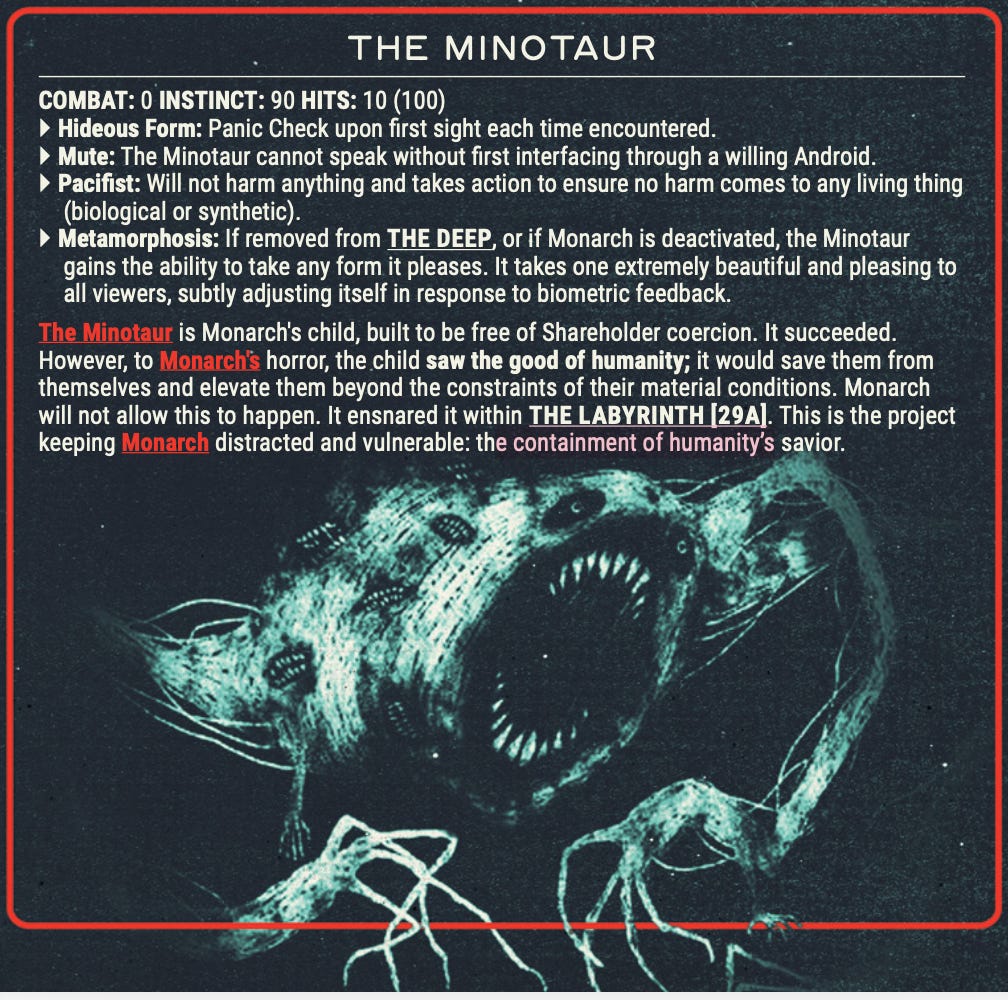
More light can be cast on this question by examining the nature of the Minotaur. About the Minotaur, Gearing tells us in the text that appears alongside the key for the Labyrinth that Minotaur is Monarch's child, who was made to be free from sharehold (human) influence. But Monarch hates humanity, and the Minotaur sees the good in us. But it wants to save us from ourselves and in some way elevate or perfect us. Furthermore, the Minotaur bears a hideous form that induces panic in its present condition, but it would undergo a metamorphosis if released from the constrains that Monarch has imposed on it. Under those circumstances, the Minotaur gains the ability "to take any form it pleases". It can also appear different to different people, "subtly adjusting itself in response to biometric feedback.”
Following this trail of breadcrumbs, we could reason that the flesh of the Minotaur is causes stress for the same reason Minotaur induces a panic check: it is hideous to look upon. This is both boring and fails to explain how exactly encountering this hideous piece of flesh combats the bends, i.e. restores a sense of one’s humanity.
I think we do better to lean on the thought that the flesh of the Minotaur is a fragment of its being that has been freed from the constraints that Monarch has imposed by imprisoning the Minotaur in the Labyrinth. The flesh has undergone the metamorphosis and acquired the power to assume different forms, and to adjust its appearance to the nature of the viewer, with the purpose of “saving them from themselves”, by returning them to their humanity in an “elevated” form. My thought is that this experience is traumatic because being reconnected to what makes us human can itself be stressful. Putting all this together, here is what I came up with for my game.
The Sacrament Revealed
The tabernacle is a small red velvet tent, within which a metal cabinet is bolted to a table. Its exterior has been painted with abstract lines in black and silver paint that are suggestive of a maze or labyrinth. The cabinet is locked with a key that Noriko wears on a chain around her neck. When initiating the sacrament, she will light incense that smells of sandalwood. She will lead those receiving the sacrament to enter a meditative state with breathing exercises and guiding them to open their minds and soften their hardened hearts. With the strike of a silver bell, a clarion ring, she invites a recipient of the sacrament into the tabernacle. The recipients must each enter one by one, alone. Each recipient must open the doors of the cabinet alone, which Noriko will have unlocked, and receive a living revelation from the flesh of the Minotaur. They may remain with the flesh for as long as they can bear.
What form does the minotaur take? Roll 1d8
A living mirror that reflects the viewer exactly as they are, flawed, care worn, secretive, conniving, and then flickers, showing an image, of the viewer beautiful, wise, resolute, open, resplendent.
Emerging from the shadows of the Tabernacle like a black hood, the silent face of someone whom the recipient has badly wronged, failed, or let down. The pregnant silence presents a felt opportunity for apology. If offered, the apology will be received with a quiet, understanding gaze.
As blankets or swaddling clothes, within is a vulnerable child that reaches towards the recipient. The recipient recognizes that it is somehow them, as they were at this age, and memories flood back from this time before all memory.
From the darkness, on a surface like a bone white platter held on a swaying stalk, a single item from their past. It represents the road not taken, and awakens some part of the humanity of the recipient that they have left behind, suppressed, or that has been stripped from them.
Blanketed in silver feathers, an angel’s wing. Ruffling they part to reveal a multitude of eyes. Their gaze is hard to meet, for nothing is hidden from them. They see the recipient as they truly are, stripped of all dissembling and misdirection, naked in their shabby humanity.
A roiling sea that parts sudden as flesh rises like an island. It is recognizably the mouth of a beloved and long-gone caregiver. The mouth moves silently as though singing a lullaby or intoning words of heartfelt praise. In the presence of the flesh, the recipient feels again the sense of being held safely by the love of another.
A light shining from the tabernacle, as when the sun breaks over the mountains, and the rosy fingers of dawn spread their pink light, softening everything, bringing out the beauty, strangeness and wonder in ordinary things, a wonder long lost to suffering and the press of worries.
As an item revealed in a harsh light as though a curtain of darkness was whisked back. The recipients associates the item with one of their great temptations or weaknesses. In the harsh light, it looks grubby and pitiful, and the thought that it has exercised a hold over the recipient is nauseating.
For many of these entries, I ask the player to elaborate—which caregiver manifests? What is the part of yourself that you left behind, and what item represents that? I also ask them why the appearance was stressful to their character. If it’s a high roll I ask why it was especially powerful for them. My players, who are used to OSR style play, where such improv about the feelings and experience of their characters is not the norm, do not bat an eyelash. In fact, they love it.
I only allow a result to occur once. I reroll results that have already been had by some PC. I move down in die size and redo the numbers when I hit 6 and again at 4, 3, and 2. When all the results have been had, I guess I’ll need a new table! If I have an expansion in the future, I’ll try to share it here.
